Kerry Bethell
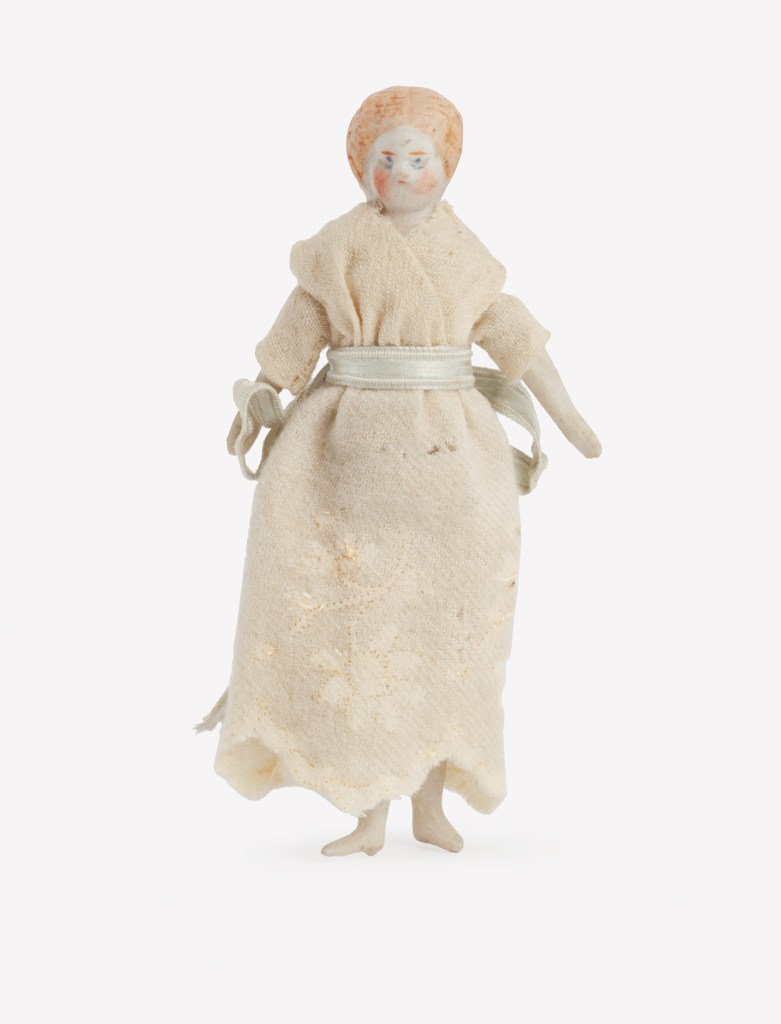
On my first viewing of the doll, only a little longer than my middle finger, I was captivated. It appealed not only for its size, but also for its colonial origins, longevity (reportedly 170 years) and obvious vulnerability. How did it survive, where and with whom? What stories might it hold beneath its glaze?
The story of the miniature girl doll is not readily found. Kathleen Eivers of Christchurch, who donated it to the Manawatu Museum in 1974, is deceased. The museum records provide little information about the doll beyond its colonial origins.
The doll was intended for a dollhouse, which were very popular in the late nineteenth century. Standing 105 mm tall, it has a china bisque head, shoulders, arms and feet attached to a cloth body, which is stuffed with sawdust and tightly packed. The use of bisque china in doll construction was popular between 1840 and 1900. Its fragility and weight meant that it was supplanted in the early twentieth century by more sturdy composition and celluloid materials. No manufacturer’s mark is visible on the doll.1
The doll’s painted face is adult-looking and holds little expression, with European features of reddish-brown hair and fair skin. She sports red eyebrows, black eyes, black pupils with a blue iris and bright checks that are unevenly blushed. Her mouth is painted with one stoke of the brush.2 The painted features of the face are worn. Such signs of wear and tear suggest this doll was played with by children, rather than collected by adults.
Similar dolls were commonly made in the home by a mother or other female relative who had purchased the dolls’ bisque head, shoulders and matching limbs. A family member or the child recipient would then construct the cloth body and clothing and paint the doll’s face and other features.
The doll is dressed in a cream flannel top with a white flannel skirt, perhaps cut from an infant’s gown. The skirt is decorated with an embroidered flower and a scalloped stitched edge. A pale blue ribbon, maybe from an infant’s bonnet, is tied around the waist. The clothes are home-sewn using materials that appear to be recycled.
Such sewing was often undertaken by the child recipient as practice in dressmaking. Home-constructed dolls were an affordable option and more representative of nineteenth-century childhood experience than manufactured bisque dolls, which were expensive and generally owned by affluent families.
This story of the doll almost did not get started, so scarce was information about its provenance. In 1974, at the time of donation, Kathleen Eivers stated that the doll arrived in New Zealand in 1841 with the Craig family. Two matters are important here. Firstly, oral accounts are known to be unreliable on matters of detail – and Kathleen Eivers’ account was 130 years in the making. That said, it should be taken as the ‘truth’ as she knew it and, with no other known accounts, it forms the point of departure for this inquiry. Secondly, Kathleen presumably had information about the doll’s later provenance that is not recorded in the museum record. Was such information not recorded because the museum’s interest centred on the object’s New Zealand colonial origins?3 Or was she not even asked?
Museum records suggest that the doll may have belonged to one of the two Craig daughters – Margaret, aged 12, and Agnes, aged 7 – at the time of embarkation.4 Perhaps their mother made it for one of the girls in preparation for the journey – something small enough to keep in a pocket and play with on the long voyage. Maybe the doll was given by a loving relative as a farewell gift to a child unlikely to be seen again. Agnes, the younger daughter, seems the more likely recipient. Further, had Margaret been the owner, it is more likely the doll would have been passed down to one of her daughters rather than to Kathleen, a cousin once removed.
Only when I discovered an article about Little Pipitea Street in Wellington, once home to Robert Craig, brother of Margaret and Agnes, and later, Kathleen Eivers’ grandfather, did a story begin to emerge. Nineteen-year-old Robert worked initially as a surveyor’s assistant before becoming a grocer. In 1855 he married Caroline Guyer, a domestic servant who had reportedly arrived in 1849 on the Cornwall. Robert bought a town acre and by 1863 had built a four-roomed cottage in Little Pipitea Street, Thorndon. The couple produced five children, James, Robert, Caroline, Agnes and Mary. Over time, Robert built another four cottages, including a five-roomed one in which the family lived.5
These cottages provide clues about the social class of the Craig family. Small in size and simple in design, they were at the lower end of the property scale, although bigger and much better sited than homes in the slum areas of the city.6 Robert worked predominantly as a grocer and James as a painter. While not poor, they were by no means wealthy. Of working stock, they sought to improve their position in the new colony. Robert developed his carpentry skills into cabinetmaking and, according to one reference, toy making.
Family members lived in Little Pipitea Street until the 1940s. The three spinster aunts lived together in one cottage. Robert and Caroline spent their married life in the street, as did their son James and his wife Fanny Craig. Their six children were born in the last decades of the nineteenth century; three died in childhood and another in his early twenties. Only daughters Roberta and Kathleen – the future Kathleen Eivers, born in 1898 – survived into adulthood. Kathleen lived in the street with her family and her three aunts until her marriage in 1938.
James and Agnes Craig died in 1861 and 1872 respectively. Family records provide no further information about seven-year-old Agnes, who may have died in childhood. What then happened to the doll? Of little monetary value and small enough to have been easily mislaid, how did it survive? Was it valued and cared for as a memento of migration or in memory of a child taken too soon? Or was it put away in the family home to be rediscovered by the Craig aunts or Kathleen herself. The occupation of the home by successive generations of the same family was no doubt a significant factor in the doll’s survival.
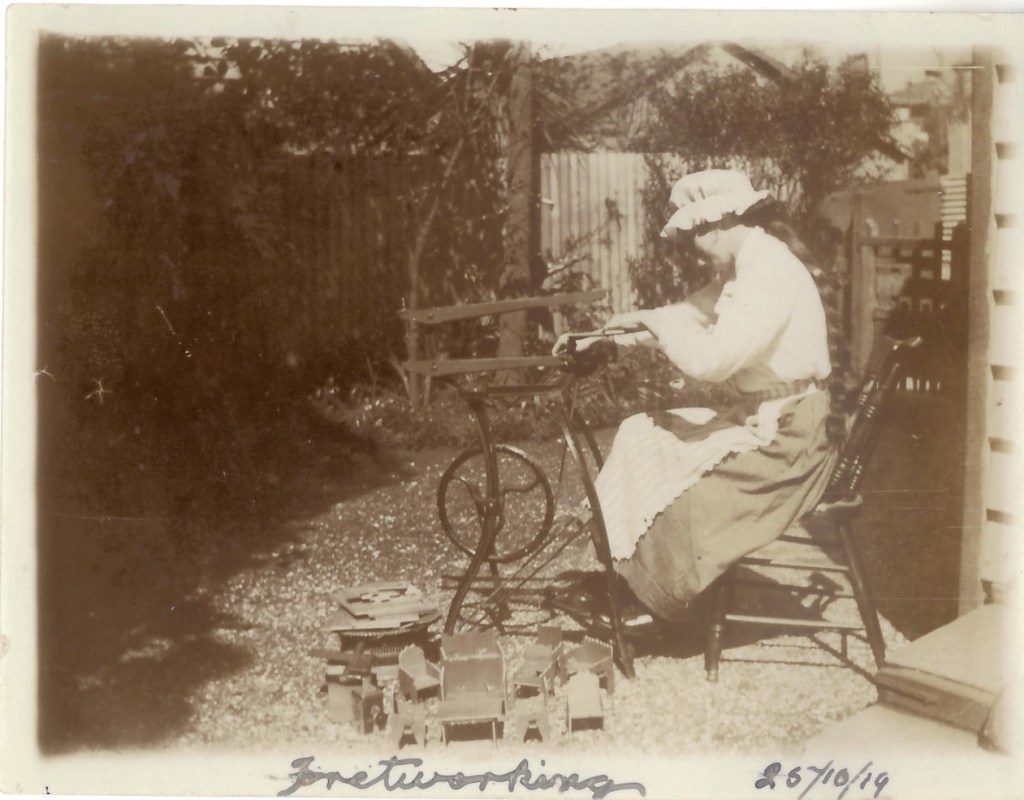
Photographs previously in Kathleen’s possession provide significant glimpses into her childhood and adulthood, and her strong interest in dolls and doll-making. The first, taken in 1919, shows 21-year-old Kathleen working outdoors on a fretworking machine. Items of wooden doll furniture presumably made by Kathleen are displayed in the foreground.
The second photograph is labelled ‘The dolls tea party’ on the back. Two girls stand on either side of a cloth-covered table on which are posed at least two dolls, a tea set and what appears to be a vase of flowers. Surrounding the table is an even larger collection of dolls, wooden furniture and related items, including a toy piano, a house and a crane toy pram, all carefully posed towards the camera.
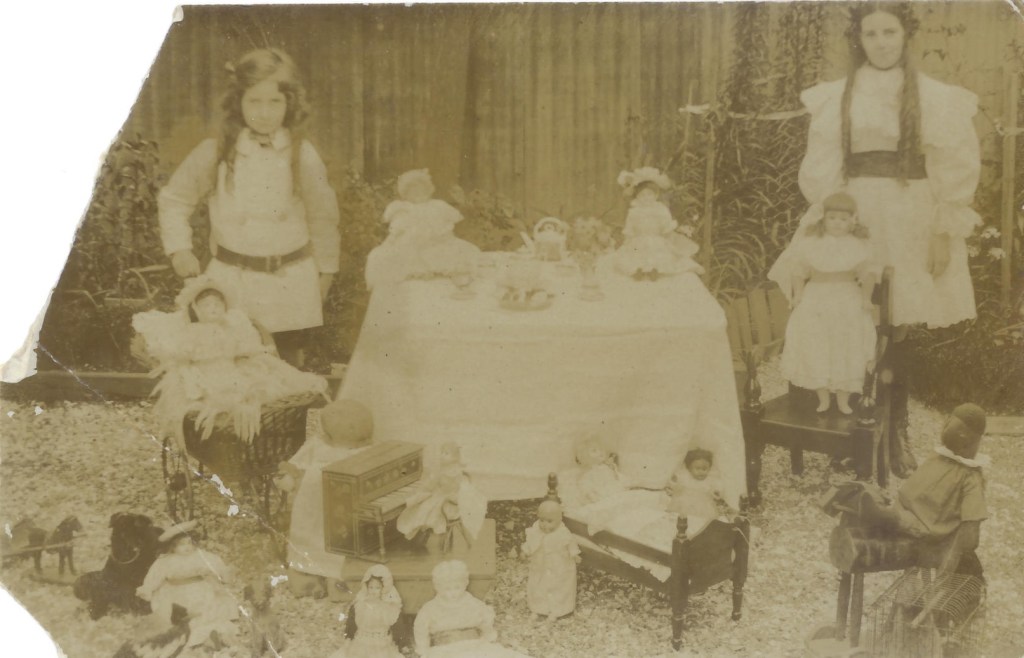
The identities of the girls, the location and the date of the photograph are not recorded. Close examination suggests that it was taken in the same garden as the 1919 photo – there is the same fence, ground covering and glimpses of the ‘cinder paths, no concrete, and the lovely cottage garden’ described by a later visitor.7 The clothing worn by the girls has been tentatively dated to between 1895 and 1910, making it possible that the younger of the two girls is Kathleen.8
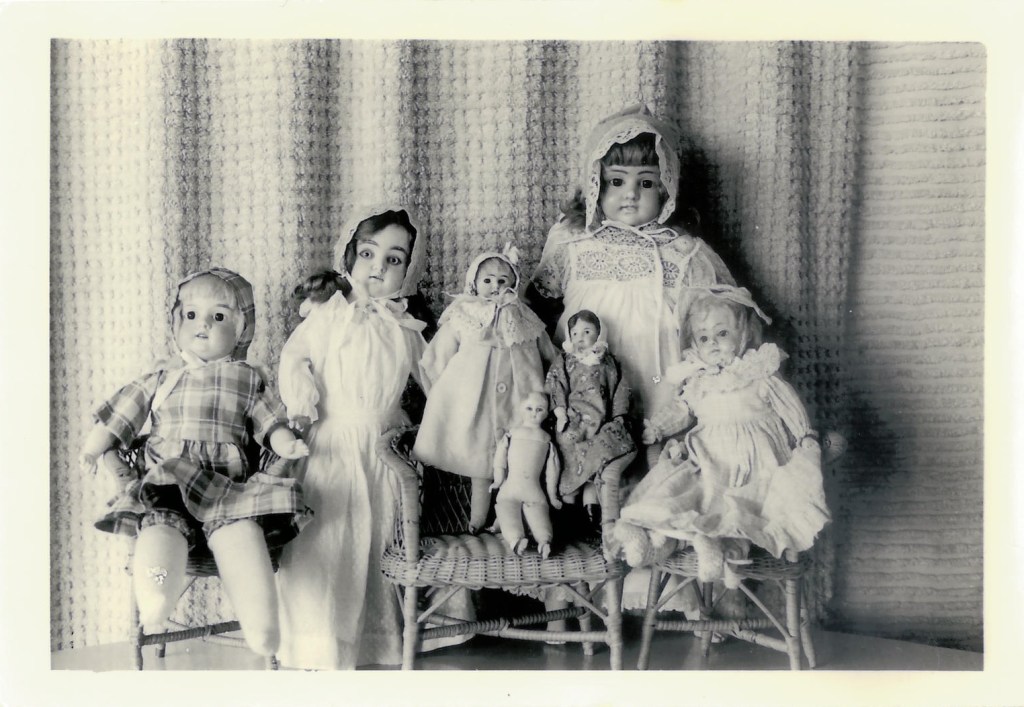
Kathleen maintained her interest in dolls into adult life as a collector and maker of dolls, many of which were given to family members or charities. Part of her collection appears in a photograph dated 1972 which bears the inscription, ‘Aren’t they a pretty group?’9
Given the Craig family’s association with Wellington, why was the doll donated to Manawatu Museum? Three of Kathleen Craig’s relatives settled in Manawatū with their respective families: two Cornford uncles in Pahīatua and Foxton and an aunt, Mrs John Eagle (born Elizabeth Annie Cornford), in Shannon. As a child Kathleen regularly visited Manawatū with her mother, establishing family connections which she maintained after her marriage and departure to Christchurch in 1936.10
By the 1950s Kathleen was the sole surviving Craig female and in accordance with tradition acquired a number of family items passed down through the generations. These included infants’ clothing and a doll’s tea set, reportedly brought out on the ship, and a coconut goblet made for her grandmother, Caroline Guyer, by a sailor on her journey to the new colony. In 1962 Kathleen donated two wooden chairs made by Robert Craig around 1845 to the National Museum (now Te Papa).11 We do not know why on a visit to Palmerston North in September 1974 she donated the doll and other items, including the above, to Manawatu Museum. Had they been declined by the National Museum?
Further questions remain. An important one concerns the doll’s age. Colleen Crooks, a local doll expert, places its likely date of construction at around the 1870s, 30 years later than recorded.12 This discrepancy, if correct, challenges the migration story told by the donor. While much more is now known about the miniature girl doll, speculation continues.
First published in Fiona McKergow and Kerry Taylor, eds, Te Hao Nui – The Great Catch: Object Stories from Te Manawa, Random House, 2011; updated and republished with the author’s permission.
Footnotes
- See Richter, China, Parian and Bisque German Dolls, for further information about manufacturer’s marks. ↩︎
- Colleen Crooks, conversation with Kerry Bethell, September 2010. ↩︎
- Townsend, ‘Seen but not Heard?’, pp. 53–54. ↩︎
- Collection record, 74/350/2, Te Manawa Museum. ↩︎
- [Lowe], ‘A short history of Little Pipitea Street, Part 1’, p. 9. ↩︎
- [Lowe], ‘A short history of Little Pipitea Street, Part 1′, p. 10. ↩︎
- [Lowe], ‘A short history of Little Pipitea Street, Part 2’, p. 3. ↩︎
- Email from Cindy Lilburn to Kerry Bethell, June 2011. ↩︎
- John Eivers, conversation with, and letters to Kerry Bethell, May 2011. ↩︎
- See, for example, Evening Post (EP), 12 March 1925, p. 11; EP, 14 January 1932, p. 15. ↩︎
- Chairs, c. 1845, gift of Kathleen Eivers, 1962, Te Papa, PF000081, URL: https://collections.tepapa.govt.nz/object/57528 ↩︎
- Colleen Crooks, conversation with Kerry Bethell, September 2010. ↩︎
Bibliography
Crooks, Colleen, ‘Porcelain doll making’, interview, part 1, Palmerston North City Library, 2019, URL: https://manawatuheritage.pncc.govt.nz/item/b546d3c7-fb0d-4ade-937e-741a1ff2955b
Crooks, Colleen, ‘Porcelain dolls’, interview, part 2, Palmerston North City Library, 2019, URL: https://manawatuheritage.pncc.govt.nz/item/ed0d03cd-9c7f-4461-b99c-6c99df55d2b3
[Lowe, R.J.], ‘A short history of Little Pipitea Street, Part 1’, Thorndon News, no. 124, November 2000, pp. 6–10.
[Lowe, R.J.], ‘A short history of Little Pipitea Street, Part 2’, Thorndon News, no. 126, July 2001, pp. 3–6.
Richter, Lydia, China, Parian and Bisque German Dolls, Hobby House Press, 1993.
Townsend, Lynette, ‘Seen but not Heard? Collecting the History of New Zealand Childhood’, MA thesis, Victoria University of Wellington, 2008.
 Te Manawa Museum Society
Leave a comment