Margaret Tennant

A crown and a crimson velvet train: the trappings of royalty, an invitation to pomp and ceremony. During the Great War many a young (and not so young) woman assumed such raiment, and, with it, the title of ‘Carnival Queen’. Among them was Miss Joyce McKelvie, the twenty-year-old daughter of Carnarvon landowner James Flockhart McKelvie, and proud wearer in 1915 of the crown and train now in Te Manawa’s collection.
The collection notes describe a crown ‘similar in shape to the English St Edward’s crown’ – the crown most usually depicted in coats of arms and other Commonwealth royal symbols. While the royal version is constructed of solid gold, set with 444 precious stones, Te Manawa’s is made from sheet brass decorated with coloured glass stones.1 It is a faithful enough replica of St Edward’s crown, having four fleurs-de-lys and four Maltese crosses attached to a base circlet. The two M-shaped arches connected to the top of the crosses are themselves topped by another Maltese cross. On the arches are soldered small balls, while a band of white rabbit fur with black markings replaces the ermine trim of the original. Inside the crown is a cap of velvet crimson.
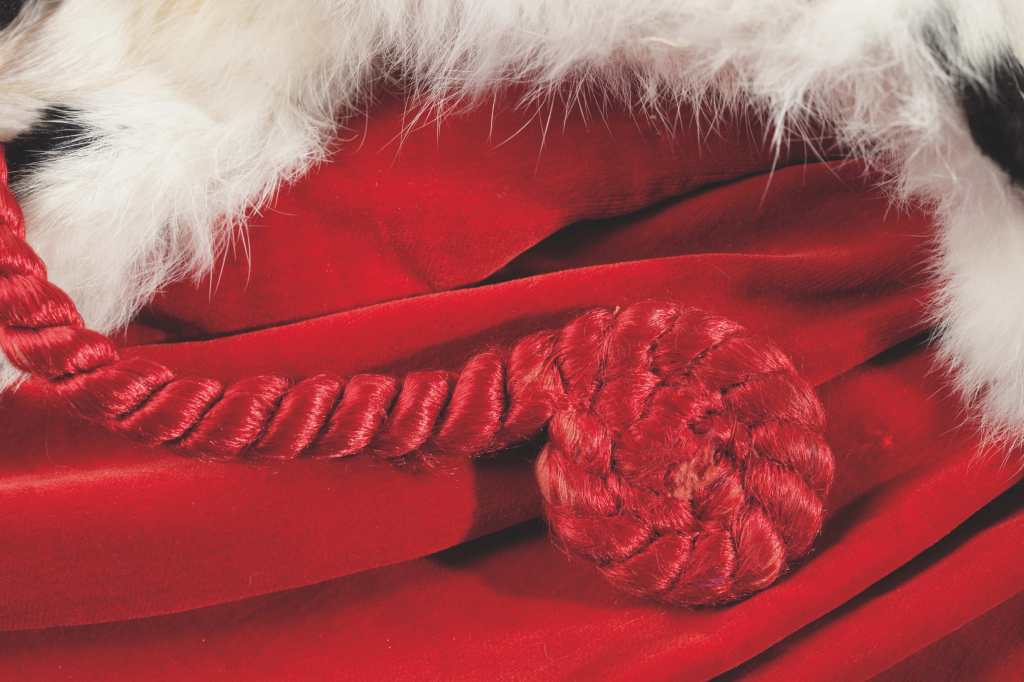
Also part of the Carnival Queen’s royal garb is a train made from crimson velvet, trimmed with rabbit fur and lined with white silk. Associated with the costume in the collection is a rectangular Belgian flag with the words ‘Belgium’ stitched across it, and a banner made out of a rectangular piece of purple satin with an inverted V shape cut out of the bottom and a triangular piece of yellow satin at the top. The drapings and most of the costumes worn at the Rangitīkei Carnival Queen’s coronation were made by Lloyd and Company, a Marton firm, and the crown – along with an orb, sceptre and trumpets which appear not to have survived – by Messrs Rees and Upchurch of Marton (the skill of one of whose workmen, Mr A. Todd, was described at the time as ‘simply marvellous’).2
While the term ‘carnival’ is usually associated with revelry and fun, the Belgian flag in this collection hints at the serious purpose of this particular festivity. By the time the Rangitīkei queen carnival was in full swing, the Great War had entered its second year and patriotic spirit was undiminished. Newspapers published the roll of honour of the dead and wounded from ‘the Dardanelles’ (then the more common term for the Gallipoli campaign). When one of the first Red Cross hospital trains returning men invalided home from Egypt and Gallipoli reached Palmerston North at midnight on Saturday 11 September, an enthusiastic crowd broke down barriers to greet the returning heroes.3 Rangitīkei and Manawatū women worked busily for various patriotic funds: the ‘Winter Waistcoats for Soldiers’, the ‘Sick and Wounded Soldiers’ and the ‘Christmas Puddings and Tobacco for N.Z. Soldiers’ funds were just a few of these.4
Queen carnivals drew upon older European traditions of carnival which saw an ‘ordinary’ person crowned for the day in an inversion of social status and norms: the May Queen and the ‘King of Misrule’ associated with Twelfth Night were among their antecedents. There was also an element of historical pageantry, which became popular throughout the British world during the late nineteenth century as a form of public drama and spectacle before fading with the advent of cinema.5 In New Zealand in 1915 the fund-raising element of queen carnivals came to the fore, providing a form of patriotic escapism amidst wartime tribulation. The Rangitīkei event was preceded by an even more elaborate carnival in Wellington which included a ‘queen’ representing Palmerston North and concluded with an elaborate coronation in the Town Hall based as closely as possible on those in Westminster Abbey.6
The Rangitīkei carnival was more modest and localised, but was no less enthusiastically contested. The seven queens represented a combination of localities and interest groups: Miss Bull, representing Hunterville; Miss McKelvie, Bulls; Mrs Houlahan, Rātā;7 Mrs W. Glasgow, Turakina; Mrs S.J. Gibbons, Sports and Pastimes; Mrs Sergeant-Major Brighting, Military Forces; and Mrs F. Purnell, Friendly Societies (a more formal age gave only marital titles and initials – or, in the case of the married women, their husband’s initial).8 The inclusion of married women was not atypical, and these were not beauty contests. In most wartime carnivals contestants included mature women, selected on the basis of their own or their husband’s community standing. ‘Worthiness’ rather than glamour was the main prerequisite for a queen of the carnival: these events were more evocative of tradition than of the more modern aesthetic of beauty contests based upon lightly-clad female bodies.9
Queen carnivals like the one held in the Rangitīkei ran over several weeks and drew on a range of fund-raising techniques. There were raffles and auctions, dances and concerts, with some events presenting a number of opportunities to extract funds – and votes – for the respective queens. Those campaigning for the friendly societies and military queens combined for a day of ‘entertainment in the park’, where revellers could ‘shoot at Kaiser Bill’ in replica and enjoy the less bellicose pleasures of a concert. There was also a concert for the military queen at the Marton Drill Hall. Most popular of all was a Parisian-style ‘Cafe Chantant’ held on several occasions for the Sports and Pastimes Queen in the Marton Town Hall. The Marton Brass Band, singers and orchestral entertainment featured, with a supper room, raffles and a produce stall staffed by local ladies in pierrot costume generating additional income.10
In some parts of the country the frivolity and excess of queen carnivals was questioned, as was their association with gambling in the form of art unions and raffles. Some regarded such jollity as an inferior form of patriotism, a descent into ‘saturnalia’ which was inappropriate at a time of national emergency and loss of life in overseas battlefields.11 There was a hint in the Rangitikei Advocate that some of the wealthy residents of the district held aloof from the carnival for fear that it would include ‘objectionable features’.12 But, for most, the event provided participants an opportunity to lift their own and others’ spirits by fund-raising for ‘our boys’, and, perhaps, a sublimation of individual grief in working for the wider interest. The amount raised in the Rangitīkei was £15,563, a total of 1,867,639 votes being cast.13
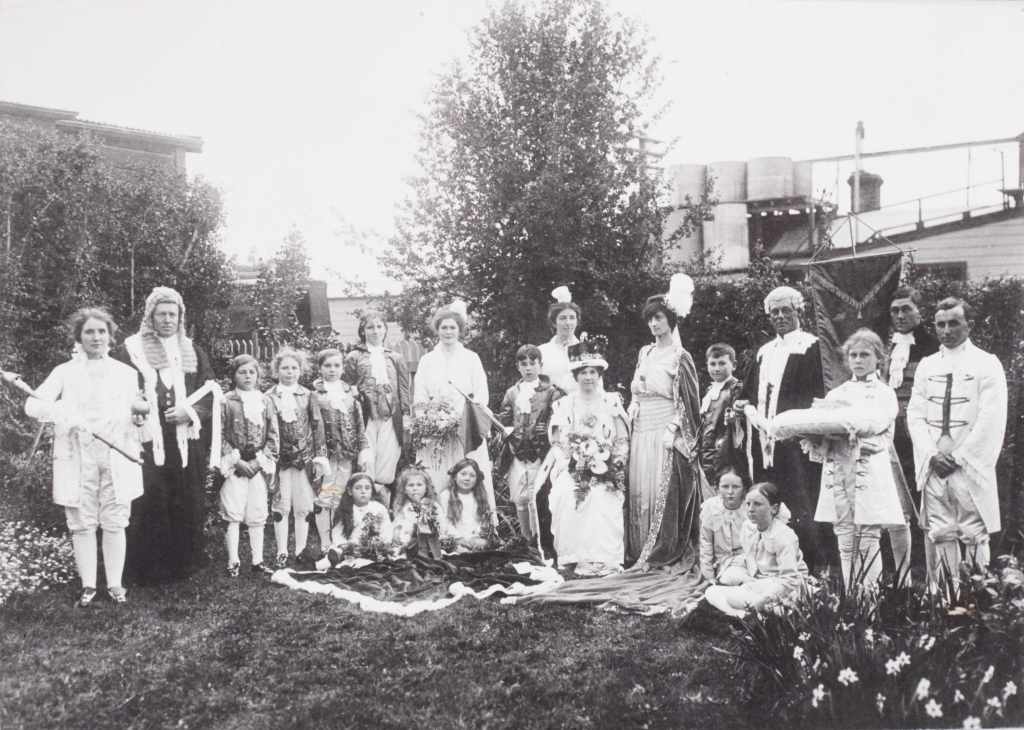
Joyce McKelvie’s team contributed £5825 to this amount, but her victory was not secured until the very last, Miss Bull having led for most of the campaign. On 29 September an elaborate coronation ceremony took place. Described as the ‘most splendid thing ever seen in Marton’, this involved the transformation of the Town Hall into a throne room dominated by a central dais festooned with flags, flowers and a ‘profusion of electric lights’.14 The elected Queen was led to her coronation by the orb-bearer, the master of ceremonies, young women dressed as pages, and representatives of the ‘Belgium Destitute’ and Britain’s wartime allies. The other queens were demoted to maids of honour for this ceremony, their trains carried by their own young pages in the procession. After a speech by the ‘Lord Chamberlain’, Joyce McKelvie was crowned Queen of the Carnival, but her regal status did not signify female authority, even within the symbolic confines of the event. Her speech from the throne was read by the ‘Lord High Chancellor’, Mr S.J. Gibbons, and reference was made in subsequent speeches to queens of England who were depicted as ‘good’ or ‘kindly’ rather than powerful. Imperial sentiment was to the fore:
Let us ever keep in mind that the very name of Britain has stood as a beacon light of liberty, protection, and helpfulness to the peoples of the world, so that in our Realm of Carnival we may each and every one acquit ourselves with honour in upholding the grand old name.15
After the crown was placed upon her head, the Carnival Queen bestowed humorous knighthoods upon local worthies (among them ‘E.A. Eglington, Baronet of Ohakea and Knight Commander of Her Majesty’s Sheep Run’, ‘Joseph Logan, Commander of her Majesty’s Stores and Grand Dispenser of Groceries’).
S.J. Gibbons, the impresario of this spectacular event, drew upon his experience in amateur opera to meticulously choreograph the placement of the 60 performers for best effect. The pageantry was supplemented by orchestral pieces, including Elgar’s ‘Land of Hope and Glory’, Handel’s ‘See the Conquering Hero Comes’ and the ‘Triumphal March’ from Verdi’s Aida. This is a reminder that even in a provincial area, musical talent could be marshalled into a respectable ‘Royal Orchestra’.
There is another reminder in the newspaper report: ‘one of the most enjoyable items was a poi dance by four Māori maidens before the Queen’. For all that the coronation resonated of empire and of traditions revered by the settler community, there were Māori participants in this event. The Rātā Queen in the competition, Mrs Laura Houlahan, may be the Māori woman depicted in another item from the Te Manawa collection: a postcard showing a Māori woman in a feathered cloak holding a greenstone mere. Although there is no identifying information, writing on the back of the card refers to ‘our Maori candidate for the Rangitikei Queen of Carnival’, and the age of the woman in the picture is in keeping with that of Houlahan, who was then 41.16 Mrs Houlahan was accompanied in the coronation parade by pages Roy Houlahan and Reuben Mete Kingi (the Mete Kingis were a well-known Maori family in the Rātā area). Houlahan sons appear to have served in the war, one giving ‘Mrs L. Houlahan (Rata)’ as his mother and next of kin in embarkation records.17 For some Maori, as well as for Pākehā, the war effort touched closely on family ties.

And what of the Carnival Queen herself? Joyce McKelvie came from a prominent Carnarvon family, her father James a prominent player in local affairs. He developed Pukemarama into one of the richest sheep and cattle stations on the west coast of the lower North Island and was a generous patron of a range of sports, in particular local racing clubs.18 Could Joyce’s last-minute success have been spurred by fatherly input into her campaign? The next grand event in Joyce’s life appears to have been her marriage in 1919 at Pukemarama to a returned soldier, James Hamilton (‘Ham’) Russell. She went on to have three sons, one of whom died at a very young age.19 After her death in 1983, her Carnival Queen crown and robe were donated to Te Manawa by her daughter-in-law. Her sister Rawi carried on something of a family tradition by becoming the leading candidate in the Manawatu A & P Association Queen Carnival of 1924.20 By this time queen carnivals had declined in scale and faded in popularity. They were soon to reappear in a more narcissistic form with the rise of beauty contests, and had later echoes in such seasonal celebrations as the Hastings and Alexandra Blossom Festivals.
First published in Fiona McKergow and Kerry Taylor, eds, Te Hao Nui – The Great Catch: Object Stories from Te Manawa, Random House, 2011; updated and republished with the author’s permission.
Footnotes
- ‘St. Edward’s Crown’, London Online. ↩︎
- Rangitikei Advocate (RA), 30 September 1915, p. 4. ↩︎
- Manawatu Evening Standard (MES), 13 September 1915, p. 6; New Zealand Free Lance, 17 September 1915, p. 20. ↩︎
- RA, 1 September 1915, p. 8; RA, 8 September 1915, p. 8; RA, 10 September 1915, p. 4. ↩︎
- Gordon, Bazaars and Fair Ladies, pp. 13–14; Woods, ‘Performing Power’, pp. 57–74. ↩︎
- Evening Post (EP), 3 June 1915, p. 10. ↩︎
- The name is sometimes spelt ‘Houlihan’ in the Rangitikei Advocate. ↩︎
- RA, 2 September 1915, p. 4. ↩︎
- For more general comment on carnivals and other forms of WWI fundraising, see Johnson, ‘The Home Front’, ch. 3. ↩︎
- RA, 3 September 1915, p. 8; RA, 4 September 1915, p. 5. ↩︎
- Johnson, ‘The Home Front’, p. 65. ↩︎
- RA, 7 September 1915, p. 4. ↩︎
- EP, 6 September 1915, p. 8. ↩︎
- RA, 30 September 1915, p. 4. ↩︎
- RA, 30 September 1915, p. 4. ↩︎
- Laura Houlahan applied for a license to act as a Native Interpreter in 1917, giving her age as 43 and her place of residence as Rata. She later noted that she had divorced her husband, E. Houlahan, in August 1917, and planned to revert to her maiden name, ‘Downs’. Correspondence, 6 November 1917, 23 May 1918, MA 1 1176/ record no. 1917/464, Archives New Zealand. ↩︎
- See ‘Lionel Joseph Houlahan’, WW 1 54210, URL: https://www.aucklandmuseum.com/war-memorial/online-cenotaph/record/C97112, accessed 16 August 2024. ↩︎
- MES, 1 July 1935, p. 6. ↩︎
- Mrs A. Sidey, conversation with Margaret Tennant, 9 July 2010. ↩︎
- Melody, The Beach Highway, p. 208. ↩︎
Bibliography
Gordon, Beverley, Bazaars and Fair Ladies: The History of the American Fundraising Fair, University of Tennessee Press, Knoxville, 1998, pp. 13–14.
Johnson, Simon, ‘The Home Front: Aspects of Civilian Patriotism in New Zealand During the First World War’, MA thesis, Massey University, 1975.
Melody, Paul, The Beach Highway: The Road to Rangitikei, Paper Plus, Marton, 2004.
‘St. Edward’s Crown’, London Online, URL: http://www.londononline.co.uk/monarchy/St_Edwards_Crown/, accessed 16 August 2024.
Woods, Michael, ‘Performing Power: Local Politics and the Taunton Pageant of 1928’, Journal of Historical Geography, vol. 25, no. 1, 1999, pp. 57–74.
 Te Manawa Museum Society
Leave a comment