Miriam Sharland
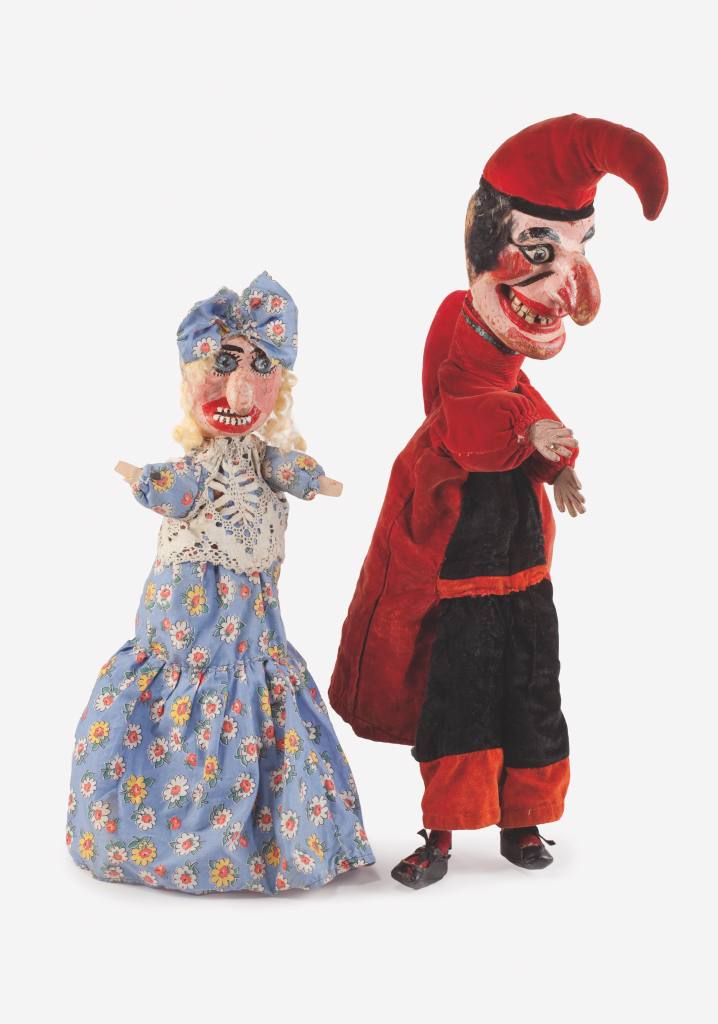
The Punch and Judy glove puppets lie in their boxes, mute commentators on social mores past and present. Every character except the hangman is present: Punch, Judy, Baby, Jew, Chinaman, Crocodile, Ghost, Clown, Fairy, Negro, Highwayman, Toby the Dog, Devil, Parson, Policeman, and Squire. The numerous props include gallows, a wooden coffin, a trident, a fairy wand, a bed, a tin pram, and a string of sausages. They are from a Punch and Judy show that was used by Annie Lupton during the interwar years, and were donated to The Science Centre and Manawatu Museum by her granddaughter Karen Kingsbeer in 1996.
Punch is resplendent in a red velvet coat. His crescent moon hat echoes the shape of his long hooked nose. He wears a high-necked shirt with puffed sleeves, trimmed with two rows of sequins, pink and blue. This is topped with a black jacket with gold trim and matching trousers. Punch is by far the biggest puppet in the collection, measuring 67 cm from the tip of his hat to the soles of his shoes, and looks every inch the well-to-do gentleman. Lurking beneath the distinguished outfit, however, is a beast: a wife beater, serial killer, villain, and child abuser. The hunchback Punch represents the chaos below the uneasily calm surface of life, the anarchy that threatens to break through and turn the world topsy-turvy.
Judy is very feminine, with blonde curls topped off with a large bow and an exuberant, light-blue dress sprinkled with yellow, white and pink flowers and trimmed with white lace. She is not pretty, with her large nose and prominent teeth, but is well turned out. She and Punch are a majestic couple. Their baby is wrapped in white lace with a blue satin bow round her neck, as though it were the most-loved baby there ever had been. She has her mother’s pale blue eyes and blonde hair, and, as yet, neither parent’s nose. Her delicate features have been applied with embroidery rather than the coarser paint treatment used for the grown-ups.
The other puppets are equally striking. The Jew wears a white and brown hound’s-tooth check suit with matching hat, and sports a small black moustache. An exotic Chinaman is dressed in black brocade with a fu manchu moustache. The Crocodile has bead eyes, a sequinned hide and a fearsome set of snapping jaws. There is a scary Ghost with a skull for a face and a wide mouth full of black teeth, and a Clown in red and white with a polka dot frill around his neck. The Fairy wears a pink gown sprinkled with sparkly fairy dust; the Negro wears a red-and-white-striped tunic; the Highwayman has a black eye-mask to conceal his identity. Even Toby the Dog sports a red frill. The Devil wears an orangey-red corduroy gown and an orange satin cloak with blue and gold trim. His red painted face with black-rimmed pale blue eyes resembles an Asian mask and he sports red sequins on his forehead and horns. The Devil cuts a handsome figure; it is easy to see how he tempted people into evil. The Parson is sombre in black with a small, mean mouth and big eyes; his hands are raised as if he is preaching. The Policeman is a big man with huge feet and a missing hand – perhaps lost in the cause of duty? He carries an insignia – his badge of authority – on his helmet. The Squire is dressed soberly in tweed and a high-necked, upstanding white collar. He represents tradition, stability and order – the antithesis of Mr Punch.
Punch originated in a character called Pulcinella in the sixteenth-century Italian commedia dell’arte (‘comedy of craft’). He made his first recorded (by the diarist Samuel Pepys) appearance as a marionette in England in 1662. Later, Punch became a glove puppet and puppeteers moved from town to town with mobile shows. Punch has a characteristic squawking voice achieved through the use of a swazzle held in the puppeteer’s mouth, which pipes his famous catchphrase as he murders each of his victims: ‘That’s the way to do it!’ Punch outwits and violently outdoes everyone in his wood and fabric world – killing the baby when it won’t stop crying, then turning it into sausages and feeding these to the dog, killing Judy when she remonstrates with him, venting some racist spleen against foreigners by murdering a few, then defeating the forces of law and order (the Doctor, the Squire, the Policeman), and even getting the hangman to put his own neck in the noose when the seemingly inept, bumbling Punch cannot work out how to do it for himself. Of course, as soon as the hangman’s head is through the noose, Punch pulls the cord, the hangman swings, and the old villain emerges victorious. Finally Punch defeats the Devil himself, sending him packing back down to Hell.
The core cast members of Punch and Judy have remained much the same over centuries and across cultures, but puppeteers have always added topical characters – Adolf Hitler, George Bush, Osama Bin Laden – to comment on the politics of the day. And every puppeteer performs a unique version of the show using characters of his or her choice and amending the story to fit the audience. When the show evolved from an adults’ into a primarily children’s entertainment in the late Victorian era, Punch’s mistress Pretty Polly was written out of the script and many versions had Satan defeat Punch, or omitted the Devil altogether. As the Victorians created the modern idea of childhood as a time for extended play (at least for the children of the rich), sets of puppets and children’s Punch and Judy scripts began to appear in toy shops.1
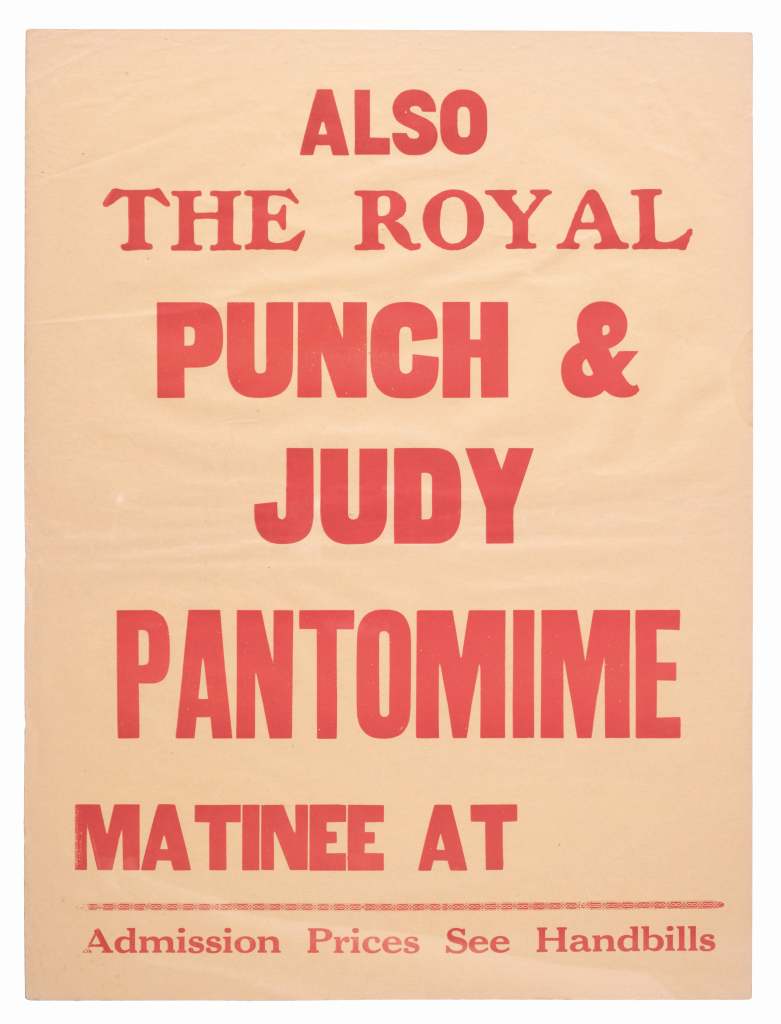
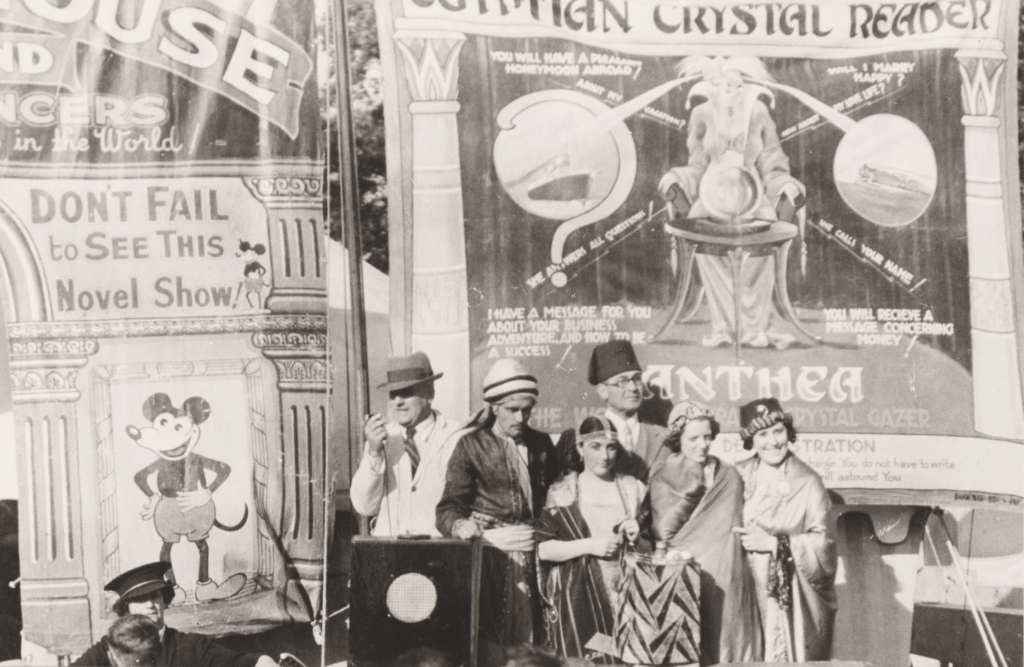
The owner and user of Te Manawa’s puppets began life as Annie Jane Jeffers Edgar. She was born in Melbourne in 1889 to Annie Jane Chambers and her husband William James Edgar, a gardener. Annie married Arthur Edward Lupton, a divorcee who is described as a vaudeville artist on their marriage certificate, in Christchurch in 1926.2 During the 1920s Annie, Arthur and their two daughters, Rona and Fuschia, performed in town halls as the Havana Novelty Jazz Orchestra, the Jubilee Bellringers (using handbells), the Harmonaders Trio Novelty Musical Act, featuring Deagan organ chimes (a double-tiered set of giant chimes, made in America in 1901), and as a comedy musical act. The family travelled throughout New Zealand by horse and cart. Annie also played saxophone, trombone and piano, and performed as a clown, magician and ‘Anthea the Crystal Gazer’.3
Annie Lupton’s Punch and Judy show was aimed squarely at children and carried a moral message. The final page of her script survives, and has the Devil punishing Punch for his misdeeds by stabbing him to death and sending him to Hell. The show ends with the Fairy coming onstage and telling the audience:
So remember, little children, it didn’t pay
For old Punchie to walk the crooked way.
Be honest, truthful, and always kind.
That’s the best way, you will always find.
Family photographs reveal glimpses of the lives of an itinerant band of performers: living in caravans, holding the tiny monkeys, socialising with troupes of acrobats and wire walkers, dressed up in costume and playing their instruments, and the set-up and backstage of the carnival. When not travelling, Annie, Arthur and their daughters were based in Palmerston North. Later, Annie broadcast an advice show as ‘Nana the Pets’ Friend’ on the Christchurch radio station 3ZB. Another alter ego was ‘Madame Karno’, whose troupe of monkeys raced real cars (Madame Karno’s Monkey Speed Kings) at theatres and agricultural shows in the late 1930s. Annie had married Roy Arthur Hill in 1938. She died at Napier in 1955.4
Female Punch and Judy puppeteers remain rare in Britain, let alone in New Zealand. Annie was an unusual woman in her time. Contemporary British female performer Caz Frost flouts convention in her Punch and Judy show by reflecting the new status of women in society. Her Judy insists that Punch stays home to mind their baby while she goes to the pub. When she returns to find that he has turned the infant into sausages, she takes the insurance money and goes to Spain on holiday, leaving him with the baby bangers. Frost also writes that the traits of cowardice, lewdness, rudeness, stupidity, selfishness, greed and violence are in us all, male and female; the Punch and Judy show holds up a mirror to our psyche and allows us to acknowledge and laugh at those failings. Another British performer, Dan Bishop, says that each character personifies aspects of the human predicament; ‘together they represent a pretty comprehensive range of the personal stresses, anxieties and frustrations most of us face on a daily basis.’ The audience experiences catharsis while watching Punch face the same troubles that they face, triumph over them through the simple act of knocking them aside with a stick, and get away scot-free.5
Foxton puppeteer Garth Frost, who played his Punch and Judy show to Wellington audiences in the 1970s, agrees. ‘If there were more Punch there’d be less violence,’ he believes. Frost made slight changes to the basic story to bring it up to date. In his version, Punch doesn’t kill Judy. He says: ‘My Judy wouldn’t stay down. I created such a strong character; she comes back at the end and chases him off stage. It’s not as dark as the original.’ Garth’s Judy has curlers and painted-on leg stubble, and wears fluffy slippers and a brunch coat. Frost says, ‘She was definitely a Kiwi – and not much prettier than Punch.’ Frost also made changes to his show to fit the political backdrop of the time, including a hangman based on Robert Muldoon, the National Prime Minister. Frost was performing his show in Wellington’s Cuba Mall on the day Muldoon presided over an opening there. ‘It was a very obvious caricature of him because I wanted to create a New Zealand version. I didn’t want to just trot out the original show.’6 Frost’s collection of punk- and glam-rock-influenced puppets is now in the collection of Te Papa, preserved, like Annie Lupton’s puppets, as a record of changing social attitudes.
First published in Fiona McKergow and Kerry Taylor, eds, Te Hao Nui – The Great Catch: Object Stories from Te Manawa, Random House, 2011; updated and republished with the author’s permission.
Footnotes
- Crone, ‘Mr and Mrs Punch in Nineteenth-century England’, pp. 1055–82. ↩︎
- See collection documentation, Te Manawa Museums Trust, 96/33. Australian birth certificate: Annie Jane Jeffers Edgar, Births Deaths and Marriages Victoria, 32221/1889, see https://www.bdm.vic.gov.au/research-and-family-history/search-your-family-history. New Zealand marriage certificate: Annie Jane Jeffers Edgar and Arthur Edward Lupton, Births, Deaths & Marriages Online, 1926/8094, see https://www.bdmonline.dia.govt.nz/. See New Zealand Truth, 19 Aug 1911, p. 6, for an account of Arthur Lupton’s unconventional previous marriage. ↩︎
- See collection documentation, Te Manawa Museums Trust, 96/33. ↩︎
- See collection documentation, Te Manawa Museums Trust, 96/33; New Zealand marriage certificate: Annie Jane Jeffers Lupton and Roy Arthur Still [sic], 1938/1677. ↩︎
- Bishop, ‘The Slapstick Symposium Papers. ↩︎
- Garth Frost, conversation with Miriam Sharland, 27 December 2010. ↩︎
Bibliography
Bishop, Dan, ‘The Slapstick Symposium Papers, Paper One, Punch’s Home Truths, URL: http://www.punchandjudy.org/docs/THE-SLAPSTICK-SYMPOSIUM-PAPERS.pdf‘, accessed 17 August 2024.
Crone, Rosalind, ‘Mr and Mrs Punch in Nineteenth-century England’, Historical Journal, vol. 49, no. 4, December 2006, pp. 1055–82.
 Te Manawa Museum Society
Leave a comment