Lilian Mutsaers

This home-sewn dress is easily read as a metaphor of love. Within each lace swirl, a small floral motif embroidered in pink, apricot and green silk thread decorates the fullness of the dress. The motif is repeated on both yokes, from which a powder-blue ribbon billows out of two carefully hand-finished front openings. The hidden edges of the ribbon are firmly secured into the bound armhole seams, leaving the visible ends to drape the full length of the dress. Additional lace trims the neck edge and sleeve hems, borders the gathered seams of the front and back yokes and completes the scalloped hem finish. The lace is attached using a variety of stitching methods, in each case the most appropriate to show it at its best.
The dress is in pristine condition. It shows no sign of the deterioration that might be expected in a garment made nearly 70 years ago. This suggests that it was cherished and perhaps only ever worn a few times. It bears the hallmarks of a seamstress who took great pride in her work and understood the intricacies of the materials she was using and how to achieve a quality finish. The interior of the dress conveys a similar narrative of care and pride. Complex finishing details contain and hide the raw edges with binding, machine finishes and delicate hand stitching.
The dress was donated to Te Manawa Museum by Vivienne Burling (formerly Boyce) in 2006. It was accompanied by a photograph of a toddler wearing it and the dressmaking pattern used to make it. Vivienne is the little girl in the photograph. We see her posed in front of a two-tone, match-lined wall. Barely higher than the darkly painted edge of the dado, she stares earnestly at the camera. A large sash bow adorns her hair and her shoes are of soft white leather to match the rest of her outfit. The background suggests the interior of the ubiquitous community hall in which residents gathered for events such as weddings and dances.
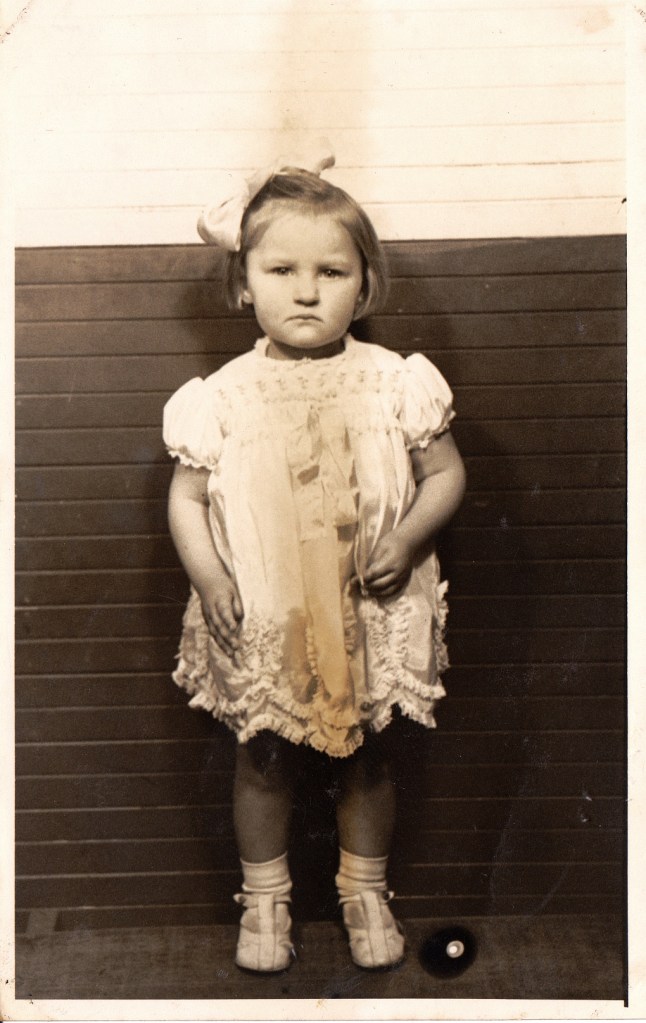
Vivienne does not remember the event. She believes she was two or three years of age when the photograph was taken, dating it to 1943 or 1944. She also believes that the hall was the Oddfellows’ Hall on Oxford Street, Levin, where her father regularly led a junior boy’s brass band. The hall was a venue for dances held for the army and air force during the Second World War.1 Her father, Major Henry Boyce, taught woodwork at a local school.
Clothing and fabric rationing was introduced in New Zealand in 1942 and had an impact on everyone. Each person had a coupon book and was issued with 26 coupons for clothing every six months. Most fabric purchases also required coupons, but some materials such as canvas and muslin did not. It was not unusual for the potential end use of a fabric to change as materials became less available.2 The small amount of fabric required to sew clothing for a child was easily squeezed out of larger pieces of cloth when cutting out an adult-sized garment. Similarly, clever tactics were often used to extend the life of clothing. Adult garments could be cut down and remade into children’s clothes. Women’s magazines contained sensible suggestions as to how to reuse fabrics for a different purpose.
The dress was made for Vivienne by her mother, Eileen Emily May Boyce (formerly Rees), during the war. It is cut from a white Celanese cloth. Like Rayon, Celanese was an early brand name for a propagation of cellulose acetate. Both brands evolved through the development of cellulose fibres and were promoted as ‘Artificial Silk’. First made commercially available in 1924, in its early years Celanese was commonly used to make undergarments, lingerie and nightwear. As the popularity of synthetic fibres grew, consumer demand led to rayon fibres being woven to imitate other yarns.3
The McCall’s pattern used to make the dress is dated 1939. Printed on the back of the envelope is a list of fabrics that would suit the style of the dress. In this instance, Celanese could be considered to have a very similar drape and fabric hand (tactile quality) to the recommended Crepe de Chine.4 This highlights the possibility that the choice of fabrics was limited by wartime restrictions. Alternatively, Eileen may have already owned a cut length of Celanese. Having lived through the Depression years, she understood the need to save things when they were available.5
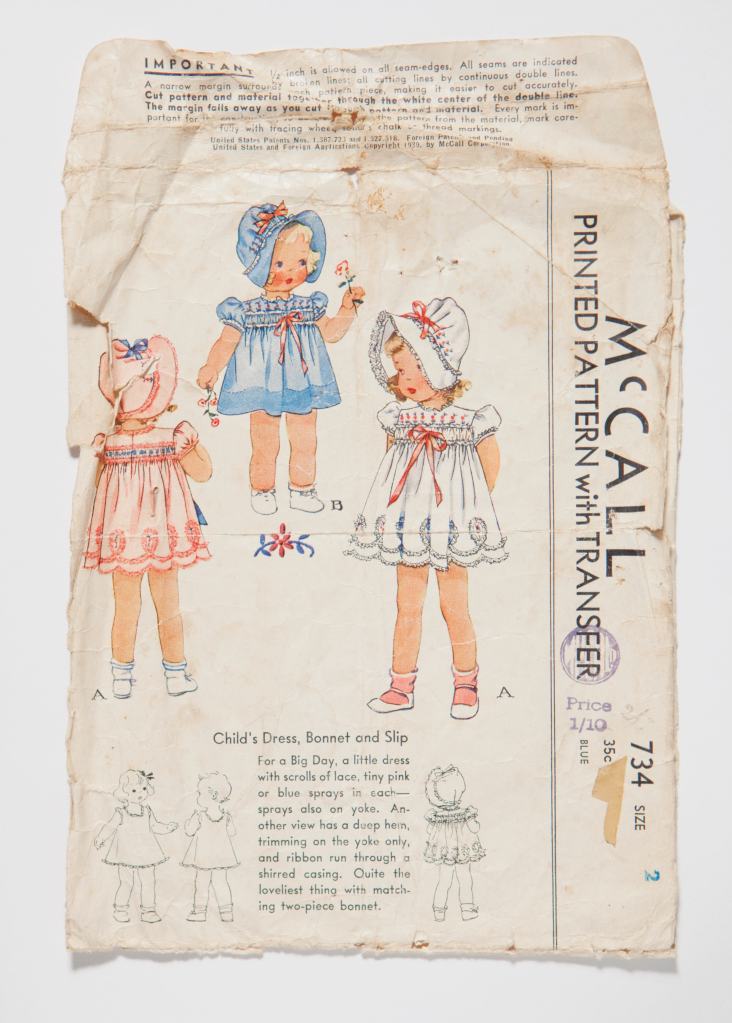
Dressmaking patterns were readily available in New Zealand to home dressmakers from the late 1800s. They were either purchased over the counter at draperies and department stores or by mail order from newspapers and women’s magazines. Each came with a set of instructions that assisted with garment construction and suggested the best cutting layout for the available fabric widths. Images depicted the fabric folded lengthwise with the selvedge edges together and showed the potential arrangement of the pattern pieces.
McCall’s patterns were innovative: they were the first printed patterns to be annotated with cutting and seam instructions.6 Information about perimeters, seam allowances and cutting considerations was given on each pattern piece. Other pattern companies used holes in a variety of shapes to communicate grainline and notch positions.
For the home sewer, it was common practice to pin the pattern pieces in place before cutting out. However, the pattern pieces used by Eileen Boyce for this dress tell a story less nuanced to home dressmaking. Oddly, there are no perforations in the paper to show the use of pins or a tracing wheel. The other oddity is that the notches that usually protrude from the pattern in an external V have been cut flush with the outer blue line and bear a simple snip in their centre. This suggests that the pattern pieces were laid on the fabric and weighted while cutting, while the notches became simple nicks in the fabric edges.
Like many women of her generation, Eileen Boyce was a terrific sewer. She sewed regularly for her family and took pride in her work. Eileen was also able to use these skills in the clothing industry during her married life. She worked for Levy’s Clothing Manufacturers in their cutting room, then at Kimberley Hospital (formally the Levin Hospital and Training School), where she was employed as a seamstress making nurses’ capes and uniforms.7 This helps to account for the condition of the pattern pieces. The use of nicks into the notches is a recognised industry method for communicating notches to machinists. It also helps to explain the professional details in the sewing of the dress.
For many women, an ability to construct and maintain clothing for themselves and other family members provided a great deal of esteem.8 Such skills sat nicely with the emphasis on thrift and economy associated with wartime. Vivienne recalls regular trips with her mother to local department stores and draperies in Levin, such as A.W. Allen Ltd, W.M. Clark Ltd, Kincaid’s Fabrics, and Davies, where Eileen would buy fabrics in end-of-season sales as part of her planning for her family’s needs.
Eileen had been taught sewing at primary school as an aspect of compulsory domestic education for girls. Vivienne learnt sewing as part of a very similar curriculum. Sewing was included in the curriculum for girls in the late nineteenth century and taught in much the same way until the mid-1970s.9 Vivienne grew up with sewing regularly around her at home. The handing on of sewing skills from mother to daughter was another familiar means by which girls learned to sew. Sewing at home was such a commonplace activity for women that it was taken for granted as part of the household routine of most families.
Vivienne has been ‘stitching ever since’, as an exhibiting embroiderer and foundation member of the Horowhenua Embroiderers Guild.10 Vivienne kept the dress for twenty years after the passing of her mother in 1986 before gifting it to Te Manawa. Eileen had felt very proud of what she had achieved in making the dress. It was important to Vivienne that ‘with all the work, it should go somewhere to be admired’.11 The survival of the dress, and the accompanying pattern and photograph, is a testament to the love and care that Eileen Boyce put into sewing for her family. Home-sewing as a cultural practice is most often documented through surviving garments such as this one.
First published in Fiona McKergow and Kerry Taylor, eds, Te Hao Nui – The Great Catch: Object Stories from Te Manawa, Random House, 2011; updated and republished with the author’s permission.
Footnotes
- Vivienne Burling, conversation with Lilian Mutsaers, 6 April 2010. ↩︎
- For more on wartime clothing practices, see Taylor, The New Zealand People at War; Nicholson, The Loving Stitch; McKergow, ‘Opening the Wardrobe of History’; McLeod, Thrift to Fantasy; Montgomerie, ‘Dressing for War’. ↩︎
- Handley, Nylon, pp. 22–8. ↩︎
- For basic aesthetic terms used in relation to fabric and fibres, see Humphries, Fabric Glossary. ↩︎
- See Mutsaers, ‘Unpacking Mrs Wood’s Suitcases’. ↩︎
- See Laboissonniere, Blueprints of Fashion. ↩︎
- Vivienne Burling, conversation with Lilian Mutsaers, 6 April 2010. ↩︎
- This is confirmed by a study of working-class women in Britain, see Buckley, ‘On the Margins’. ↩︎
- See Fry, It’s Different for Daughters. ↩︎
- ‘Horowhenua Embroiderers Guild celebrates 30 years’ Horowhenua Chronicle, 15 May 2019. ↩︎
- Vivienne Burling, conversation with Lilian Mutsaers, 6 April 2010. ↩︎
Bibliography
Buckley, Cheryl, ‘On the Margins: Theorizing the History and Significance of Making and Designing Clothes at Home’, in Barbara Burman (ed.), The Culture of Sewing: Gender, Consumption and Home Dressmaking, Berg, Oxford, 1999, pp. 55–71.
Fry, Ruth, It’s Different for Daughters: A History of the Curriculum for Girls in New Zealand Schools, 1900–1975, New Zealand Council for Education Research, Wellington, 1985.
Handley, Susannah, Nylon: The Manmade Fashion Revolution, Bloomsbury, London, 1999.
Humphries, Mary, Fabric Glossary, 3rd edition, Pearson Education Inc., New Jersey, 2004.
Laboissonniere, Wade, Blueprints of Fashion: Home Sewing Patterns of the 1940s, Schiffer Publishing, Atglen, Pennsylvania, 2009.
McLeod, Rosemary, Thrift to Fantasy: Home Textile Crafts of the 1930s–1950s, HarperCollins Publishers, Auckland, 2005.
McKergow, Fiona, ‘Opening the Wardrobe of History: Dress, Artefacts and Material Life of the 1940s and 1950s’, in Bronwyn Dalley and Bronwyn Labrum (eds), Fragments: New Zealand Social & Cultural History, Auckland University Press, Auckland, 2000, pp. 163–87.
Montgomerie, Deborah, ‘Dressing for War: Glamour and Duty in Women’s Lives During the Second World War’, in Bronwyn Labrum, Fiona McKergow and Stephanie Gibson, eds, Looking Flash: Clothing in Aotearoa New Zealand, Auckland University Press, Auckland, 2007, pp. 168–85.
Mutsaers, Lilian, ‘Unpacking Mrs Wood’s Suitcases: The Signifying Potential of Unsewn Cloth’, Master of Philosophy thesis, Massey University, Wellington, 2009.
Nicholson, Heather, The Loving Stitch: A History of Knitting and Spinning in New Zealand, Auckland University Press, Auckland, 1998.
Taylor, Nancy, The New Zealand People at War: The Home Front, Historical Publications Branch, Department of Internal Affairs, Wellington, 1986.
 Te Manawa Museum Society
Leave a comment