Simon Johnson
Made in Germany
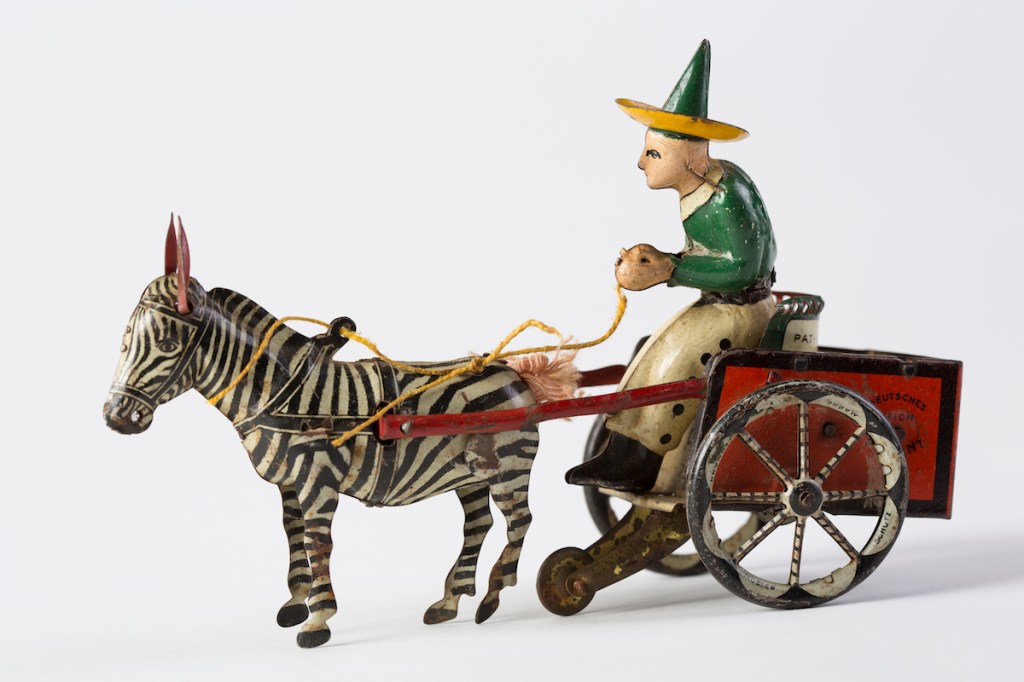
‘Zikra’ is a rare survivor from the millions of tinplate clockwork novelties made between 1900 and 1950. They were fragile, relatively cheap and disposable. The first toy factories emerged in Europe in the second half of the nineteenth century. This development coincided with the growth of the mass market production of consumer products and changing attitudes to childhood, particularly among the middle classes. Play became seen as educational, and fantasy had a valid place in children’s lives. The publication of children’s books grew strongly in the decades before 1914 with authors such as Edith Nesbit and Frances Hodgson Burnett becoming immensely popular.
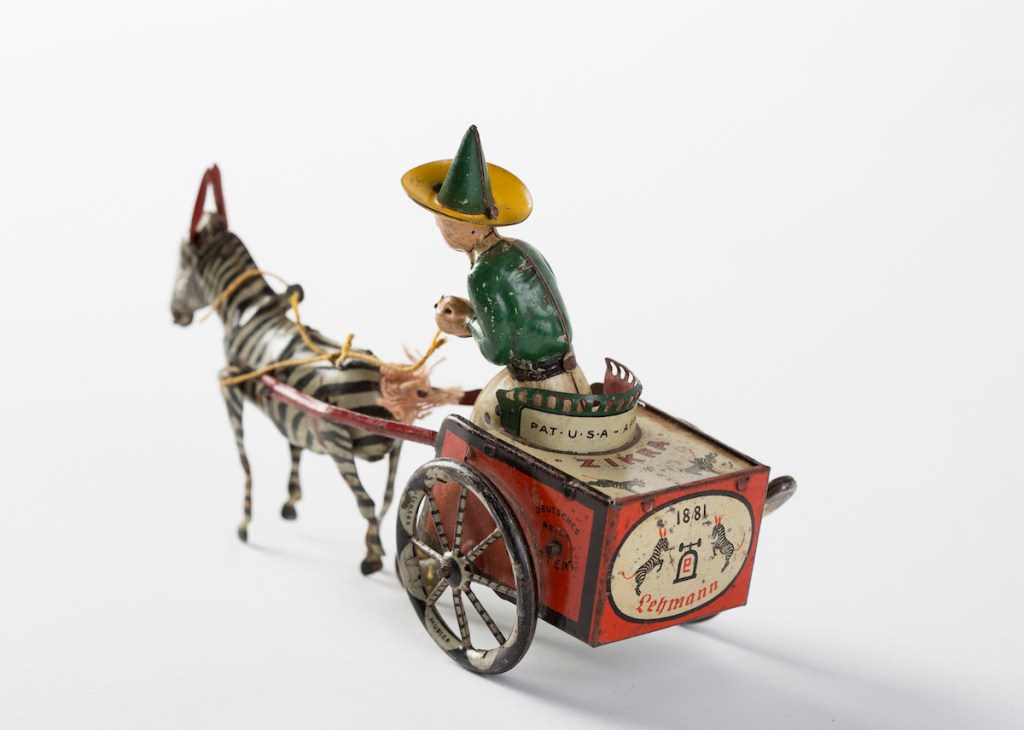
During this period German toymaking firms dominated the world market. Protectionist lobbies in Britain tapped into prevailing anti-German feeling, complaining that ‘to a large and ever increasing extent, our children’s playthings … are made in Germany’.1 Lehmann was one such producer. Founded by Ernst Paul Lehmann in 1881, the firm was one of Germany’s largest scale toy manufacturers with exports amounting to 90 per cent of production.2 Its specialty was quirky tinplate novelties driven by a simple clockwork motor powered by a piano wire spring. Additional movements – a waving hand or a bucking zebra – were controlled by linkages to the mechanism.
Cheap and Cheerful
Henry Jackson Mason’s ‘Zikra’ zebra drawn cart is a typical Lehmann production. He purchased the toy from the Maraekakaho Store, in the Hastings district, when he was seven years old in 1926 or 1927. It was similar in style and construction to an earlier model in which the cart was pulled by a mule.3 The Lehmann catalogue describes the toy as ‘[a] Mexican zebra team. The zebra refuses to be tamed and leaps about wildly.’4 Cieslik believes that it might have been inspired by an unsuccessful German stud farm in Dar es Salaam, which attempted to cross breed zebra with domesticated horses.5
Like all tin toys, ‘Zikra’ was made from sheets of tinplated and chromolithographed mild steel. Each panel was then pressed into a mould using a shaped die to create a particular part – a zebra’s leg, a cart wheel, or the rider’s body. These were assembled using a system of tabs which fitted through slots in the adjoining panel and were folded over. Early presses would have been hand operated using a central screw mechanism to raise and lower the die. Lehmann used an outline of one of these presses as its logo – see above. By the time ‘Zikra’ was made, all the presses in the factory were mechanised and powered by a series of belts and shafts driven by a stationary engine in the basement.6
Some German toy manufacturers, notably Marklin and Bing, made expensive, high quality toys which were partly hand finished. Lehmann’s success was based on cheap toys manufactured in large quantities. In 1914, 10,000 units were made of one toy alone, a clockwork motorcyclist. A 1924 price list aimed at UK retailers shows that most items were priced at between five shillings and one pound per dozen.7 ‘Zikra’ does not appear on this list, but a near identical toy, ‘The Stubborn Donkey’, is listed at sixteen shillings a dozen. These were Christmas stocking fillers or occasional gifts from indulgent grandparents and cost between five and ten shillings each from retailers. In Europe large numbers were sold by street vendors or on stalls at town markets.8
All tin toys, regardless of when and where they were made, are inherently fragile and easily damaged by rough handling. Clockwork examples, such as ‘Zikra’, are powered by a mechanism built into the model so that it cannot be adjusted or repaired. When something broke, the toy would be thrown away. Their short lives explain why so few remain extant. Lehmann may have made millions of clockwork novelties between 1881 and 1945 but those which have made it into the 21st century intact can be worth well over $1,000 to collectors.
The Patriotic Toymaker
Ernst Paul Lehmann was a product of the new, dynamic German Empire which was founded in 1871. Between 1871 and 1914 Germany emulated Britain in becoming a modern industrialised power and German products became known worldwide. Lehmann was immensely proud of his role as one of the ‘Founders’ of the new Germany.9 The walls of his factory carried boosterish slogans such as ‘Germany to the Fore!’10 After becoming a Brandenburg Municipal Councillor in 1900 he pushed for a memorial watchtower to be built in honour of Otto von Bismarck, a native of Brandenburg and the architect of German unification.
Freemasonry reimagined by Monty Python
Lehmann was a member of the carnivalesque men’s movement known as Schlaraffia.11 Its stated ideals were ‘humour, friendship, art and creativity in the frames of the German language and traditions’. Many members were artists, writers and composers. Franz Lehar was a member; so was Gustav Mahler. The name is based on Schlaraffenland, a mythical country fit for gluttons and idlers where sausages grow on trees and pre-cooked pigs and chickens offer themselves to be eaten. The idea of a land of plenty is still sufficiently familiar in Germany for ‘Schlaraffenland’ to be used for a brand of mattress and the name of a Berlin fast food outlet.
Schlaraffia could be described as freemasonry re-imagined by Monty Python. The standard greeting is ‘Lulu’ and Schlaraffian meeting rooms are decorated in medieval style. Members affect oddball, knightly titles and ‘duelling’ consists of singing, play acting or poetry reading with prizes of drinks or cigars awarded to the victor. This buffoonery was intended to uphold the Schlaraffian ideal of creating a haven from everyday life. To discuss business or the outside world at meetings was considered ‘profane’, while the rituals and culture of Schlaraffia were ‘sacred’.12
The movement was intensely German in focus, a factor which would have appealed to the patriotic Ernst Lehmann. Even today, only German is spoken at meetings, whether they are held in Denver, Colorado or Perth, Australia. At the turn of the 20th century members sang songs including lines such as ‘to be German is our strongest value’ and ‘from victory to victory towards the glory and honour of Germany’.13
Lehmann clearly enjoyed membership of Schlaraffia and named a number of his toys after invented Schlaraffian words and greetings which would have made little sense to most customers. Ihi, Aha and Oho were delivery vans and a car respectively. Uhu – ‘owl’ in Schlaraffian – was the name given to an amphibious car. Odd conveyances were a Lehmann trademark and include an ostrich towing a mail van, a mother duck hitched to a wheeled bucket containing swimming ducklings, and an ‘anxious bride’ waving her arms from a cart towed by an erratic cyclist. Such toys display a bizarre playfulness which would have gone down well at a Schlaraffian ‘Sippung’ (meeting).
Reading the Market
Ernst Lehmann was a shrewd operator. He attended toy makers’ conferences worldwide and had a good eye for market placement. He exported more of his production than any other German toymaker.14 A tap-dancing figure of a black man sold under the name ‘Oh My’ became ‘Alabama Coon Jigger’ for the American market.15 A man astride a pig which spun around in circles was simply ‘The Dancing Pig’ for all European markets except Britain, where it became ‘Paddy’s Dancing Pig’. To English eyes the figure would have been instantly recognisable as the Irishman of political cartoons with his distinctive hat, tailcoat and breeches.
The Lehmann factory stood in Brandenburg, a city some 60 kilometres west of Berlin. It was run on similar lines to all early 20th century factories producing mass market consumer goods. Ninety per cent of the assembly line staff were women who were paid according to their output. Salaried positions were held largely by men.16 Such was the level of industrial espionage among toy manufacturers that Ernst Lehmann patented every feature of a new toy before it left the developmental stage. Even employees were kept in the dark in case they were headhunted by the opposition.17 The firm’s success was based on the cheapness of its products and the enduring appeal of automata – mechanical creations which mimic human or animal actions.
New Directions
Ernst Paul Lehmann died in 1934. Unlike many family firms in which the second generation lacked the verve of their creators, Lehmann was fortunate. The factory was inherited by Ernst Lehmann’s cousin Johannes Richter, a talented entrepreneur in his own right. Disaster came after the war when Brandenburg became part of the new East Germany. Richter fled to the west and slowly began production in Nuremberg. Competition came from Japan, whose tin toy firms flouted Lehmann’s patents with such regularity that the company could no longer afford to defend them. Richter’s sons Wolfgang and Eberhard responded by pivoting the company 180 degrees and introducing an expensive large scale garden railway in 1965.18 The new product was named LGB – Lehmann Gross-Bahn.
Initially LGB thrived. However, like many nationally based companies it fell victim to globalisation. After being swallowed by local rival Marklin, both brands succumbed to toy giant Simba Dickie in 2013. Production is now located in Hungary.
First published by Te Manawa Museum on 10 August 2021; updated and republished with the author’s permission.
Footnotes
- Brown, Factory of Dreams, p. 20. ↩︎
- Osseman, Antalya Toy Museum. ↩︎
- Lehmann Toy Collection. ↩︎
- Wodonga & District Historical Society, WHS 01012. ↩︎
- Cieslik, Lehmann Toys, pp. 118–19. ↩︎
- Cieslik, Lehmann Toys, p. 186. ↩︎
- Cieslik, Lehmann Toys, p. 185. ↩︎
- Cieslik, Lehmann Toys, pp. 117–18. ↩︎
- Cieslik, Lehmann Toys, pp. 9–41. ↩︎
- Cieslik, Lehmann Toys, p. 180. ↩︎
- Cieslik, Lehmann Toys, p. 74. ↩︎
- Novikov-Almagor, Schlaraffia in Kraków, pp. 143–56. ↩︎
- Novikov-Almagor, Schlaraffia in Kraków, p. 154. ↩︎
- Pressland, The Art of the Tin Toy, p. 50. ↩︎
- Pressland, The Art of the Tin Toy, p. 141. ↩︎
- Cieslik, Lehmann Toys, p. 189. ↩︎
- Cieslik, Lehmann Toys, pp. 181–82. ↩︎
- Cieslik, Lehmann Toys, pp. 42–49. ↩︎
Bibliography
Barton, Christopher P., and Kyle Summerville, Historical Racialized Toys in the United States, Routledge, 2016.
Brown, Kenneth D., Factory of Dreams: A History of Meccano Ltd, Crucible Books, 2008.
Bryan, Eric, A history of Lehmann Toys, Collectors’ Club of Great Britain, 2012, URL: https://www.collectors-club-of-great-britain.co.uk/articles/a-history-of-lehmann-toys/
Campbell, Gordon (ed.), Grove Encyclopedia of the Decorative Arts, Oxford University Press, 2006.
Cieslik, Juren, and Marianne Cieslik, Lehmann Toys: The History of EP Lehmann, 1881–1981, New Cavendish, 1982.
Hamlin, David D, Work and Play: the Production and Consumption of Toys in Germany, 1870–1914, University of Michigan Press, 2007.
Lehmann Toy Collection, Private Showcase, URL: https://lehmanntoycollection.com/
Mahler Foundation, Schlaraffia Chasalla, URL: https://mahlerfoundation.org/mahler/plaatsen/germany/kassel/schlaraffia-chasalla
Novikov-Almagor, Anna, Schlaraffia in Kraków, 1909–1938, Muzeum Historii Polski, 2010.
Osseman, Dick, ‘Antalya Toy Museum Lehmann Toy’, photograph, URL: https://commons.wikimedia.org/wiki/File:Antalya_Toy_Museum_5589.jpg
Pressland, David, The Art of the Tin Toy, Crown, 1976.
Schlaraffia North America, Short history of Schlaraffia, URL: http://www.schlaraffen.com/whoarewe.html
Wodonga & District Historical Society Inc, ‘Domestic Object – Lehmann Tin Lithographed Windup Zikra Zebra Cart, Ernest Lehmann Co., 1920s, WHS 01012, Victorian Collections, URL: https://victoriancollections.net.au/items/638afefd6520f2bb9f776cc1
 Te Manawa Museum Society

Leave a comment