Simon Johnson
Potato Power!
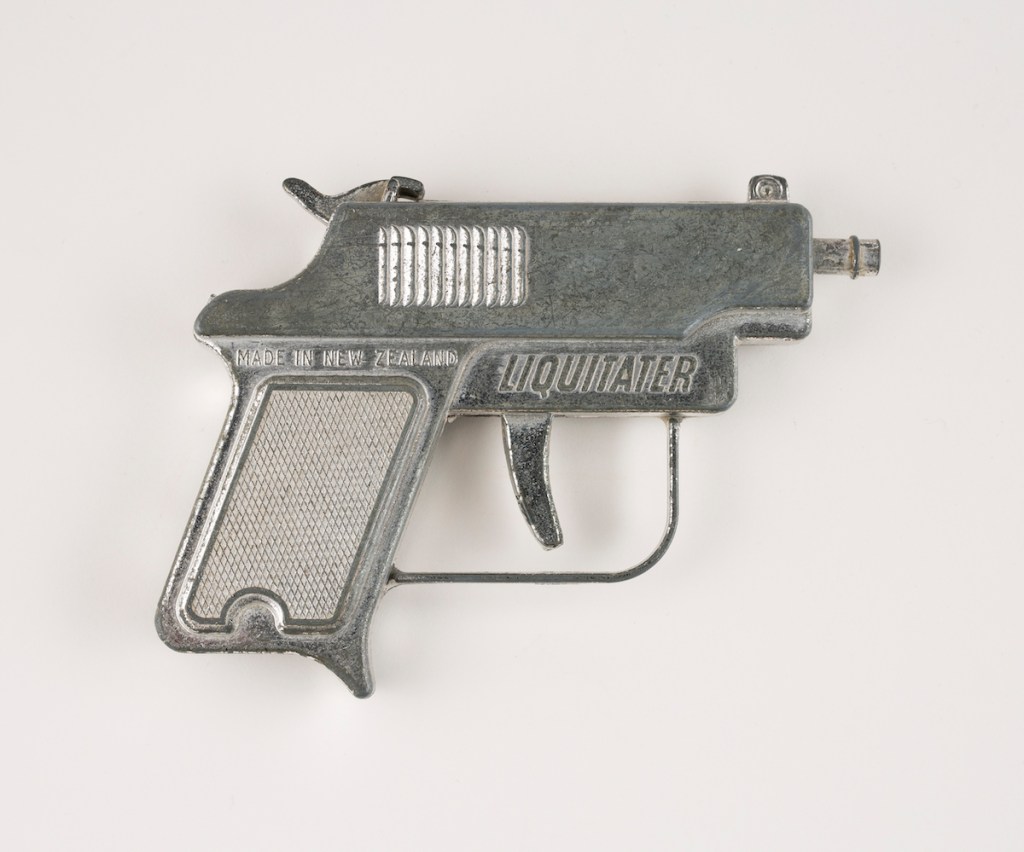
Spud guns operate on the same principle as water pistols. Squeezing the trigger creates air pressure, either expelling water from a reservoir or a fragment of raw potato lodged in the barrel. The spud gun warrior would keep a potato in his pocket and load his gun by pressing the narrow tip of the barrel into the tuber, twisting it sideways before pulling it out. This effectively blocked the barrel so that when the trigger was squeezed sharply, compressed air would fire the pellet with enough force to sting bare skin at short range.
The ‘Liquitater’ spud gun is a bequest from the estate of Colin Alve, who farmed near Ōpiki and owned a contracting business. Local newspapers provide fleeting glimpses of his activities as a pupil at Ōpiki School in the 1930s: calf rearing competitions, running races, football matches, fancy dress parties, and the like.1 By contrast the lives of his forebears – German migrants who settled in Wairarapa in the 1870s – are well documented on the Alve family history website.
Colin Alve’s spud gun was manufactured in New Zealand by Lincoln Toys – a company established by Lincoln Laidlaw, whose father was the first director of the Farmers’ Trading Company – in the 1950s or 1960s.2 As Colin and his wife Margaret Gillanders had no children of their own it is unclear why they were in possession of a postwar era spud gun. Perhaps it was used to provide entertainment for youthful visitors to their home?

In the Beginning was the Spud
Spud guns were popularised by American entrepreneur Joe Cossman in the 1950s. He bought the tooling from a toy manufacturer who had none of his marketing nous for US $600. Cossman knew that the US was experiencing a potato glut and persuaded the Department of Agriculture to back his ‘Project Potato’ advertising campaign. He allegedly sold two million spud guns in short order, making a fortune.3
It seems likely that no patent existed for spud guns because there were many different types available during my childhood in the 1960s. Many were made of ‘muck metal’, the popular term for any cheap alloy containing aluminium, lead, zinc and varying amounts of other metals. The virtue of such alloys was their low melting point, and they were widely used in the diecasting of cheap, mass produced items, particularly in the toy industry. Their disadvantage lies in being relatively fragile compared with a pure metal such as steel or aluminium.
Made in New Zealand
The Lincoln Toys ‘Liquitater’ is interesting in that it was made in New Zealand. Before the scrapping of import licences in the 1980s many small businesses made toys.4 Not only did customs duties add to the price of imported toys but the toys themselves sold quickly on their arrival and were unavailable for most of the year. This created a ready market for local products, most of which were made in small, even home-based, workshops. They included live steam models, accessories for model railways and the iconic Fun Ho! range of vehicles that were manufactured in Inglewood.
Producing a spud gun from castings would not have required hi-tech equipment. By using low melting point alloys the parts could have been produced quickly and cheaply. Import restrictions made such small scale local enterprise viable.
Boys and Guns
Public opinion has turned against toy guns in recent decades. The chief driver has been mass shootings such as the 15 March 2019 terrorist attack on Christchurch’s masjidain (mosques) and widely publicised killings in US schools. Allied to this is a revulsion at any form of fantasy violence and the belief that toy weapons reinforce gender stereotypes. After the 2012 shootings at Sandy Hook Elementary School in Newton, Connecticut, public opinion was such that a first grader in Montgomery County School was suspended for a day after pointing his finger at a classmate and saying ‘Pow’.5 When Prince George was photographed playing with a toy pistol while the royals were watching a polo match, there was a media storm in which his mother Kate (aka Catherine, Duchess of Cambridge) was accused of ‘getting it wrong’.6 Closer to home, Marlborough Boys’ College was temporarily locked down after it was believed a student was carrying a gun. It proved to be a toy revolver.7
Many educationalists take a more nuanced view, claiming that all imaginative play is an essential part of cognitive development and that children learn the boundary between fantasy and reality as part of the process. New Zealand educationalist Pennie Brownlee sums up this argument:
Imaginary weapons … fulfil the needs children express as they play. Children have been doing this since the beginning of human existence … the resulting weapon is never going to be perceived as ‘real’.8
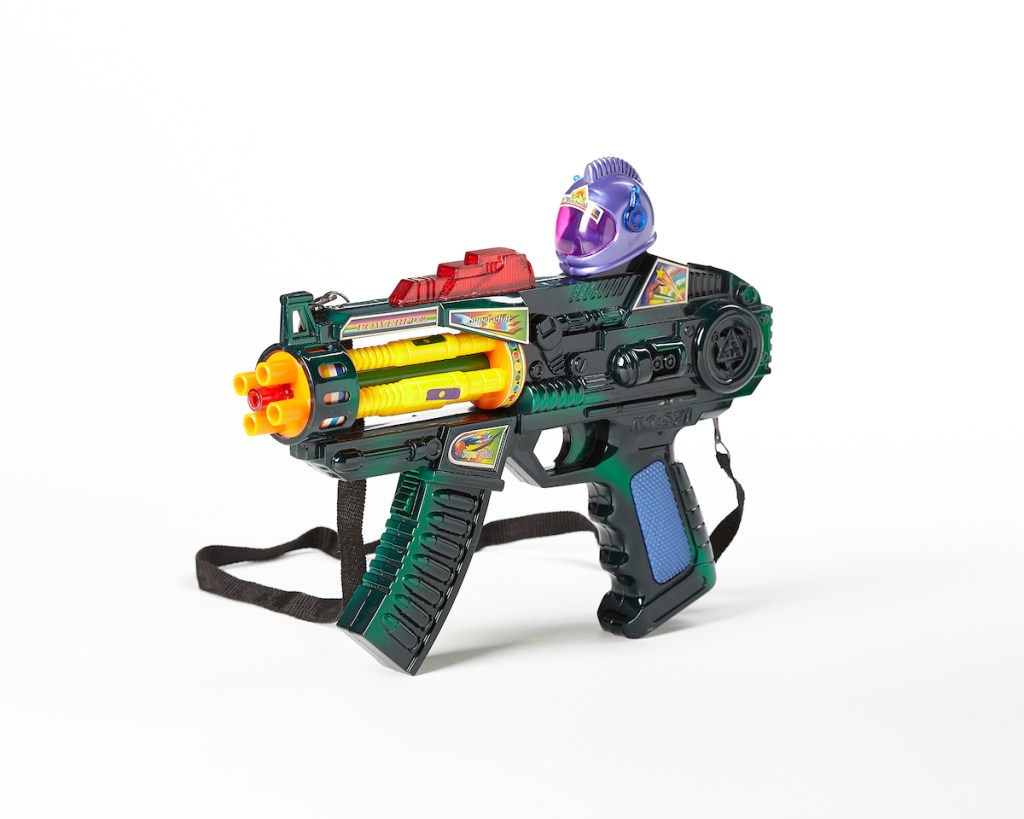
Brownlee and others draw a line between toy replicas of real guns – the AK-47 is particularly popular – and water blasters, ray guns and Nerf guns, which are brightly coloured fantasy weapons. Research presented on American parenting blogs suggests there is no proven connection between playing with toy guns in childhood and committing gun crimes as an adult.9 In fact, childhood cruelty to animals is cited as a more reliable indicator of sociopathic tendencies.10 An opposing view was held by the Play for Life movement that was active in New Zealand in the late 1980s and early 1990s.11
Spud Guns in the 21st Century
Spud guns were not a high profile toy in their heyday. They were a stocking filler, or a novelty bought with a couple of weeks’ pocket money. Today they are sold as retro curiosities such as a father or uncle might buy for a child, having half an eye on his own childhood. Like all toy guns they are still marketed as ‘boys’ toys’.
My own memories of playing with a spud gun are of mock battles with neighbouring boys. The waste land running from behind St James School to lower Te Awe Awe Street (now Chilton Grove) provided a suitable No Man’s Land of coarse grass and lupin bushes.
First published by Te Manawa Museum on 11 August 2021; updated and republished with the author’s permission.
Footnotes
- Manawatu Times, 23 December 1933, p. 9; Manawatu Standard, 2 October 1934, p. 2; Manawatu Times, 21 February 1935, p. 5; Manawatu Times, 10 August 1935, p. 2; Manawatu Times, 24 September 1935, p. 4. ↩︎
- Kiwi Auctions, 10 May–1 June 2024; Veart, Hello Girls and Boys!, pp. 186–90. ↩︎
- E. Joseph Cossman, How I Made $1,000,000 in Mail Order – and You Can Too, Simon and Schuster, 1964, pp. 134–43. ↩︎
- Veart, Hello Girls and Boys!, pp. 220–22. ↩︎
- Washington Post, 2 January 2013. ↩︎
- New Zealand Herald, 12 June 2018. ↩︎
- Stuff, 5 July 2018. ↩︎
- Brownlee, ‘Bang Bang! You’re Dead!’, pp. 38–39. ↩︎
- Today’s Parent, 22 June 2012; ParentCo., 2 May 2017; Parent Map, 21 March 2018. ↩︎
- Today’s Parent, 22 June 2012. ↩︎
- Veart, Hello Girls and Boys!, pp. 227–31. ↩︎
Bibliography
Brownlee, Pennie, ‘Bang Bang! You’re Dead’, New Zealand Journal of Infant and Toddler Education, vol. 10, no. 2, 2008, pp. 38–39, URL: https://penniebrownlee.weebly.com/uploads/1/0/4/3/10437917/bang_bang_youre_dead_1.pdf
Cohen, Shawna, ‘Is playing with guns normal?’, Today’s Parent, 8 May 2015, URL: https://www.todaysparent.com/family/is-playing-with-guns-normal/
Cossman, E. Joseph, How I Made $1,000,000 in Mail Order – and You Can Too!, Simon and Schuster, 1964.
Jacobson, Malia, ‘Weapons Ban: Just how bad are toy guns for kids?’, Parent Map, 21 March 2018, URL: https://www.parentmap.com/article/weapons-ban-just-how-bad-are-toy-guns-for-kids
Kiwi Auctions, 10 May–1 June 2024, URL: https://kiwiauctions.co.nz/auctions/16/catalogue/0793 ↩︎
[Unknown author], ‘The toy gun debate can be incredibly confusing for parents of boys’, ParentCo., 2 May 2017, URL: https://www.parent.com/toy-gun-debate-can-incredibly-confusing-parents-boys/
Veart, David, Hello Girls and Boys! A New Zealand Toy Story, Auckland University Press, 2014.
 Te Manawa Museum Society
Leave a comment