Simon Johnson

Peter French was given this Meccano Airport Service Set No. 4 for Christmas by his parents in 1969. At that time his family lived in Palmerston North and he believes the set may have been purchased at Collinson & Cunninghame, one of the city’s longstanding department stores. He can remember waiting in the family car in King Street while his mother returned with a large parcel.1

The Mechanics Made Easy set featured in another post was made in the foundation years of the Meccano empire. By contrast, the Airport Service Set No. 4 was a far more complex set that was sold in the mid 1960s. This was shortly after Meccano Ltd had collapsed and its shares were acquired by rival company Lines Brothers, the producers of Tri-ang toys. The set stands at a crossroads in toy manufacturing when Lines Bros sought to adapt Meccano to a changing market. Many adult enthusiasts reacted against this by setting up an alternative Meccanoman movement that looked back to an imagined golden age of Meccano modelling.
Meccano Ltd had produced a wide range of products since its establishment. Frank Hornby, the company’s founder, branched out into 0 gauge (1 ¼” track) model railways in 1920 and in the absence of German competition this was an instant success.2 In 1934 he introduced a range of model vehicles, or ‘modelled miniatures’, that were branded Dinky Toys. There were other lines too, mostly aimed at boys and parents who believed that technological literacy was important for young men. These included chemistry and electrical sets, and car and aeroplane constructor outfits. Frank Hornby died a millionaire in 1936.
Frank’s son Roland succeeded him as chairman of the Board of Directors. Initially the company maintained its dominance, but in the years following the Second World War the directors failed to keep up with changes in the market. By the late 1950s their key brands had new competitors, with Dinky Toys model vehicles under threat from Matchbox and Corgi, and Hornby Dublo electric trains undercut by Tri-ang Railways. When slot cars became the ‘must have’ toy Roland Hornby shrugged it off. ‘There’s nothing to it’, he said. ‘Just cars and racing.’3
Meccano Ltd introduced ‘Circuit 24’ in 1962 when the directors saw how much money Tri-ang was making from ‘Scalextric’, but the product was a flop. Similarly, the company met the challenge of Lego with an inferior clone branded ‘CLiKi,’ which the Brighton Toy Museum describes as ‘the most disastrous toy in the history of the British toy industry.’4 Other Meccano toys failed to hit the target. There were adjustable roller skates, self-hardening plasticine and the ‘Hornby Hoverer’, a toy hovercraft powered by a glow plug motor. Britain was in the middle of a toy boom when Meccano Ltd went into receivership in 1964. With the boom had come competition and Meccano Ltd failed to show the pioneering verve of its founder.5
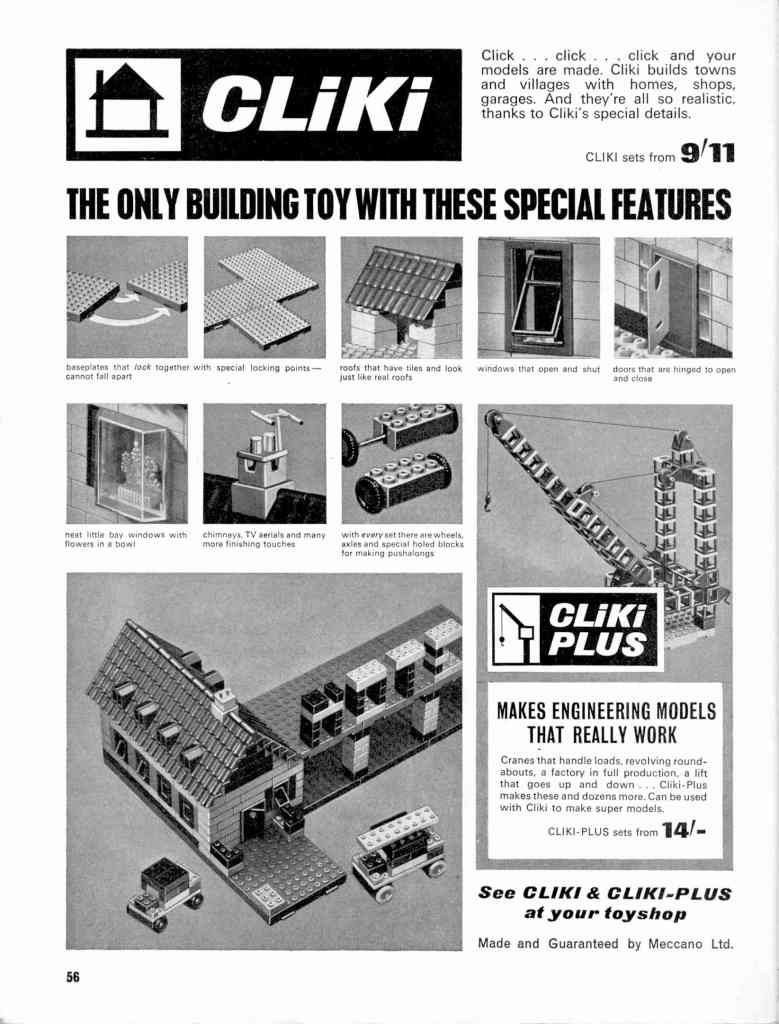
New Look Meccano for the Swinging Sixties
The Meccano Airport Service Set dates from the beginning of the new order under Lines Bros control. Although sets numbers 00–10 contained the same parts as before and could still be upgraded with accessory outfits, the larger sets were themed: Site Engineering Set, Highway Vehicles Set, and so on. The manual included with each set contained models appropriate to each theme. More importantly, the predominantly red and green colours of the structural parts were changed to yellow and silver.

The object of this exercise is made clear in a promotional article in the Meccano Magazine of August 1964:
‘Meccano gets with it’ is what they are saying in the shops of Great Britain – a phrase that heralds a dynamic change in the presentation of the world’s most famous construction system.6
This was, after all, the 1960s, and ‘getting with it’ was de rigeur.
The Rise of the Meccanoman
Not all Meccano enthusiasts appreciated changes to the brand, particularly adult modellers. They also complained about the lack of Meccano model building content in the Meccano Magazine. Many believed Meccano had lost its way since the war and disliked the new colour scheme, which they believed was only suitable for earthmoving machinery.7
Tom Ritchie’s doctoral thesis (and associated blog), which was based on the collections of the Science Museum in London, applied a semiotic model to the changing meanings ascribed to Meccano and sees a divergence taking place in the mid 1960s.8 The image Lines Bros wanted to promote with their new-look themed sets and bright colours was of a progressive toy ready to compete with the many rivals for children’s attention, including Lego, slot cars and, above all, television.
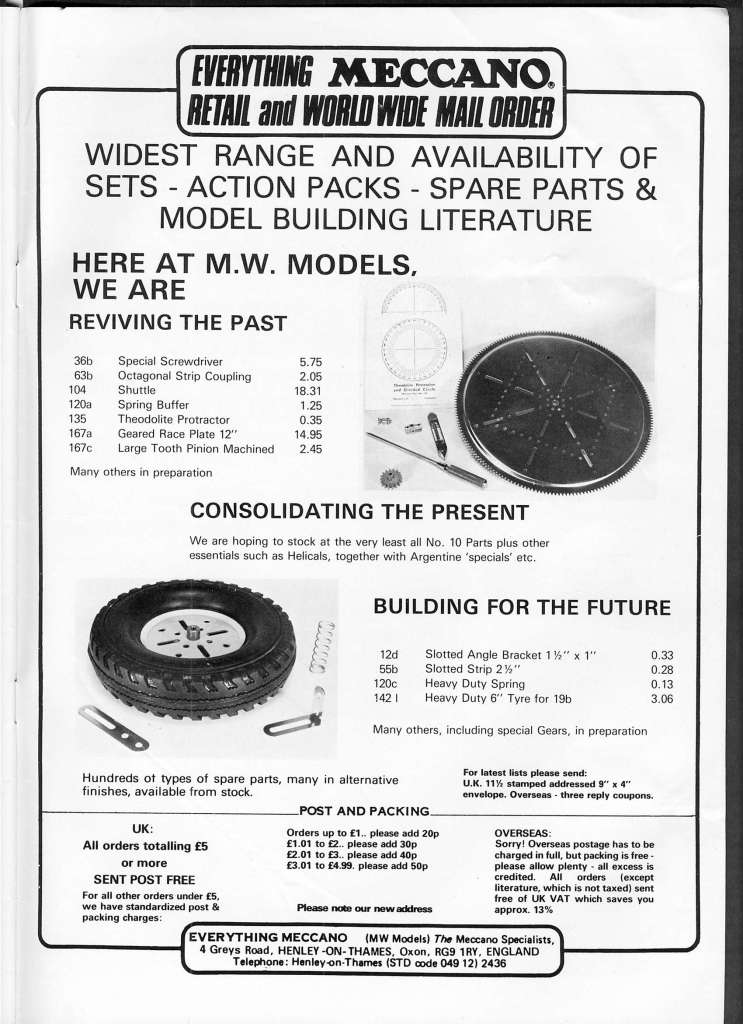
Meccano was essentially a toy, and had to appeal to toy buyers. Adult modellers, many of whom grew up in the 1930s, were unhappy. For them Meccano – to use Frank Hornby’s slogan – was ‘Engineering in Miniature.’ In 1965 a Meccanoman’s Club was formed, along with a journal aimed at advanced modellers. Members of the club with an engineering background began reproducing pre-war parts that had become obsolete, notably the iconic geared roller bearing used on the giant blocksetting crane which appeared on many manual covers.
These two strands of the hobby have continued to the present day. Clubs for adult modellers spread around the world in much the same way as boys’ clubs had done between the wars. Many, like New Zealand’s Federation of Meccano Modellers, publish their own magazines. These are primarily men’s clubs. Club websites and online videos of model building expos show men in their later years with complex, well finished models. In this, Meccanomen occupy a similar niche to adult railway modellers or builders of detailed plastic aircraft and vehicle kit sets. Freed from the financial constraints of childhood they are able to pursue their hobbies at the highest level and buy whatever parts they need.
Fifty years on from the changes to Meccano’s image initiated by Lines Bros, current Meccanomen are no longer bound by notions of loyalty to ‘original’ Liverpool-made Meccano. Many small companies and workshops around the world not only supply parts based on obsolete Meccano items, but also a range of new, Meccano compatible components aimed at the adult hobbyist. These include a wider range of gears, large motor tyres, and specialised structural parts which are made in India, Argentina, Australia and the UK.
Decline and Fall
Back in the commercial world, Meccano continued to falter. In 1971 Lines Bros collapsed and was taken over by Airfix, best known for its plastic model kits. When Airfix failed ten years later, the Meccano brand passed through a number of hands and is currently (2024) owned by the Canadian toy giant Spin Master Ltd.
Meccano has followed a similar 100 year trajectory to other iconic British brands, particularly in the car industry. As of 2024, the Rolls Royce marque is now owned by BMW, Jaguar by Tata of India, and MG by the Chinese state-owned car manufacturer SAIC Motor. Over the last 30 years global companies have tended to expand at the expense of established national brands.
Under Spin Master, Meccano products have been driven by global trends. Gone is the system of progressive sets which can be enlarged by accessory outfits. Rather, the emphasis is on smaller sets, some intended to build one specific model, including Ducati motorcycle, Ferrari racing car, and so on. Many of the parts in these sets are specific to a particular model, rather than having multiple applications.
It is tempting to speculate as to why one-off models are a better sales prospect than a toy which can be dismantled after assembly and built into something else. Is it a symptom of children being time poor like the rest of us or impatient with hobbies that demand taking a longer view? Or, is it a symptom of deeper conundrums that lie largely outside their control?
In one way, today’s Meccano is promoted in a similar way to its ancestor, Frank Hornby’s Mechanics Made Easy. Hornby marketed the system as an educational toy in which the process of building the model was more important than the completed model or toy itself. The packaging of the Meccano Ferrari above reveals a similar message. The Meccano logo is subtitled ‘Maker System,’ aligning Meccano with the wider maker movement which emphasises learning through doing. Below this is the acronym STEM (science, technology, engineering, mathematics) within a small circle. Many educationalists see STEM subjects as critical to child development as well as ensuring the future technological literacy of the workforce.
Frank Hornby would have understood these aspirations. In 1917 he published a reader’s essay in Meccano Magazine which imagined Meccano as an instrument of future British greatness:
In the future the nation will produce a class of engineers that has never been excelled before, due to the popularity of Meccano amongst the boys of this country.9
Hornby’s vision was a male-centred. The image of the Meccano Boy remained unchanged for most of the 20th century, even after Lines Bros, and later Airfix, acquired the brand. However, a core objective of the STEM educational policies of many countries is to narrow the gender gap in STEM-based professions. This is surely why a number of Meccano model kits now feature girls, particularly the Meccanoid robotic sets which teach programming as well as constructional skills.
When Peter French’s Airport Service Set was made in the mid to late 1960s, it was common for adult Meccano modellers to talk in terms of Frank Hornby’s vision being under threat. The truth is that Hornby was first and foremost a marketeer with a nose for the aspirational culture of his day. Had he been a 21st century entrepreneur with an awareness of the commercial possibilities of STEM educational toys, he too would have presented a new four foot tall personal robot being constructed by a girl if it was good for business.

A Meccano Boy in Palmie
I was a ‘Meccano Boy’ in the 1960s and my Christmas accessory outfits certainly came from Collinson & Cunninghame. Although the store sold Meccano spare parts, so did Pink and Collison motorcycle dealers in Cuba Street. This may seem a little odd, but it could have been because the owners held an import licence for these items. Most imported goods, from handkerchiefs to bicycles, required an approved licence in the 1960s and 1970s.10 These were a valuable asset for any company to hold.
Another possible explanation is that Pink and Collison saw the Meccano hobby as a valuable skill base for ownership of the British motorcycles that formed the bulk of their stock. Both Meccano model building and maintaining an English motorcycle demanded strong improvisational skills. English motorcycle companies could rarely afford to design a new model from scratch and often developed them from a pre-existing ‘parts bin’. The bikes were notoriously unreliable compared to the Japanese marques that succeeded them, requiring constant attention from their owners. Some British bike enthusiasts took a Meccano Boy’s attitude to their passion by building a ‘special’ from the parts of two different brands. Thus, a Triumph motor in a Norton frame became a ‘Triton’, and so on.
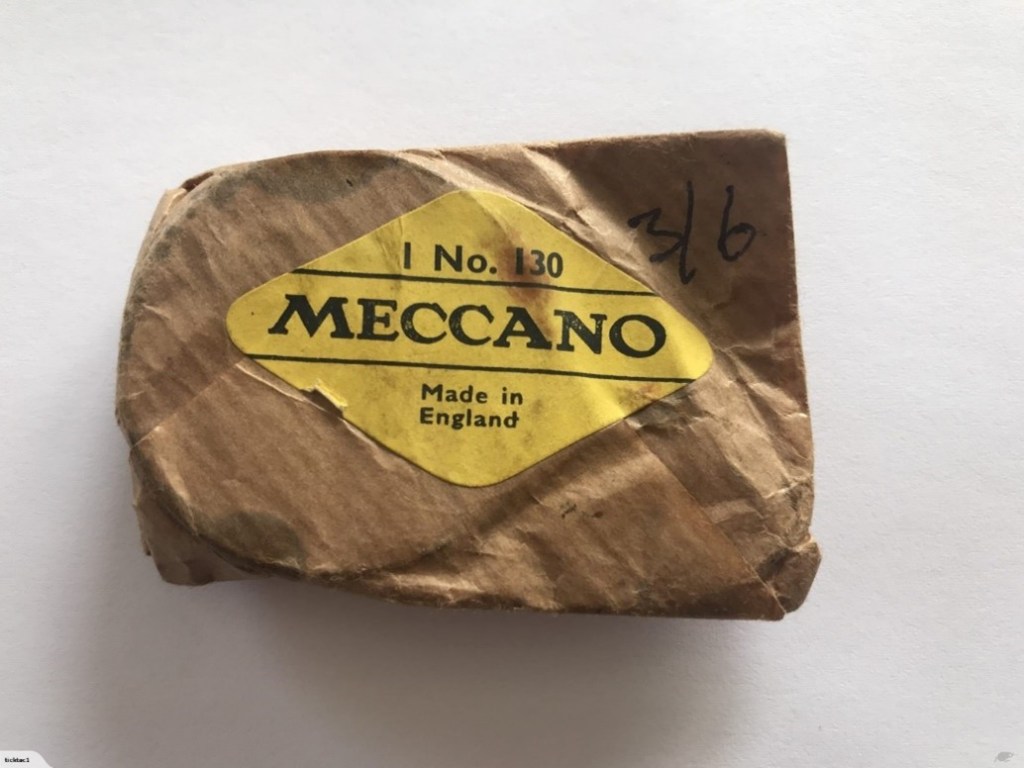
Import licencing meant that the Meccano part you wanted was rarely available when you wanted it. Pink and Collison’s Meccano spares were housed in a tiny annex to one side of the counter. It was the size of a large walk-in wardrobe and lined with narrow shelves on which items were arranged according to their parts number. Manager Bob Pink would allow me into this room to browse whenever the parts I needed were out of stock. If you wanted a pair of gears to give a 4:1 ratio you might have to buy two pairs of 2:1 or buy two 12 ½” angle girders to make up a single two foot girder. Perhaps Bob hoped that I might go on to buy a BSA or Ariel motorcycle.
First published by Te Manawa Museum on 28 April 2021; updated and republished with the author’s permission.
Footnotes
- Collection record, Meccano Airport Service Set No. 4, Te Manawa Museum Trust, 96/110/15. ↩︎
- Graebe and Graebe, Hornby Gauge O System, p. 10. ↩︎
- Brighton Toy and Model Index ↩︎
- Brighton Toy and Model Index ↩︎
- Foster, Hornby Dublo Trains, p. 80. ↩︎
- Meccano Magazine, August 1964, p. 32. ↩︎
- See Letters to the Editor columns in Meccano Magazine from 1965 onward. ↩︎
- Ritchie, ‘Object Identity’, p. 56. ↩︎
- Meccano Magazine, March-April 1917, p. 2. ↩︎
- Dyer, interview, part 2, 2018. ↩︎
Bibliography
Bowler, Peter J., ‘Meccano Magazine: Boys’ toys and the popularization of science in early twentieth-century Britain’, BJHS Themes, Volume 3: Worlds of science fo rchildren and young people, 1830-1991, 2018, pp. 129–46. DOI: https://doi.org/10.1017/bjt.2018.5
Brighton Toy and Model Index, URL: https://www.brightontoymuseum.co.uk/index/Main_Page
Brown, Kenneth D., Factory of Dreams; A History of Meccano Ltd, 1901–1979, Crucible Books, 2007.
Dyer, Colin, assistant manager at PDC, interview, part 2, Palmerston North City Library, 2018, URL: https://manawatuheritage.pncc.govt.nz/item/8842b4d0-c5e1-4f17-a2a2-5d7f4a6e08c9
Foster, Michael J., Hornby Dublo Trains, New Cavendish Books, 1980.
Graebe, Chris, and Julie Graebe, The Hornby Gauge O System, New Cavendish Books, 1984.
Meccano Magazine Online, 1916–1981, URL: http://meccano.magazines.free.fr/
Ritchie, Thomas, ‘Object Identity: Deconstructing the “Hartree Differential Analyser” and reconstructing a Meccano Analogue Computer’, PhD thesis, University of Kent, 2019.
Veart, David, Hello Girls and Boys! A New Zealand Toy Story. Auckland University Press, 2014.
Wainman, Ruth, ‘“Engineering for Boys”: Meccano and the Shaping of a Technical Vision of Boyhood in Twentieth-Century Britain’, Cultural and Social History, vol. 14, no. 3, 2017, pp. 381–96. DOI: https://doi.org/10.1080/14780038.2017.1314581
Wright, Geoff, The Meccano Super Models, New Cavendish Books, 1978.
 Te Manawa Museum Society
Leave a comment