Tony Rasmussen

‘I remember those!’ is an exclamation that punctuates almost any conversation about Airfix kitsets. Growing up during the 1960s and 1970s, building kitsets was very likely to have been part of your childhood, especially, but not exclusively, if you were a boy. Spending hours hunched over a table assembling do-it-yourself models, fingers sticking together from excess glue, the smell of enamel paints filling the air, while constructing miniature replicas of tanks, planes, cars or ships was both a sensory and imagination-filled pastime that beat doing schoolwork hands down.
In New Zealand, the kitsets that youngsters were likely to be building came from a British company called Airfix. An early leader in plastics manufacture, Airfix was founded by Nicholas Kove in 1939. The name ‘Airfix’ denotes the inflatable products made by the company, such as swimming rings, baby rattles and dolls heads. After World War Two, Kove invested in injection moulding machinery and began producing combs from scrap plastic.
In 1949 the Ferguson Company commissioned Airfix to construct a ready-made promotional toy tractor. Its popularity led to Airfix obtaining the rights to manufacture it for sale through retail outlets like Woolworths. In 1952, Airfix pushed ahead with plans to create a new kitset, an Elizabethan galleon, the Golden Hind. The tiny model, which buyers had to assemble themselves, was sold through Woolworths and was enormously popular, especially at a time leading up to the coronation of Queen Elizabeth II. The kitset was sold in a small plastic bag stapled to a header card, enabling the buyer to see the contents.1 Transparent packaging for smaller kits was to become a hallmark of the company, culminating in the introduction of blister packs in the early 1970s.
The company’s second kitset, a Spitfire aircraft, became an even greater sales success, and Airfix soon became the most popular kitset brand throughout Great Britain and the Commonwealth. In Palmerston North, Airfix products could be found in all of the department stores, as well as hobby shops like Haseldens, Price Cycles and Models, or Martins Toy World. Airfix was even available in small suburban newsagents, such as those in the Terrace End, Roslyn and Hokowhitu shopping centres, which often doubled as toy and gift shops.
The growth of the Airfix brand is interwoven with that of the baby boom generation. World War Two was still within the memory of many adults in the 1960s, and the post-war years of technological advancement in aviation, motoring, space exploration and television gave Airfix ample inspiration when it came to generating new product lines. Not only did the name Airfix become synonymous with virtually any plastic kitset, but for decades high volumes of Airfix toy soldiers were pirated as low-quality copies.
The Catalogues
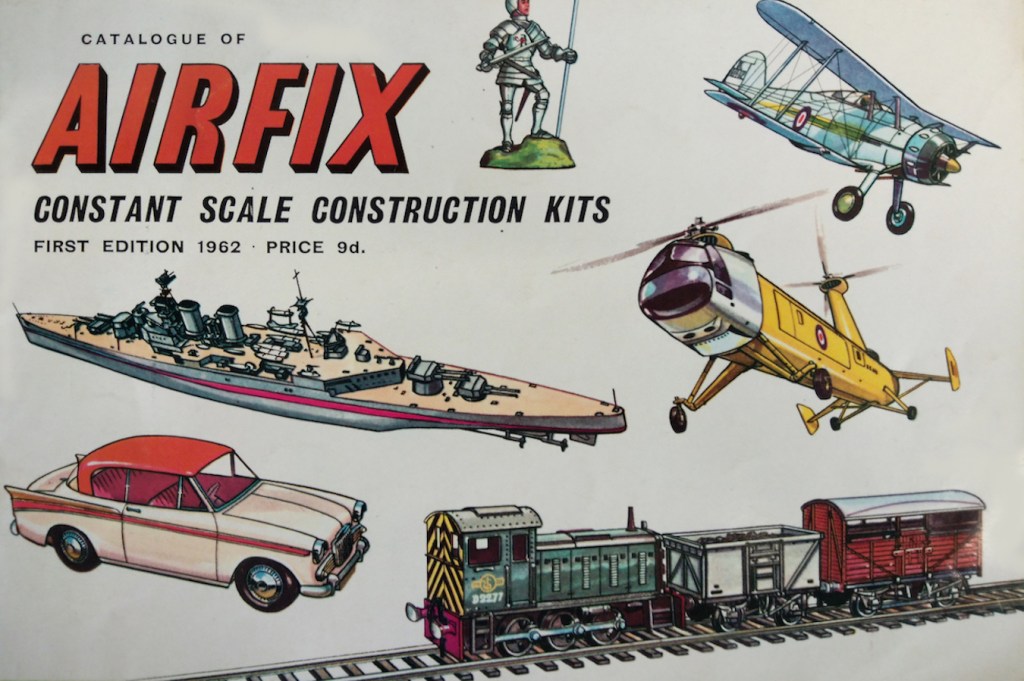
In 2018, I donated three Airfix catalogues to Te Manawa. One is a first edition catalogue produced in 1962. The others are for 1966 (5th edition) and 1967 (6th edition) respectively. These pre-date my own kitset-building experience, but I distinctly remember my brother’s 1967 edition copy primarily because its dramatic cover illustration of three Lightning jet aircraft in flight against a red background remains etched in my memory. The catalogues were given to me by long-time Palmerston North resident and model engineer Bruce Geange and with his permission I passed them to Te Manawa for permanent safe keeping.
Other museums acknowledge the significance of Airfix to popular culture. The Powerhouse Museum in Sydney holds a collection donated by a former Airfix Modellers Club member, which includes a membership badge and letter from 1970s Club President, former British comedian Dick Emery.2 The largest collection I have located is at the Victoria and Albert Museum, London, and includes kitsets, kitset parts, drawings, illustrations and plans together with a sizable collection of games and toys (Airfix held a licence to produce many of these, marketed through a separate catalogue). Part of the V&A collection includes oil paintings used to illustrate the packaging of kitsets.3
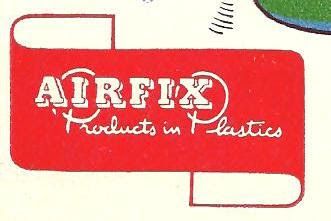
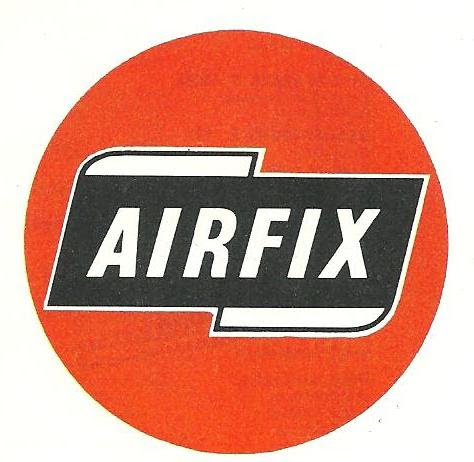
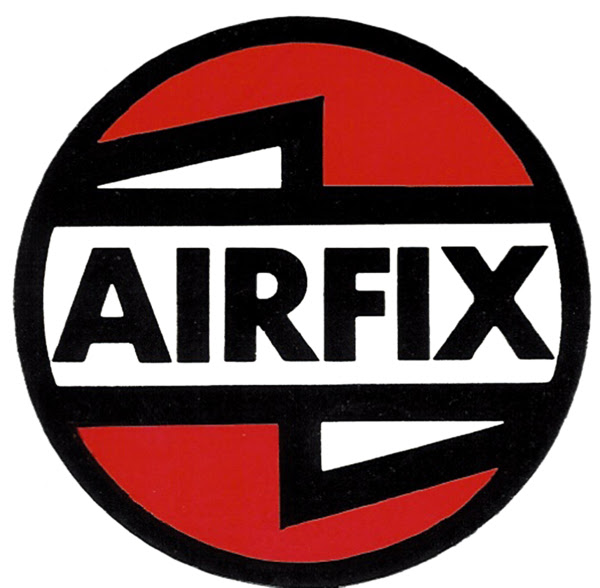
Airfix’s logo makes it one of the most recognised in the field of kitset modelling. The 1962 catalogue carries a simplified variant of what came to be the Type 2 logo, with italicised red lettering in a shadow font and no border. By the late 1960s, the catalogues carry the Type 3 logo, with white lettering on a black bordered background and flared ‘wings’ on the upper and lower edges. Whereas other manufacturers had moulded kitsets to fit inside pre-made packaging, Airfix applied the principal of ‘constant scale’ to its models, allowing hobbyists to display their finished kits together in realistic groups.

Catalogues such as these are important reference documents for anyone wanting to research changes in kitset modelling, since they portray which kitsets were entering the range (or being dropped) in any given year. The catalogues also display a remarkable transition in illustrative style. While the 1962 edition cover features simple coloured line drawings that have a toy-like quality to them, the later editions display action-packed, life-like illustrations.
It is unclear why Airfix took steps to introduce more confronting imagery when it did. One explanation is that it simply marked a more aggressive marketing strategy that connected hobbyists to the excitement of the jet age. Increased competition from other manufacturers is another. Its historical models were also subjected to the same artistic treatment as its contemporary kits. Teenagers were trying to understand the comparatively recent wartime experiences of their parents and grandparents. Although they were becoming increasingly distanced from ‘the war’ (meaning World War Two), talk of it still pervaded the family home. Changes in the styles of the catalogues suggest how the young were developing a more sophisticated, nuanced understanding of the wider world. A degree of authenticity came to be expected of products that modellers were buying with their ‘pocket money’ or wages which young people were earning in higher numbers than before. Since 1960, when the Airfix Modeller’s Magazine had gone into production, the company had been receptive to customers’ requests for particular kitsets. As Cold War era geopolitics and the space race aroused curiosity amongst modellers, Airfix responded with a choice of kitsets, which by the early 1970s included spacecraft and even a selection of kitsets portraying Soviet-era subjects.
The ‘boy’s own’ style of the catalogues under discussion mark a particular moment in time for Airfix. As the company entered the 1970s, its catalogues began advertising models designed to appeal to female modellers, such as a showjumper (who bore an uncanny resemblance to Princess Anne, an avid horse rider), dinosaurs and wildlife.4 Catalogue design underwent another transformation, appearing in portrait format and with full-colour cover photographs that portrayed modelmaking as a shared, even wholesome, family pastime. Reasons for the significant changes in advertising style have much to do with public perceptions of Airfix products and are discussed in the next part.
First published by Te Manawa on 15 August 2023; updated and republished with the author’s permission.
Acknowledgements
I would like to thank Jeremy Brook of the Airfix Collectors’ Club (UK) for providing the logo files.
Footnotes
- Pask, Airfix Kits, p. 13. ↩︎
- ‘Airfix Modellers Club Members Letter’, Powerhouse Collection. ↩︎
- See search results for ‘Airfix Oil Painting’, V&A Collections Online. ↩︎
- Pask, Airfix Kits, p. 37. ↩︎
Bibliography
‘Airfix Modellers Club Members Letter’, Powerhouse Museum of Applied Arts and Sciences, 2011/75/1-5, URL: https://collection.powerhouse.com.au/object/496286, accessed 14 April 2023.
‘Airfix Oil Painting’, V&A Collections Online, URL: https://collections.vam.ac.uk/search/?q=airfix%20oil%20painting&images_exist=true&page=1&page_size=15, accessed 14 April 2023.
Pask, Trevor, Airfix Kits, Shire Publications Ltd, UK, 2010.
 Te Manawa Museum Society
Leave a comment