Margaret Tennant
Children’s radio
In the 1920s, radio was a wonderful new technology. 2ZF, the first radio station in Manawatū, started broadcasting in 1925. Within two years it had a children’s session hosted by ‘Uncle Jim’ (Leet) and ‘Uncle Ken’ (Collins). Birthday calls were especially popular, and by December 1927 the station had a club of around 100 youngsters.1 Children were recognised as an important audience for radio right from the start.
Following a restructure of broadcasting by the First Labour Government, state commercial radio station 2ZA, ‘The Voice of the Manawatu’, began broadcasting in October 1938. By the 1970s it was the most profitable radio station in the North Island, with four full-time staff in the newsroom alone.2
Children continued to be part of the radio community, but nationally there was a shift from ‘aunties’ and ‘uncles’ to non-human personalities such as 2ZB’s Buzz O’Bumble and his associated friends; Yudi the Yeti on New Plymouth’s radio station; Henny Penny in Oamaru; and Robbie the Robot in Dunedin.3
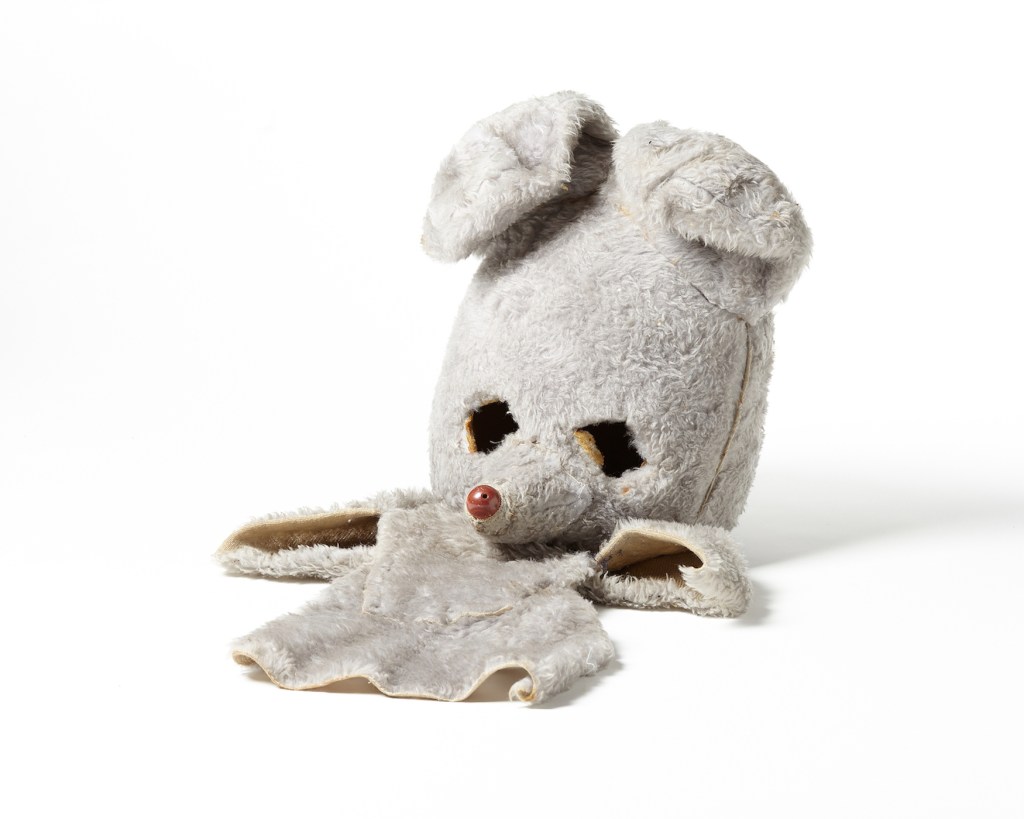
Station 2ZA had Morrie the Mouse. Radio announcer Jim Sullivan first inserted Morrie into the 7.50 am children’s slot in 1969. Jim made suitable squeaks with ‘convoluted mouth movements’, which were replaced by a series of squeaks on a sound loop in later years. He notes that in the days when announcers like himself were banned from expressing opinions on air, he ‘was able to criticise local big-wigs by having Morrie voice his disapproval of their treatment of the ratepayers’.4
A Morrie the Mouse fan club soon eventuated. As time went on children had their bit of local fame when their name was announced, and they could go into a draw for a birthday cake from Bridewell’s Bakery. ‘You were the coolest kid alive if your name was read out’ wrote one contributor to the Old Palmerston North Facebook page.5
Prior to Jim’s departure from 2ZA in 1971, a local pet shop donated a real mouse in a cage to represent the radio rodent. Jim was not at all keen on this development: ‘Radio’s great attraction was that it called on the imagination and an imagined Morrie was always more special to me than a real mouse’.
He was to express disappointment in the later direction taken by the Morrie character, involving a costumed human being. Instead of Morrie being a ‘mouse of the mind’ he was, in Jim’s view, ‘Disneyfied’ and commercialised.
The Costumed Mouse: Morrie Leaves the Studio
2ZA staff lists from the 1970s suggest there were nearly 40 administrative, programming, technical and ‘on-air’ staff at the time.6 2ZA personnel, many of them youthful, were highly visible out and about in the community. New technology made this possible, but radio 2ZA was also a state commercial station, partly reliant on advertising at a time when private radio was starting to compete. When 2ZA staff appeared at openings of fast food outlets, slept overnight in shop windows, parachuted out of planes and appeared at events like the stock cars in 2ZA tee-shirts, they were not just having fun, but attempting to retain market share and appeal to advertisers. Morrie and Monty became part of this outreach.
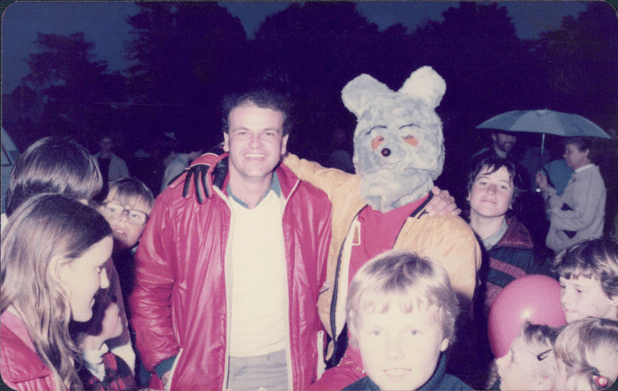
Paul Fairless, who was appointed as a 2ZA programme trainee in 1975, remembers being the first staff member to appear publicly in costume as Morrie the Mouse. Morrie was used for promotional events, drawing vast crowds of children. When Paul and a minder first went to a local intermediate school to test out the costume, he had what he calls his ‘Michael Jackson moment’. Come school break-time he was mobbed by excited pupils who rocked the car, causing him to be locked inside for his own safety!7
The first Morrie costume was a tawny orange colour. Not particularly well made, it soon became tatty from the constant pawing by enthusiastic children. It was upgraded in 1978, when the classier (but no more comfortable) version designed by the New Zealand Ballet came into use. Made of chicken wire and plastic-infused fabric, the costume looked more like a large rat than the cute little mouse that many children had imagined. It could be frightening. Paul Fairless remembers being beaten with an umbrella by an elderly woman for scaring children at an event in the Square.
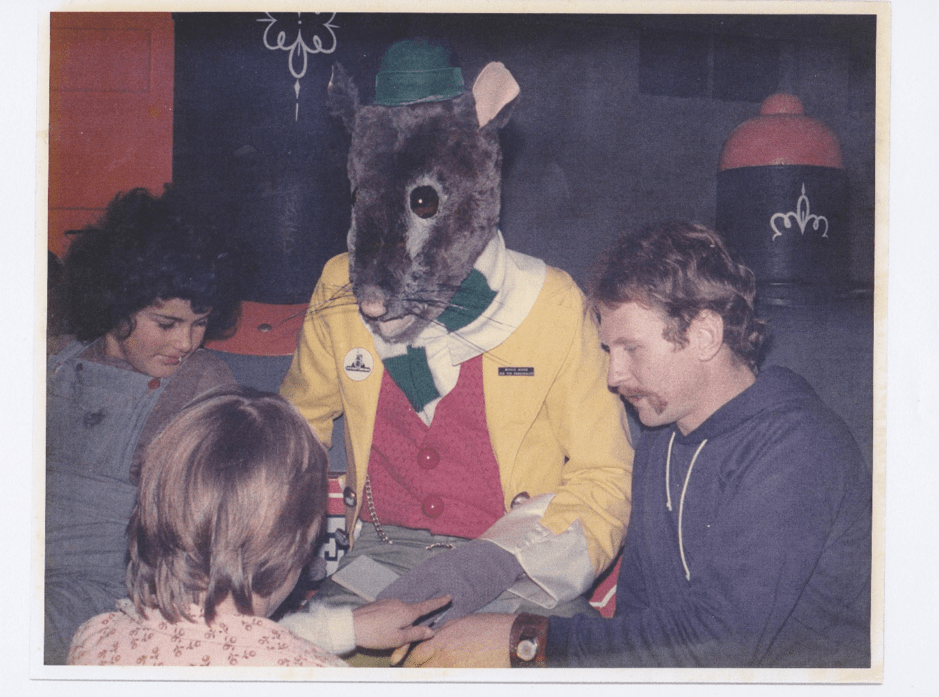
The Morrie costume was also hot and stuffy. One of the ‘Morries’, Athol Williamson, reckons it was possible to wear the head for only 30 to 45 minutes before it steamed up and the person inside was drenched with sweat.8
He tells how, when not in use, the head was stored in a 2ZA toilet, startling those who unwittingly lifted the lid off the box. There was a story about it falling from a helicopter and smashing during one of Morrie’s jaunts, hopefully not traumatising any fans.
In his day Morrie the Mouse was, as many have noted, ‘HUGE’. He was taken to visit schools and rest homes and hospitals, and appeared at business promotions, gala days and fairs, Christmas parades and the stock cars. But the most famous outing was to his own ‘wedding’ on Easter Saturday 1980. This event drew an estimated 5,000–10,000 into the Square – Manawatū Standard photographs show children perched upon the roof of the ‘Ladies’ Rest’ for a better view, health and safety not exactly being to the fore.9
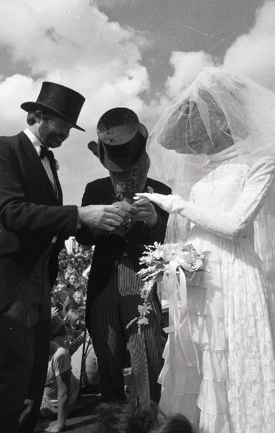
Along with the cake and cordial and organ music there was a narrative about Morrie’s ‘whirlwind romance’ with field mouse Molly, following their meeting at a Taihape picnic. Molly took advantage of the old leap year tradition to propose to her high profile sweetheart. An Easter wedding was hurriedly arranged (no living in sin for this pair!).
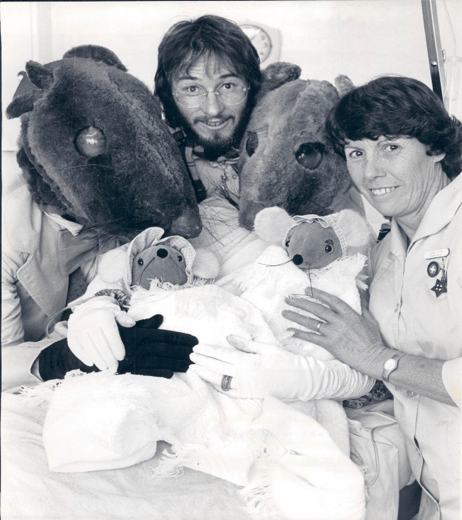
Molly was veiled and dressed in white, Morrie was dapper in his cravat and top hat, daisies in his buttonhole. The ceremony was performed by JP Guido de Bres, before local DJ Kev Loughlin chauffeured the happy couple off to a caravan holiday. It was, in its way, all very conventional, with baby mice, twins Monty and Muffy, following in due course. But parenthood had its perils. Did it potentially make Morrie less relatable to his juvenile fan base?
Monty Mouse
Morrie was eventually usurped by his ‘son’, Monty.
When Chris Burn joined Radio 2ZA at its George Street base in 1984 he inherited Morrie the Mouse; ‘I took a while to adjust – talking to a mouse’, he recalls. By this time Morrie’s narrative may have run its course, and he and Molly were eventually sent to Olive Tree retirement village. Chris wanted to ‘beef things up’ and developed Monty into a livelier and more youthful mouse persona.
Monty rode around on a BMX bike and wore a red track suit, making his costume more flexible and replaceable than Morrie’s had been. Like some of his fan club, he had a paper round. Chris also altered his sound, using a cork in a gin bottle to create different inflexions on the mouse’s squeak. Graham Johnston, who was later associated with the Manawatū Youth Theatre, was one of those to wear the Monty costume.
Monty, like Morrie, was a regular at community events. But eventually he too had his day. As Chris Burn notes, radio animals had become old hat by the 1990s. Morrie and Molly had already been sent off to a retirement village, and Muffy to Ngā Tawa, and one day Monty simply wasn’t there either. Chris accommodated Monty’s absence with a story about the mouse’s departure to do his OE.10
Rival radio station 2XS had started broadcasting in Manawatū in May 1981, soon making inroads into listening audiences. By the 1990s it wasn’t just the radio mice who had faded, but 2ZA itself was eventually rebranded as a FM ‘classic hits’ station in 1993, with diminishing amounts of local content on it, alongside an AM news and talkback frequency. The high point of community radio was over.
Morrie and Monty Mouse remain in the memories of many Palmerstonians of a certain age. Photographs inevitably show them surrounded by clusters of excited children, a pre-internet media phenomenon and very much part of the history of Manawatū childhood.
This article is not to be used without attribution.
Footnotes
- Fleming, ‘Radio Broadcasting in Palmerston North, 1924–1937’, p. 15. ↩︎
- Evans, interview, part 1, 2020. ↩︎
- Radio programming in Listener, 19 November 1983, pp. 106–11, lists these ‘personalities’, though many other stations had birthday calls at 7.50am. ↩︎
- Email from Jim Sullivan to Margaret Tennant, 5 August 2024 and 24 August 2024. ↩︎
- ‘Old Palmerston North’ Facebook page, 11 October 2023 and following comments. ↩︎
- ‘2ZA staff lists, with names and positions’, Series 2, Folder 1, 1974–1983, Palmerston North Community Archive. ↩︎
- Paul Fairless, conversation with Margaret Tennant, 10 July 2023 and 4 September 2023; Email from Paul Fairless to Margaret Tennant, 4 August 2023. ↩︎
- Athol Williamson, interviewed by Margaret Tennant, 13 November 2023. ↩︎
- Description of the wedding from Manawatu Standard, 5 April 1980, p. 1. ↩︎
- Chris Burn, interviewed by Margaret Tennant, 31 August 2020. See also exchanges on ‘Old Palmerston North’ Facebook page, 2 May 2020 and following comments. ↩︎
Bibliography
2ZA, Series 2, Folder 1, 1974–1983, Palmerston North Community Archive.
Evans, Arnie, ‘Life as a regional radio and TV reporter’, interview, part 1, Palmerston North City Library, 2020, URL: https://manawatuheritage.pncc.govt.nz/item/68a686ab-c0cb-46f4-be1f-f8c3c65cd788
Fleming, Philip, ‘Radio Broadcasting in Palmerston North, 1924–1937’, BA (Hons) Research Exercise, Massey University, 1980.
 Te Manawa Museum Society
Leave a comment