Russell Poole
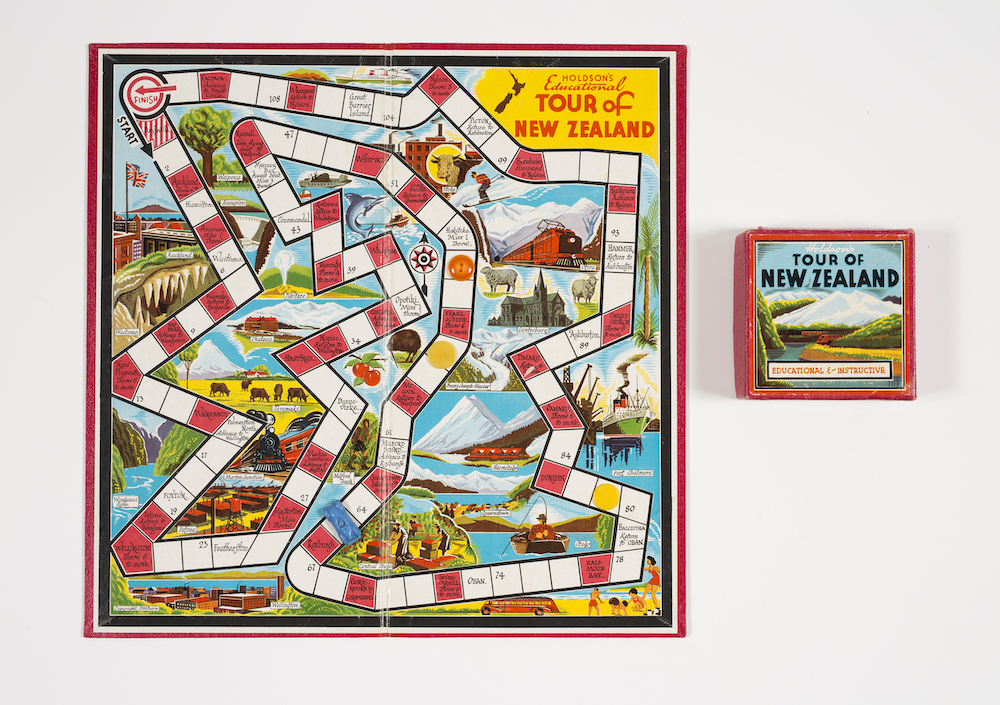
The ‘Tour of New Zealand’ board game was created in the 1950s, when I was a child myself.
To begin this story I decided to get into the right mindset by transporting myself back to the 1950s. What better way than by visiting the popular ‘Timespanner’ page on Facebook? This is run by Lisa Truttman, an Auckland-based local historian, who hosts a blog of the same name.
Timespanner posts old photos, mostly of Auckland. They are not necessarily glamorous. When I visited her site, the most recent post concerned a rubbish tip on Upland Road in Remuera. It had originally been a small volcano (Rangitoto-iti) and then a scoria quarry before being backfilled with rubbish some 70 years ago.
The post had already attracted a lot of attention. In one comment an Aucklander described a family visit to the tip. Having dropped off their rubbish they stayed on to explore the tip’s resources.
Back then a tip was not simply a place to take unwanted stuff but also a source of new treasures to bring home.
Amongst the rubbish this Aucklander and her sister found a boxed game, complete with all its pieces. Naturally they took it home: ‘It was a board game where you travelled around New Zealand, and it gave us many happy hours of family fun.’
This game, entitled ‘Tour of New Zealand’, was the very one I have been invited to describe in my blog post. How about that for serendipity!
Te Manawa’s copy was donated in good condition by Tina McKenzie in 1993. At the time, her mother, Mina McKenzie (Ngāti Hauiti, Ngāti Raukawa ki te Tonga, Te Ati Haunui-a-Pāpārangi, Rangitāne o Manawatū), was the director of the museum.1 The game was part of a collection developed by Tina and was not played by her family.
The National Library has a copy presented by long-serving Alexander Turnbull librarian Janet Valerie Horncy.2 The copy at Puke Ariki in New Plymouth was donated by someone who had been given it as a child in the late 1960s or early 1970s; it was a gift from Santa Claus at a Caledonian Society picnic in Auckland.3
Altogether, thousands of copies of the game were produced between the early 1950s and the early 1980s, when production ceased. There must be numerous examples stowed away in houses throughout the country.
So let’s take a look at the game.
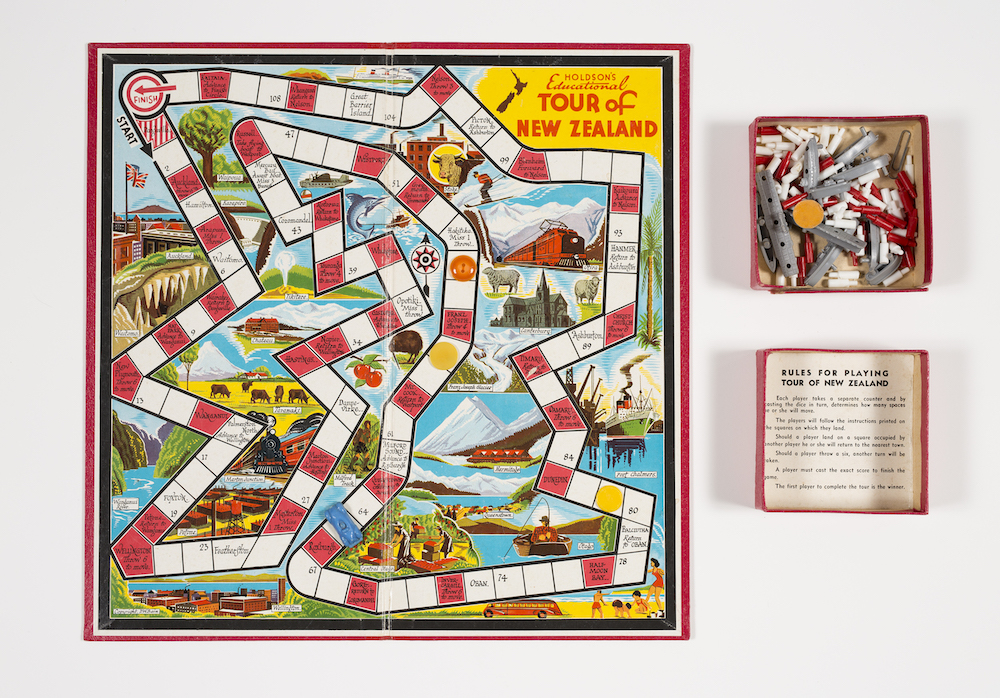
The outside of the board shows trains or buses travelling in mountain scenery, as befits a tour of New Zealand.
Opening the board reveals a game similar to ‘Snakes and Ladders’ but based on the roads and population centres of New Zealand. The players proceed along a path of 111 red and white squares.
Filling up the rest of the space are small scenes from different localities in Aotearoa.
Some of these scenes represent attractions and recreational opportunities that you might seek out while on an actual tour. Your circuit of the board would take you past the Waipoua Kauri Forest, Rangitōtō in the Hauraki Gulf, the Waitomo Caves, a geyser at Tikitere near Rotorua, the Chateau Tongariro against the background of Ruapehu, the Whanganui River, the Hermitage Hotel at Mt Cook Village, Franz Josef Glacier and Christchurch’s Anglican Cathedral.
You would see big game fishing at Mercury Bay and fly fishing on Lake Wānaka or Hawea. Queenstown, the home of boating and skiing, is shown at the edge of Lake Wakatipu. A tramper plods his way through tangled vegetation on the Milford Track.
Other places of touristic interest you would pass are the hydroelectric dam at Karapiro. Completed in 1947, it was fairly new when the game was created. Older, but still impressive, is the railway tunnel at Otira. When it opened in 1923 it was the seventh longest tunnel in the world and the longest in the British Empire.
The buildings shown in central Auckland and Wellington would be impressive if you came from a small regional centre or from a farm.
On your tour around the board you would find farming represented by dairying in Taranaki, orcharding in Central Otago and sheep in Canterbury.
Some industrial installations and public works are also on the itinerary. Freezing works are generously represented, with the inclusion of Gear Meat Works at Petone and Nelson Freezing Company’s works at Stoke. At Port Chalmers a ship is docked alongside an impressive crane. At Marton railway junction two trains pass each other at a faster clip than normally managed by KiwiRail.
Distinctively Māori themes in the game are few and far between. Waitangi doesn’t get a look in. Perhaps Tikitere, given the use of that name rather than the English ‘Hell’s Gate’, is an exception.
Contemplating the board reminded me of the tours my family did in the 1950s. We visited Queenstown on numerous occasions. We saw the Hermitage Hotel before it burnt down in 1957.
We didn’t make it to the Waikato to see the Karapiro Dam, but we were present at the opening of the Roxburgh Dam in 1956.
My memories of these tours include some typically kiwi features of that era that don’t find a place in this game. A favourite was the combined road-rail bridge over the Waitaki River. We also liked the Lyttelton ferry, which took us to Wellington for a memorable holiday.
The box that accompanies the board is mainly red with a scene of a train winding through the countryside on the lid. Inside the box are tokens (or ‘counters’) used to mark players’ positions. Some additional counters have evidently crept in from another popular board game known as Battleships that we used to play at school.
The dice is missing, probably appropriated for some other game.
Printed on a leaflet are the rules, which are essentially the same as ‘Snakes and Ladders’, a hugely popular game of Indian origin.
While there are no snakes to descend in the ‘Tour’, the instruction to return to Coromandel if you landed on Greymouth or Gore or to Nelson if you landed on Whangārei could wreck your chances of winning the game.
There are no ladders either but the instruction to let a flying boat whisk you from Russell to Westport could put you out in front of your competitors.
You could spend a long time in Wellington, Invercargill or Oamaru while waiting to throw a six. Palmerston North, by contrast, was a good place to land because you could advance directly to Wellington.
Strategising would get you nowhere in this game, which is one of pure luck.
Auckland manufacturer of games and jigsaws, Thomas Holdsworth & Sons Ltd, produced the game starting in the early 1950s and continuing up to the 1980s.
The copyright belongs to D W Bain (Christchurch artist Dudley Watson Bain (1909–1986)), who did the artwork, as you can see in the bottom left-hand corner.
I couldn’t find out much about Bain, but artwork by him also appears in a jigsaw manufactured by Holdsworth entitled ‘Industries and Products of New Zealand’. Although I haven’t seen a copy it sounds more intensively educational than the ‘Tour of New Zealand’.
More imaginatively, and less educationally, Bain collaborated with his wife Phyllis Bain (née Bostock) in a children’s book ‘Fairy Folk at Work’. Phyllis wrote the story, which tells how one night each year the gnomes, elves, water spirits and fairies gather to plan the summer. Each of the twelve pages of text faces a full-page colour illustration by Dudley Bain. Additionally, each page has a pictorial border of gnomes and sprites.
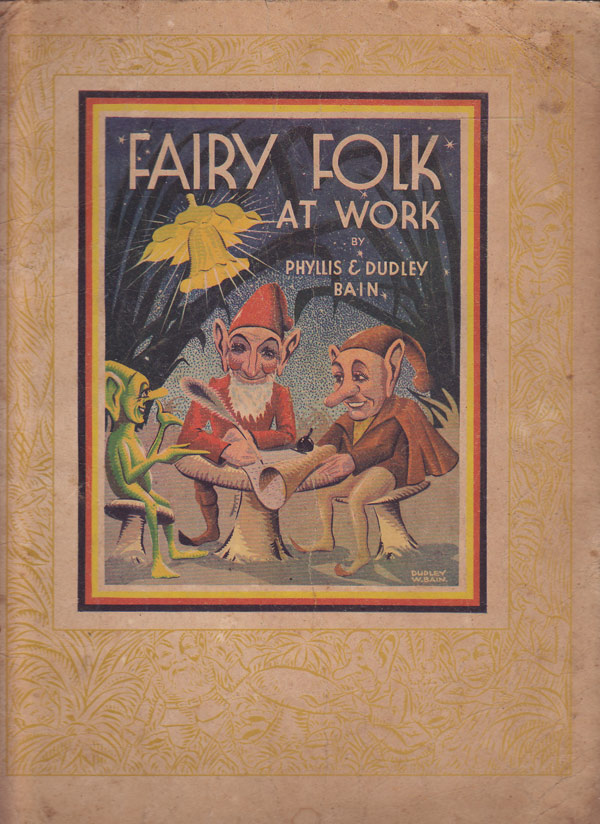
The book was published in 1951 by Holdsworth. Well-worn copies, obviously cherished by generations of children, are regularly offered for sale by online booksellers.
Although Thomas Holdsworth & Sons would not have made money out of the copy of ‘Tour of New Zealand’ retrieved from the Upland Road tip, I’m sure they and Dudley Bain would have been gratified to learn how many hours of ‘family fun’ it generated.
As I completed my research I was gratified to learn that the Upland Road tip no longer exists. Grassed down and planted with trees, it leads a new life as Little Rangitoto Reserve. With its open spaces and fine array of playground equipment it must bring hours of enjoyment to the children who visit.
Footnotes
- Margaret Tennant, ‘Mina McKenzie and the Manawatu Museum’, Manawatū Journal of History, no. 18, 2022, p. 30. ↩︎
- URL: https://tiaki.natlib.govt.nz/#details=ecatalogue.160306 ↩︎
- Game, board, 1960s, Puke Ariki, PA2004.113, URL: https://collection.pukeariki.com/objects/38075/game-board, accessed 29 October 2024. ↩︎
Bibliography
Tennant, Margaret, ‘McKenzie, Mina Louise’, Dictionary of New Zealand Biography, first published in 2024, Te Ara – the Encyclopedia of New Zealand, URL: https://teara.govt.nz/en/biographies/6m17/mckenzie-mina-louise, accessed 29 October 2024.
 Te Manawa Museum Society
Leave a comment