Fiona McKergow
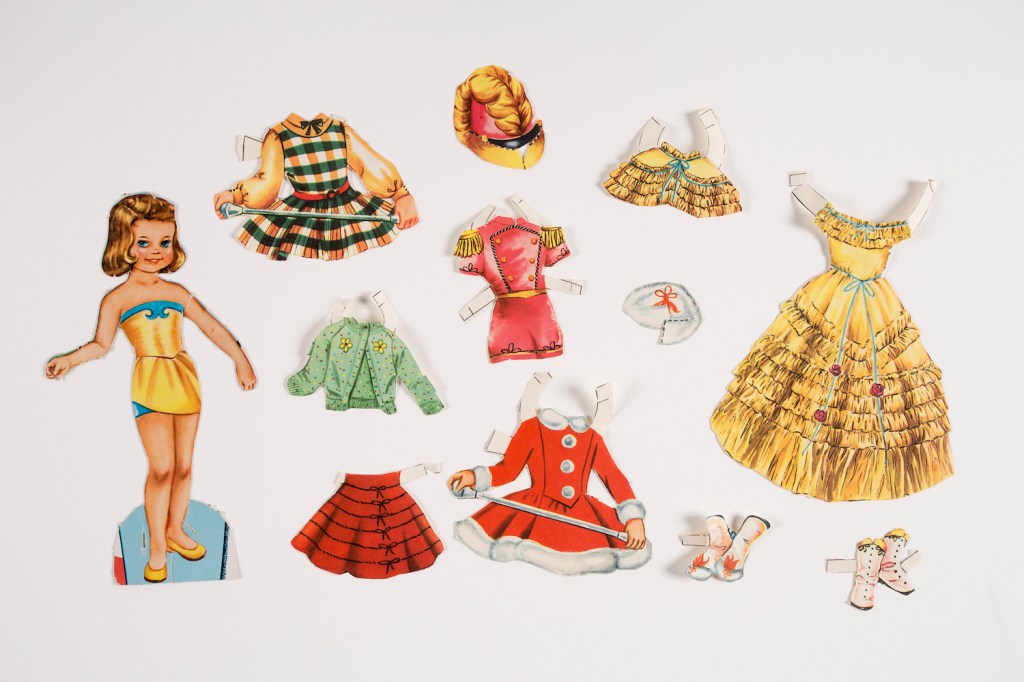
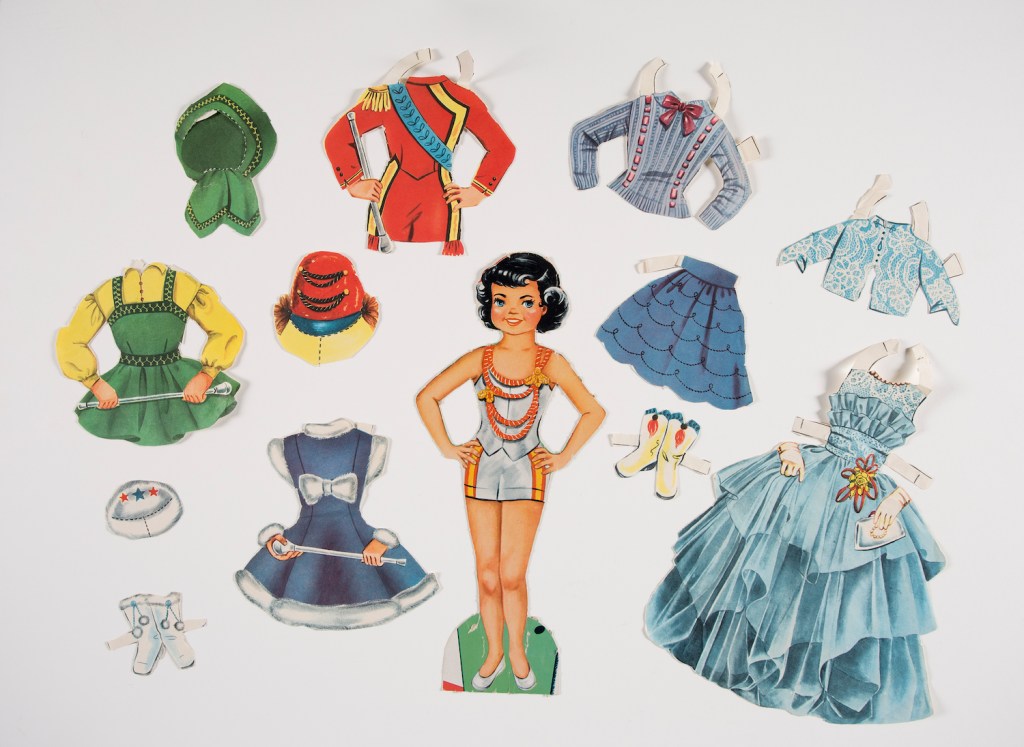
At first glance, these paper dolls depict jaunty, American-style fashion for active, self-confident girls in all situations and seasons. But then by chance, and by looking more closely, I figured out they were majorettes from ‘Majorette Paper Dolls’, a cutout book issued by Saalfield Publishing Company, Akron, Ohio, in 1957.1 There were originally three dolls and more outfits. ‘Laurie’ (above) has brown hair and ‘Pat’ (below) has black hair. ‘Cindy’, who is missing from the set, was blonde.
These majorette paper doll sets were played with by two families. Mary O’Neill, a resident of Palmerston North, gave ten sets of paper dolls that had belonged to her daughters in the 1950s and 1960s to Jeanette Ansell, a neighbour with younger children.2 These sets are from a range of paper doll cutout books that also depict babies and teenagers with age-related outfits that were pre-printed or drafted and cut from sheets of patterned paper. Jeanette Ansell later realised they were of historical interest and donated them to Te Manawa Museum in 2003. As the museum’s only collection of paper dolls, it was an insightful gift. Such childhood items are ephemeral and easily damaged, outgrown and discarded.
The majorette outfits have military elements. One of the red jumpsuits is double-breasted with padded shoulders and tasselled epaulettes, while the other has a diagonal blue sash and gold braid. They were paired with brightly-coloured peaked helmets, one with a large plume, not unlike an ostrich feather, the other with brass buttons and black cords. Alongside the majorette outfits, there are opulent ball gowns that are frothy and feminine, decorated with lace, frills, ribbons and flowers. There are also items of everyday wear such as tops, cardigans and skirts in solid colours and white shoes.
The majorette paper dolls are depictions of agile and energetic girls, as adept at marching with twirling batons as twirling with partners on the dance floor. Both activities involve ‘moving in unison’ and ‘keeping together in time’.3 While marching by majorettes has elements of close-order military drill, their baton twirling combines elements of dance and gymnastics. A metal rod is twirled through a coordinated routine and a high level of coordination and control of the body is needed. Ballroom dancing is also not unlike close-order military drill in that it requires the controlled coordination of one body in relation to another to music.
Marching was a popular competitive summer sport for girls and young women in New Zealand from the 1940s to the 1970s. Teams of ten (three ranks of three with a leader) wore identical uniforms. Competitive formation marching was unique to New Zealand. ‘Marching girls’ (usually aged from eight to 28) and majorettes were involved in uniformed display activities performed to pipe and band music. Some local marching teams even described themselves as majorettes, but marching was a sporting activity in its own right and not a warm-up act to another event. It also had little resemblance to dance and gymnastics.4
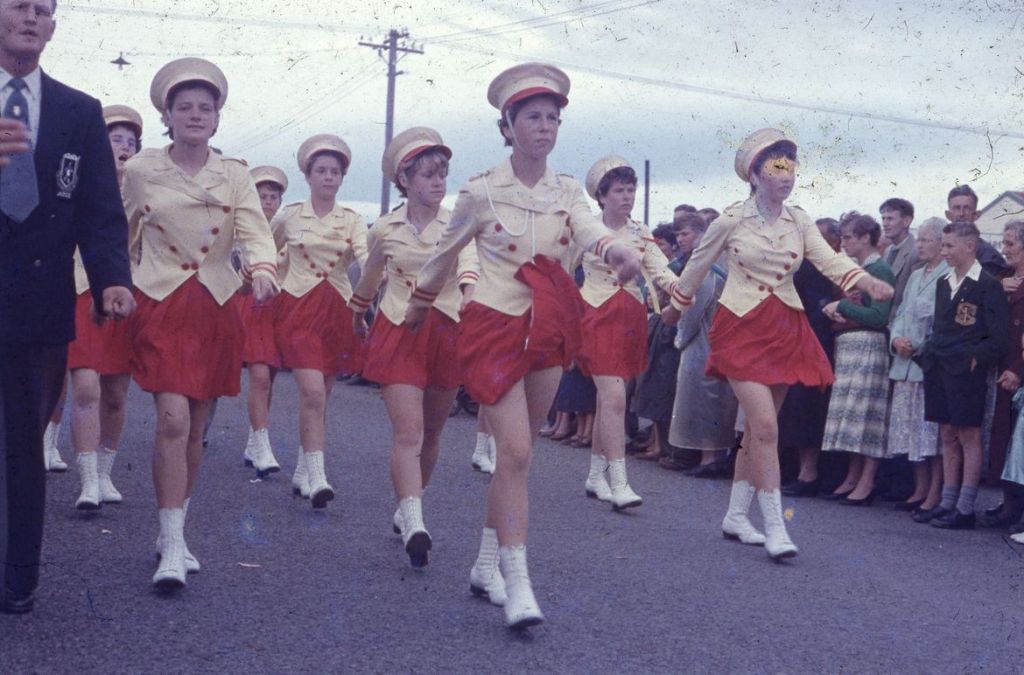
Throughout the mid-twentieth century, huge emphasis was placed on raising and educating children to be physically active, whether at home, in school grounds, or via the provision of community parks, pools and sports facilities.5 The majorette paper dolls are an artful blend of active and passive forms of recreation and play. Ironically, while these paper dolls represent vigorous, outdoor activity, paper dolls are strongly associated with quiet, indoor recreation and play, and in some cases periods of convalescence.
Women’s columns in local newspapers offered advice on how to entertain a convalescing child. As a column in the Manawatu Times suggested, activities for the bedridden could include cutting out pictures to glue into a scrapbook, writing stories and making paper dolls:
A family of paper dolls cut out form a fashion magazine are light and easily handled. Children like to colour their dresses and christen them by writing their names on the backs.6
It was not only girls who played with paper dolls. Boys, too, were encouraged in this form of constructive and imaginative play. ‘Uncle Pete’s Corner’, a column for boys in the Manawatu Times, instructed its readers how to make ‘a chain of little men holding one another’s hands’ perform a dance:
Get permission to put a saucepan of water over the gas, and put the cardboard on top like a lid as soon as the water boils. Now if you place the little paper dolls on the cardboard, they will perform a realistic war-dance.7
Children’s pages had been a feature of magazines and newspapers from the late nineteenth century. Content such as tales and rhymes was provided by adults for children, but by the late 1920s more emphasis was placed on content created by children themselves. Most often this consisted of letters, an opportunity many local children appear to have enjoyed. Daily activities, pets and toys were the main subjects. Through these letters, there are fleeting glimpses of paper dolls as accessible, enjoyable and instructive features of children’s lives. In 1941, ‘Little Bo Peep’ of Feilding wrote a ‘newsy letter’ to ‘Hub’, who ran a children’s column for the Manawatu Times, saying:
On Friday I bought a paper doll cut-out book. It contains dresses of all nations, and they look lovely when dressed.
While countless paper dolls were designed to convey fashion information to children, others introduced children to a diversity of world cultures through dress. Dressing dolls was a leisurely contrast to doing chores. There was a good reason for this child’s pen name:
Tonight, after I had milked my cow, Judith, I helped Dad to draft the lambs ready for tomorrow’s shearing.8
Homemade paper dolls were a unique alternative to commercially manufactured paper doll cut-out books such as these. They might be contrived from cardboard, decorated with crepe paper, fabric, buttons and lace, or coloured in with crayons, pencils or paints. Through paper doll making children were learning a range of cutting and designing techniques.9 But the complexities of social life were also narrated by children through outfit changes and storytelling.10
Modern commercial paper dolls aimed at a children’s market had their real precursor in ‘toy books’. ‘Little Fanny’ was the first paper doll character that was developed specially for children. The History of Little Fanny, Exemplified in a Series of Figures, was published by S. & J. Fuller, London, in 1810. It consisted of a slipcase with a storybook, seven cutout figures, a head that could be moved from one outfit to the next, two hats, a basket of fish and a barrel of milk. These items were used to act out a tale that was meant to warn girls of the dangers of immorality and the benefits of virtue.11
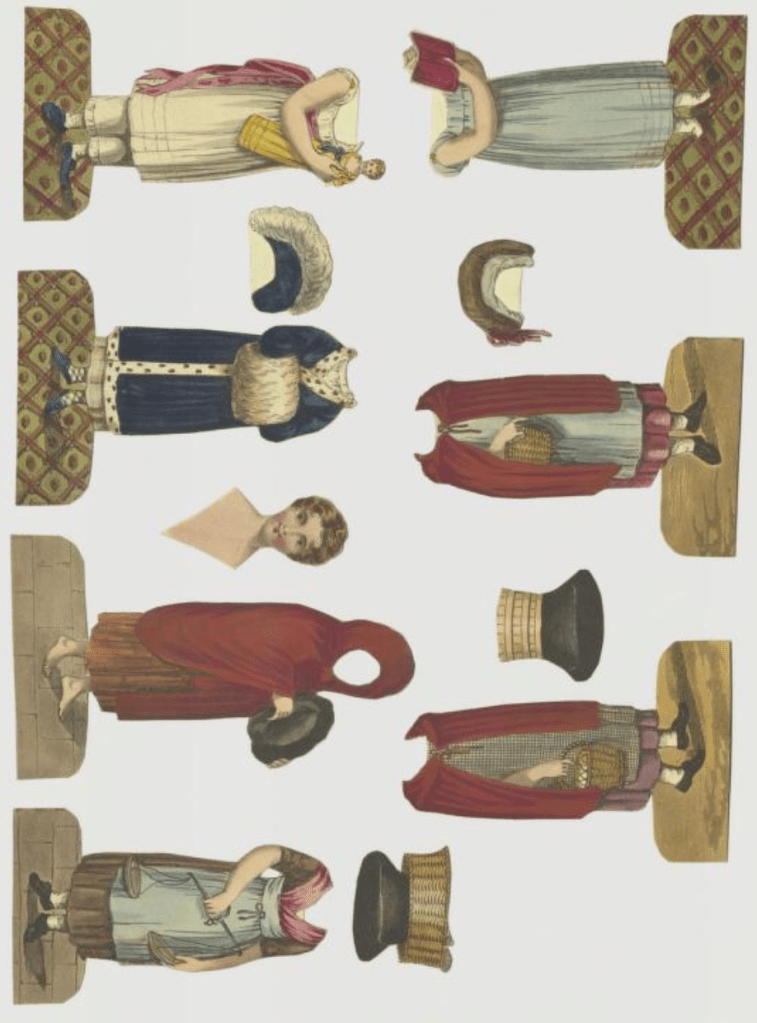
An example held at Canterbury Museum is almost complete, with six dolls and the barrel of milk remaining; it’s likely to be a more recent edition as most of the dolls have attached heads.
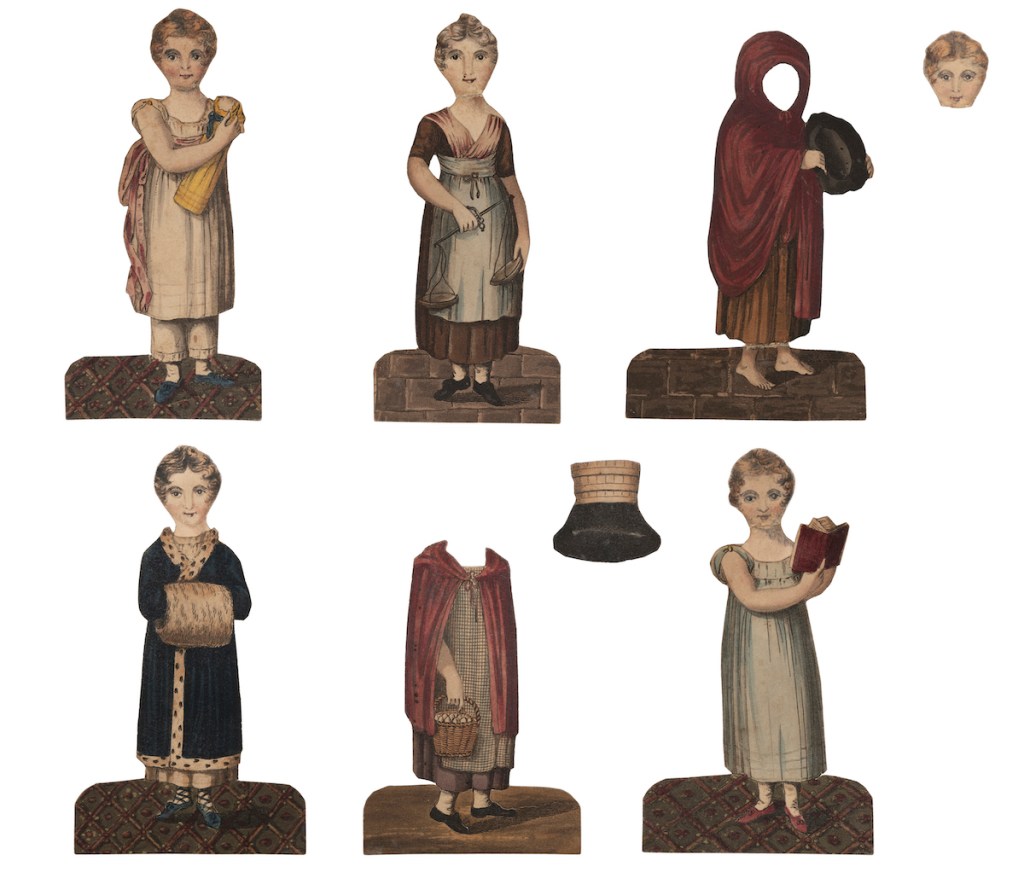
The child begins with Little Fanny ‘fancy dressed in a white frock, and pink sash, with a doll in her arms’. She then puts on ‘a great coat, muff, and bonnet’ and sets out from home. But as an idle and vain child she is subject to misfortune. For this chapter, she wears a ‘red cloak, with a hat in her hand, begging her bread’. She begins to repent, appearing as an errand girl with a basket of fish on her head and then as a ‘neater and cleaner’ employee carrying milk and eggs. Nearing redemption, she carries a basket of butter to her mother’s house (missing from the set above), but out of shame she cannot enter and sits on the steps and cries. By the end of the story, she is ‘restored to her former station, modestly dressed in a coloured frock with a book in her hand’. Little Fanny is ‘no longer idle, proud, or vain’, instead she is ‘pious, modest, diligent, and mild’.12
The publishers issued a companion volume, The History and Adventures of Little Henry, Exemplified in a Series of Figures. However, Little Henry’s misfortunes were not of his own making. They were the fault of a careless nursery maid who lost him, forcing him to become a beggar and work his way through humble occupations to become a heroic sailor who ‘leads the boats in battle’.13
There seems to be little connection between Little Fanny as a model of girlhood and the energetic postwar majorette. Little Fanny was not remotely sporty. She was not in possession of a ‘modern body’ shaped by strenuous exercise to maintain her health and fitness. But Little Fanny was the forerunner of a huge variety of paper doll books, including many featuring majorettes, even if she had little hope of gaining approval from publicly vaunting her dexterity and rhythm.
For a companion piece by Stephanie Gibson, see Paper Dolls Collection.
Acknowledgements
Many thanks to Stephanie Gibson, Te Papa, and Paulien Martens, Scott Reeves and Nicholas Boigelot, Canterbury Museum.
Footnotes
- ‘Majorette Paper Dolls’, #2760, Saalfield Publishing Company, 1957, URLs: https://www.ebay.com/itm/176965151139, https://www.ebay.com.au/itm/326491373466 and https://www.worthpoint.com/worthopedia/original-1957-majorette-paper-dolls-4547838142 (accessed 12 April 2025). ↩︎
- Paper doll sets, 1950s–1960s, donated by Mrs J.G. Ansell, Te Manawa Museums Trust, 2003/125/2, 4–10, URL: https://collection.temanawa.co.nz/objects?query=%22paper+doll%22 (accessed 12 April 2025). ↩︎
- McNeill, Keeping Together in Time, pp. vi, 1. ↩︎
- Macdonald, ‘Putting Bodies on the Line’, pp. 85–100. ↩︎
- Macdonald, Strong, Beautiful and Modern, pp. 10, 26. ↩︎
- Manawatu Times, 18 June 1934, p. 2. ↩︎
- Manawatu Times, 12 December 1936, p. 16. ↩︎
- Manawatu Times, 20 December 1941, p. 4. ↩︎
- Gibson, ‘Paper Dolls’; Gardner, ‘Paper Dolls’. ↩︎
- Adams and Keene, Papers Dolls, p. 84. ↩︎
- Ruffin, ‘The History of Little Fanny’. ↩︎
- The History of Little Fanny, pp. 1–15. ↩︎
- The History and Adventures of Little Henry, pp. 1–20. ↩︎
Bibliography
Adams, Katherine H., and Michael L. Keene, Papers Dolls: Fragile Figures, Enduring Symbols, McFarland & Co., Jefferson NC, 2017.
Gardner, Susan, ‘Paper Dolls’, Society for the History of Childhood and Youth, 3 April 2024, URL: https://shcydigitalchildhoods.org/dir/paper-dolls/ (accessed 15 June 2024).
Gibson, Stephanie, ‘Paper Dolls’, Te Papa Collections Online, August 2010, URL: https://collections.tepapa.govt.nz/topic/2303 (accessed 31 January 2024).
Macdonald, Charlotte, ‘Putting Bodies on the Line: Marching Spaces in Cold War Culture’, in Patricia Vertinsky and John Bales, eds, Sites of Sport: Space, Place, Experience, Frank Cass, London, 2004, pp. 85–100.
Macdonald, Charlotte, Strong, Beautiful and Modern: National Fitness in Britain, New Zealand, Australia and Canada, 1935–1960, Bridget Williams Books, Wellington, 2011.
McNeill, William, Keeping Together in Time: Dance and Drill in Human History, Harvard University Press, Cambridge MA, 1995.
Ruffin, Ellen, ‘The History of Little Fanny’, Special Collections, University of Southern Mississippi, URL: https://www.lib.usm.edu/spcol/exhibitions/item_of_the_month/iotm_sept_08/ (accessed 31 January 2024).
The History of Little Fanny, Exemplified in a Series of Figures, S. and J. Fuller, London, 1810, URL: https://archive.org/details/historyoflittlefanny1810/page/n17/mode/2up (accessed 31 January 2024).
The History and Adventures of Little Henry, Exemplified in a Series of Figures, S. and J. Fuller, London, 1810, URL: https://archive.org/details/history-and-adventures-of-little-henry-1810/page/18/mode/2up (accessed 31 January 2024).

 Te Manawa Museum Society
Leave a comment