Amos Ngo
A Game for All?
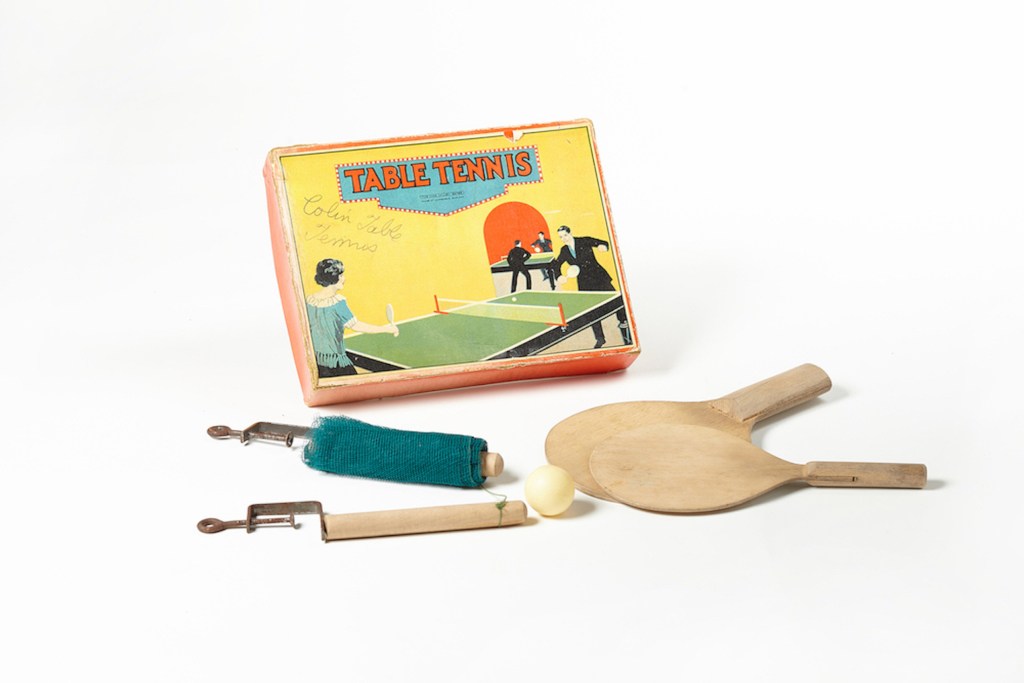
Table tennis, also known as ping pong, has a long history in New Zealand. It was one of many sports that thrived and established an enduring foothold in the country’s sporting world during the interwar period. While it is unclear from where table tennis was brought into New Zealand, it is plausible to suggest that, like many racket sports, it originated in England. Many items of table tennis equipment, like Colin Alve’s Chad Valley boxed set held at Te Manawa Museum, were made in England, before making their way to New Zealand as imported goods, that were ultimately intended for family use.
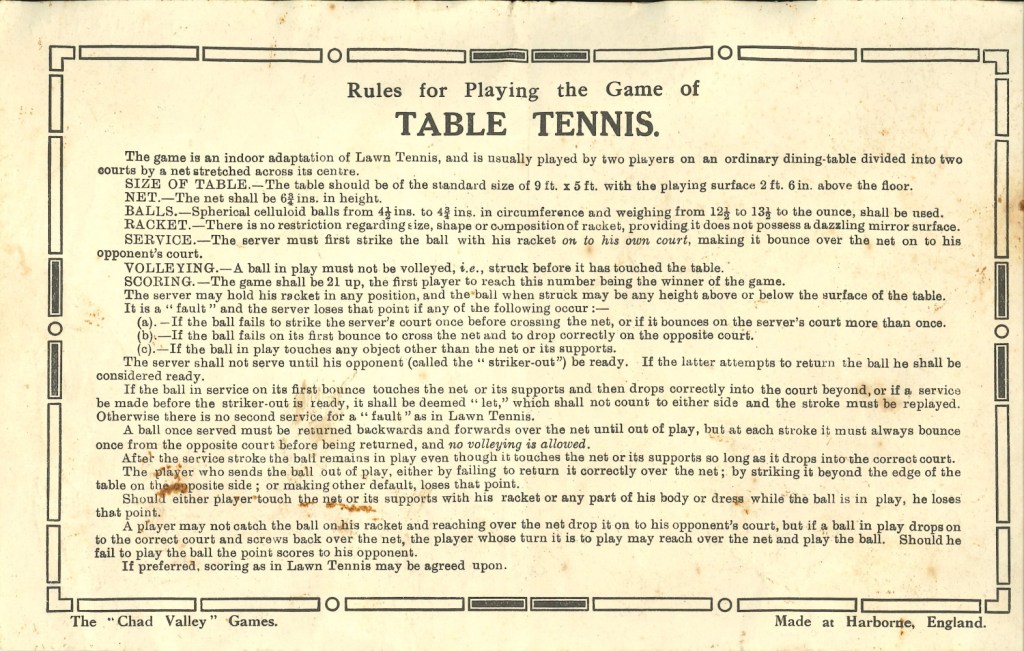
Since its introduction to New Zealand in the 1890s, table tennis has received an enthusiastic reception across the country. Its convenient and affordable set-up attracted many followers, both in competitive and recreational contexts. Additionally, its suitability for indoor play drew athletes from other sporting disciplines who wished to retain their physical fitness during wintertime when outdoor venues were compromised by unfavourable weather.
A Children’s Game?
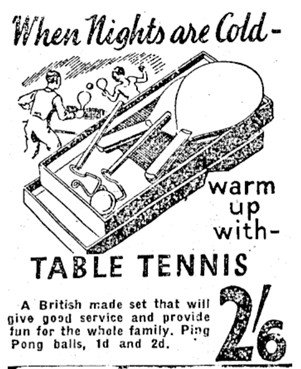
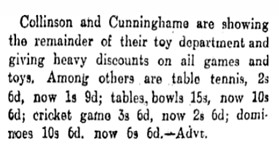
Before table tennis became an organised sport, it was sold and introduced to the public as a children’s game. As early as 1901, newspaper advertisements would reference table tennis as one of the many ‘special attractions for the children’.1 Being sold together with other toys, board games and books, table tennis sets were a common part of many children’s lives. Even as table tennis progressed into an organised sport for adults in Palmerston North, it was still being played by those of an early age.
The early exposure of children to table tennis may have contributed to an active table tennis community in Palmerston North and Manawatū. However, its perceived association with children also led to some early resistance, especially within the local sporting community. Moreover, its ‘childish’ image may have discouraged members of the sporting community from considering it a serious sport.
Manawatu Table Tennis Association
The Manawatū region was one of the early strongholds for table tennis in New Zealand. Records of table tennis being played in Palmerston North can be traced back to as early as 1901, when advertisements for table tennis sets were published in local newspapers. The following year witnessed a ‘ping pong tournament’ being held at the ‘bowling green pavilion’ where 13 members took part.2 Table tennis was then played spasmodically in the region before its establishment as an organised sport in the 1930s.
The 1930s was an important era for sport in New Zealand, as it witnessed the progression into an organised sport in almost every part of the country. The Manawatu Ping Pong Association (later changed its name to Manawatu Table Tennis Association) was established in 1931, and it was the first provincial table tennis association to be founded outside of Auckland. Members of the association would play an important role in the establishment of the New Zealand Table Tennis Association (NZTTA), the national body for the sport. Amongst the eight delegates that attended the inaugural meeting on April 11, 1934, that officially established the national body, was Mr. C. F. Williams who was present on behalf of the Manawatū region. Closer to the end of the decade, organised levels of table tennis featured even more prominently in Palmerston North. Entries to the inter-club competitions of the Association were increasing year on year, and frequent inter-provincial matches and championship tournaments were arranged where players from Wellington, Masterton, Whanganui, and as far away as Auckland, came to Palmerston North to contest with local players at table tennis.
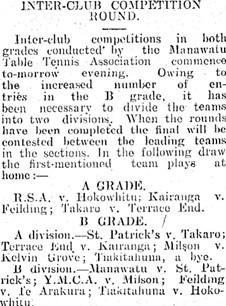
In 1937, according to the records of the New Zealand Table Tennis Association, the Manawatu Table Tennis Association hosted 20 teams with an affiliated membership of 200 registered players. The number of affiliated players might seem considerably fewer than other sports; however, this number only accounts for those who participated in organised forms of table tennis. There was another section of society that engaged with table tennis as an informal social and recreational activity. In fact, these informal forms of engagement comprised a considerable portion of participants, and the number of players of table tennis may be significantly higher than New Zealand Table Tennis Association records suggest.
Table Tennis as a Social and Recreational Activity
While organised table tennis was becoming increasingly popular across New Zealand, there was also a parallel development of the sport as a social and recreational activity. Informal forms of participation in sporting activities are often neglected in sports history but are equally important to our understanding of the complete history of sporting activities. Outside clubrooms and competition venues, table tennis paddles and balls were a popular feature of social events. As early as 1922, at a dance night held by the Takoro Bowling, Croquet and Tennis Club, it was reported that about 70 couples were present, and ‘cards, table bowls, and table tennis were provided for the non-dancers’.3 The virtue of table tennis as a fashionable activity that facilitated social networks and personal interaction was widely recognised and praised. Hence, many newspaper articles that reported on successful social events in the 1930s mentioned table tennis. Table tennis sets were a common asset of lodges and friendly societies, social clubs, companies and workplaces throughout the Manawatū region. Here is an example from the Horowhenua Chronicle of June 1935:
Last evening a party comprising two car-loads of the members of the New Century Tent (Levin), I.O.R., paid a visit to the Onward Tent, Palmerston North, which provided a highly enjoyable interlude in the work of the Lodge. Upon their arrival at the Orange Hall in the city, the visitors were welcomed by C.R. Sister Sandford, and following the transaction of the usual business of the Lodge were most hospitably entertained, the variety of amusements provided including indoor bowls, table tennis, cards and dancing. A dainty supper was also served by the Palmerston members.4
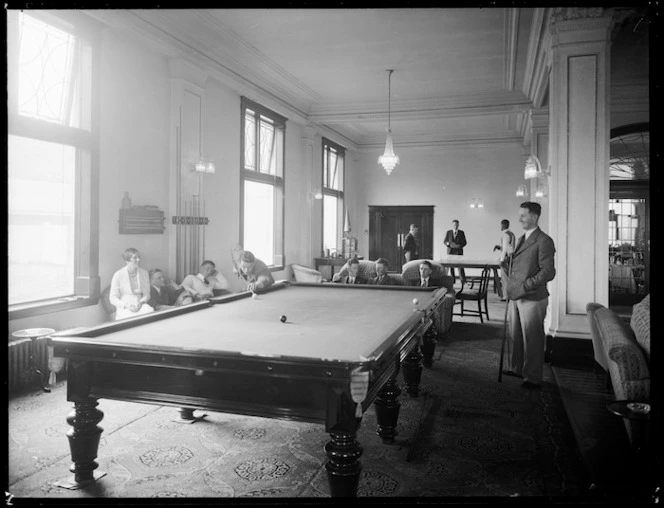
For illustrative purposes, the photograph below from the Chateau Tongariro perfectly encapsulates how table tennis was played in most social and recreational settings. A close look at the photograph shows a table tennis table towards the back of the room beyond the billiards table. This is the type of setting in which many New Zealanders, especially men and boys, experienced table tennis in the 1930s. Often located in a public lounge room, alongside a billiard table and a range of other social activities, it was played informally and casually.
Women’s Participation
The arrival of table tennis at Manawatū was not merely the introduction of another pastime. It was appealing for women, as their participation was significant, spanning both organised and recreational contexts. Its widespread presence at social events allowed many women to gain an early familiarity with it. The playing of table tennis under such contexts further provided women with opportunities to foster social interaction and expand interpersonal networks. Whether an early exposure to table tennis in the recreational sense led many women to progress into competitive play is unclear. Regardless, women’s participation in the organised levels was also notable.
Returning to Te Manawa’s table tennis set, the cover of the box depicts a women and a man playing against each other. This was perhaps an unconventional depiction, considering that women and men rarely played side by side in sporting activities with only a few exceptions such as badminton and tennis.5
Moreover, in the 1920s and 1930s, when women’s participation in sporting activities was still being debated in the public sphere and discussion persisted about which sports were suitable for women, table tennis did not appear to be subject to such scrutiny and contestation.6 From the outset, the first series of weekly inter-club competitions organised by the Manawatu Ping Pong Association in 1931 already included women’s events in the matches. One of the earliest inter-associations in the country in 1934 between Manawatū and Whanganui also featured women’s singles, women’s doubles, and mixed doubles disciplines. It is difficult to calculate precisely how many women participated in the game of table tennis because the informal engagement in the recreational sense was not formally documented. Nevertheless, within the often rigid gender boundaries of New Zealand sport at the time, table tennis constituted a notable exception, affording opportunities for women that were otherwise limited or unavailable in other sporting arenas.
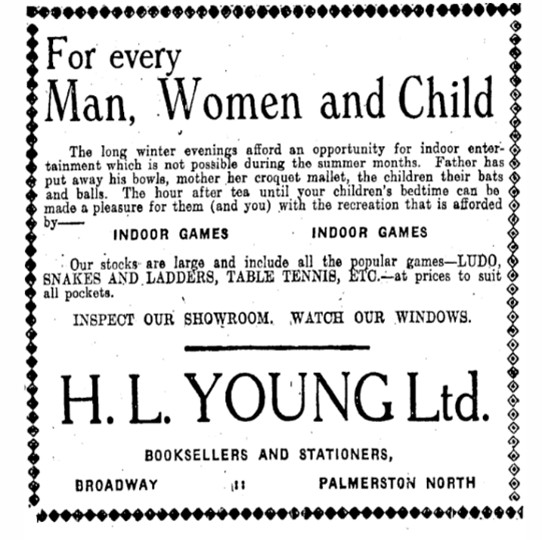
To conclude, the quote below perfectly encapsulates table tennis’s role within Palmerston North, and New Zealand society at large, as it was indeed ‘For every Man, Women, and Child’. Its dual characteristic as both a competitive sport and a social recreational activity boosted participation across communities. A small table tennis set, two paddles and a ball proved a meaningful addition to the everyday lives of many, making it truly a game for all.
Footnotes
- Evening Star, 11 December 1901, p. 8. ↩︎
- Manawatu Standard, 13 March 1902, p. 4. ↩︎
- Manawatu Times, 15 July 1922, p. 3. ↩︎
- Horowhenua Chronicle, 18 June 1935, p. 5. ↩︎
- Song Ze Ngo and Geoff Watson, ‘A Supplementary Sport? Towards a Historical Analysis of the Development of Badminton in New Zealand, c. 1870–1939’, The International Journal of the History of Sport, vol. 40, no. 12, September 2023), pp. 1049–68, https://doi.org/10.1080/09523367.2023.2284314. ↩︎
- Greg Ryan and Geoff Watson, Sport and the New Zealanders: A History, Auckland University Press, Auckland, 2018, pp. 154–173. ↩︎
Bibliography
Ngo, Song Ze, ‘A history of the development of table tennis (ping pong) in New Zealand, c. 1890–1939’, MA thesis, Massey University, 2024.
Ngo, Song Ze and Geoff Watson, ‘A Supplementary Sport? Towards a Historical Analysis of the Development of Badminton in New Zealand, c. 1870–1939’, The International Journal of the History of Sport, vol. 40, no. 12, September 2023), pp. 1049–68, https://doi.org/10.1080/09523367.2023.2284314.
Ryan, Greg and Geoff Watson, Sport and the New Zealanders: A History, Auckland University Press, Auckland, 2018.
 Te Manawa Museum Society
Leave a comment