Robert McLachlan
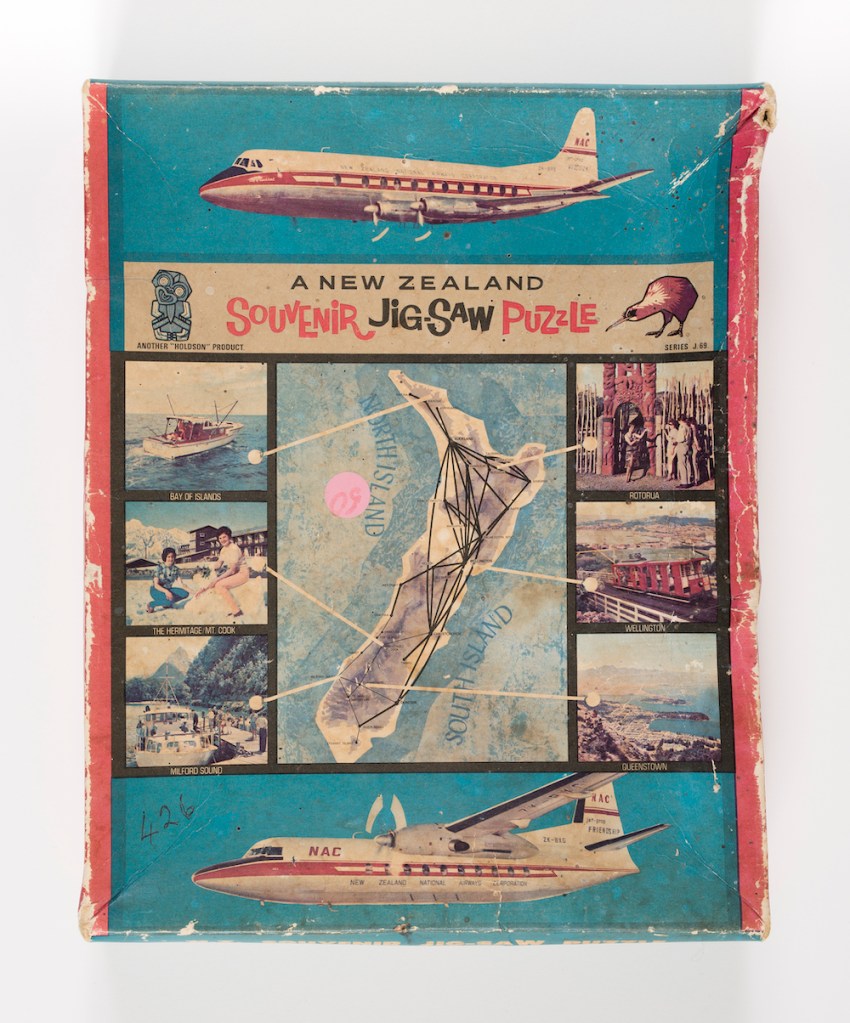
This jigsaw puzzle was commissioned by the New Zealand National Airways Corporation (NAC) and donated to the Manawatu Museum by Christina McKenzie in 1993. It was not from her own childhood – the box still has a pink sticker from the op shop where she bought it.
But as it turns out, I had this jigsaw as a child. I completed it many, many times. Every detail, especially the crisp outlines of the aircraft and the funky font, are engraved on my mind. Judging from the tattered condition of the box, this copy was equally well used.
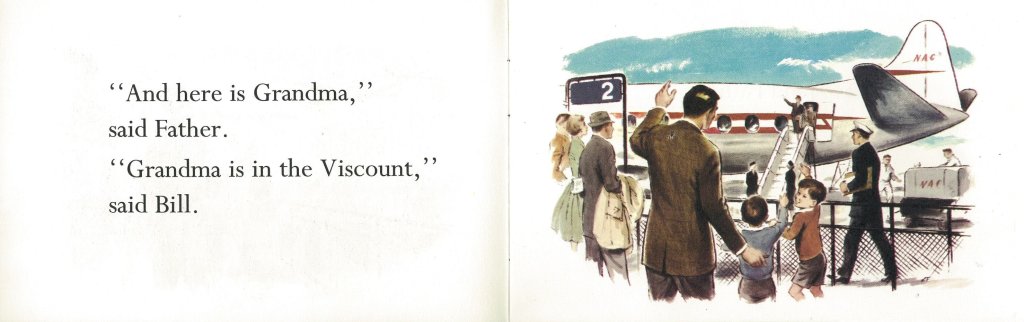
It was all about the aircraft – the Vickers Viscount at the top and the Fokker Friendship at the bottom. There was even a similarly-themed early school reader – the tiny books with little plot, before you could move onto more substantial fare like ‘Sweet Porridge’ – in which I recall the children went to the airport and saw a Viscount.1
In 1947 all private airlines were nationalised and merged into the newly-created NAC. By contrast, although the state had long been heavily involved in building and operating trains, the railways themselves were not corporatised until 1982.
Originally operating piston-driven propeller aircraft like the DC3, the advent of the Vickers Viscount turboprop, which entered commercial service in 1950, was a game-changer. NAC eventually bought five 60-seat aircraft, which were in service from 1958 to 1975. The ‘City of Auckland’ is shown in the jigsaw; the others were named after Palmerston North, Wellington, Christchurch and Dunedin.2
Even then Palmerston North was the smallest of these five cities, and was presumably included because of its importance in the early days of civil aviation. Union Airways’ inaugural flight took place from Palmerston North’s Milson Aerodrome on 15 January 1936, to Taieri (Dunedin) by way of Ōmaka (Blenheim) and Wigram (Christchurch). In the 1960s Christchurch–Palmerston North–Auckland was a key route served by the Vickers Viscounts.
Vickers, founded in 1828, was a British firm that began by making church bells and expanded into all areas of engineering, including ships, aircraft, and weaponry including the Vickers machine gun. Vickers was bought by Rolls-Royce in 1999. Fokker, founded in 1912, was a Dutch aircraft company that for a time in the late 1920s was the largest in the world. It introduced its own turboprop craft, the 44-seat Friendship, in 1958. NAC would eventually buy 18 of them, in service from 1960 to 1990.3 Fokker went bankrupt in 1996.
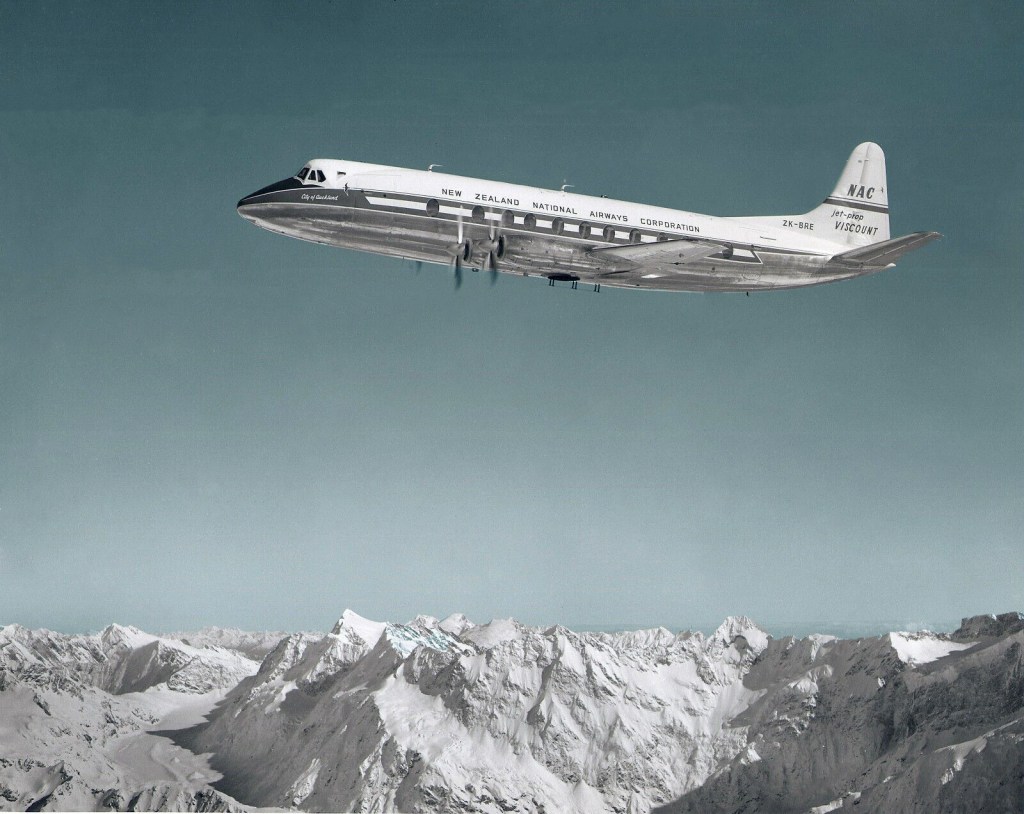
The Press raved about the Viscount’s arrival in 1958: its speed (‘more than 300 miles an hour, will satisfy those to whom every second counts’), its quietness and lack of vibration (a full cup of coffee would not spill on the ‘adjustable tray fixed to the seats in front’), its pressurised cabin that allowed it to fly high above the weather at 20,000 feet, its magnificent windows, and its air-conditioning that allowed smoking.
New Zealanders who reach for a cigarette instinctively in any situation or place will be able to smoke to their heart’s content, in the Viscount. There is an ash tray in the arm of the seat. … As well as the individual reading lamps there are strip lights in the roof. Sitting back in their comfortable seats they will be able to read or smoke, enjoy a cup of coffee and light refreshments served to them by two hostesses, watch the changing cloud patterns or the scenery, and almost forget, if they close their eyes, that they are in an aircraft.4
Although it wasn’t quite a jet (it still had propellers), it was close – in a turboprop, the turbine power aims forward to drive the propeller, while in a jet it aims backwards – and NAC branded it as a ‘jet-prop’. Passenger numbers jumped from 650,000 in 1960 to 1,480,000 in 1970.5
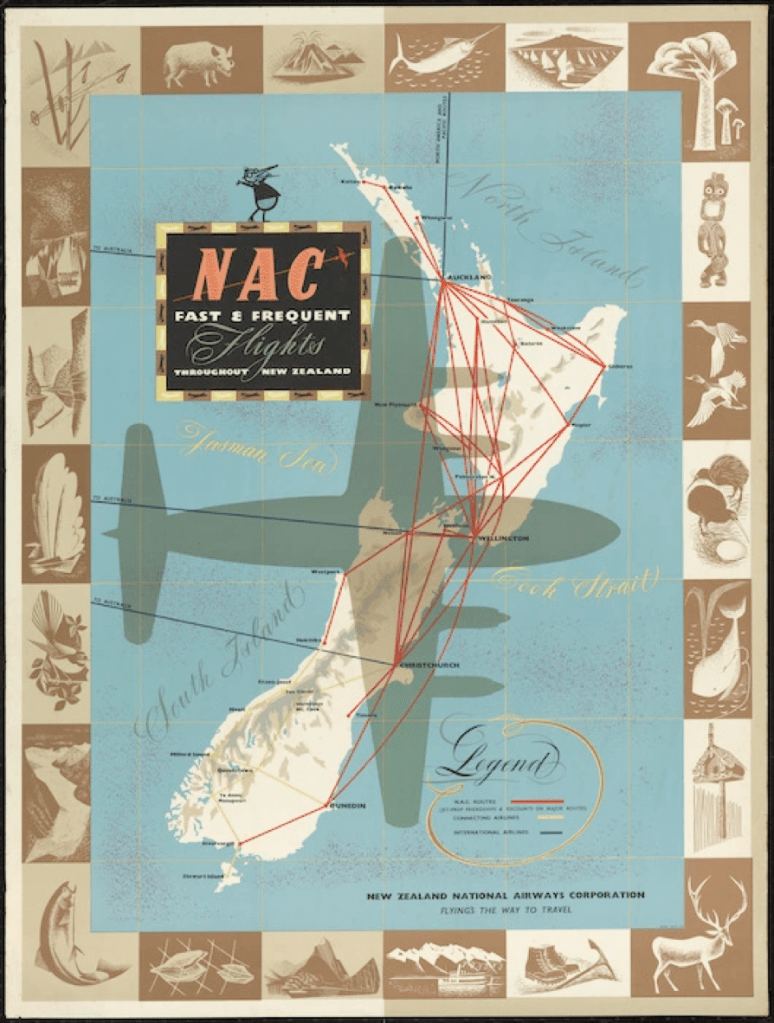
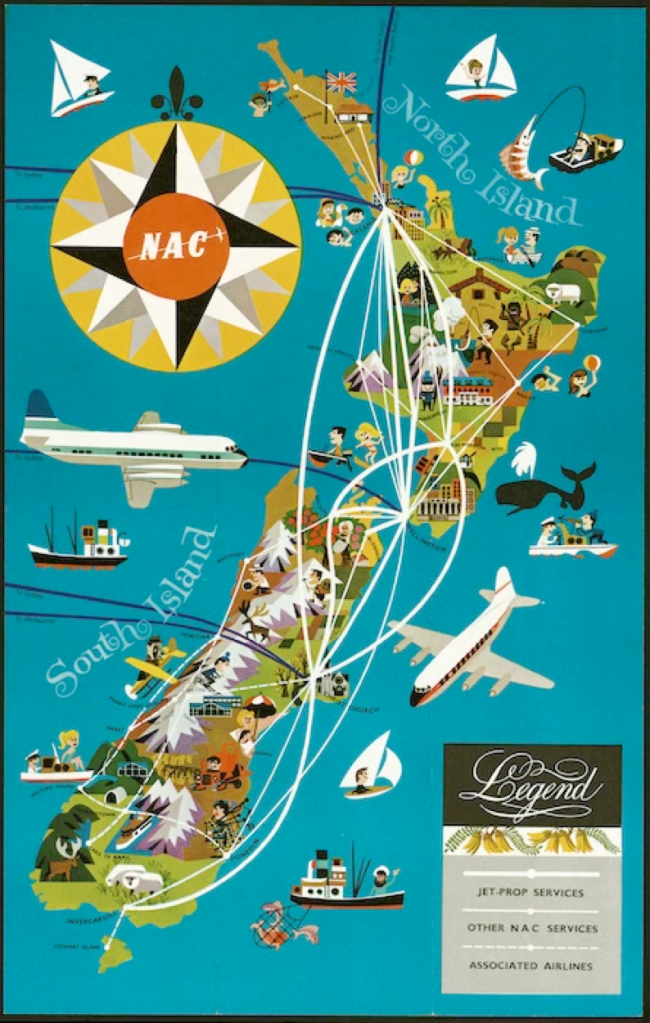
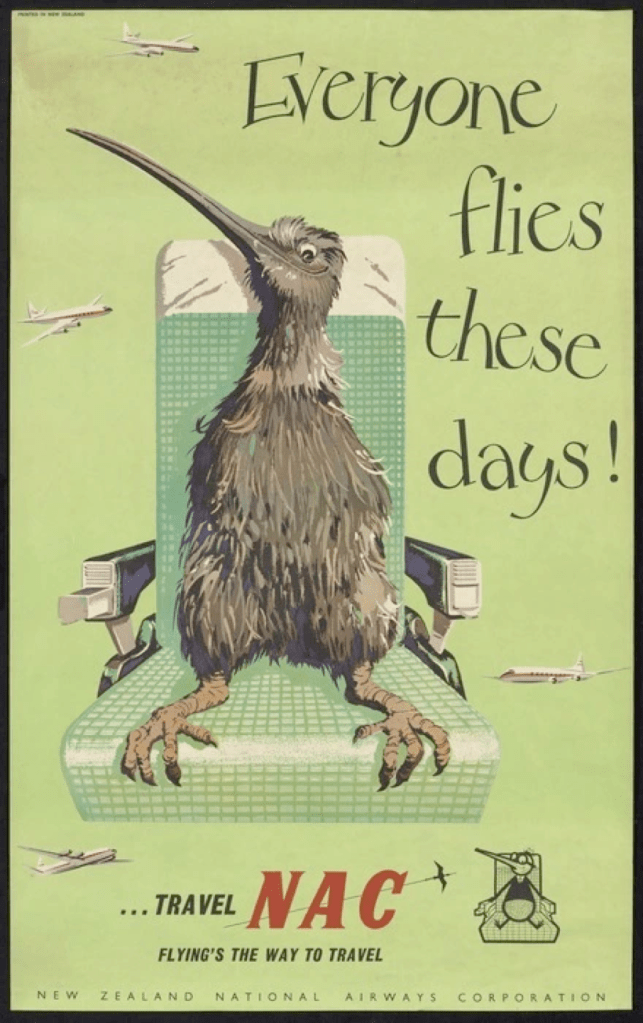
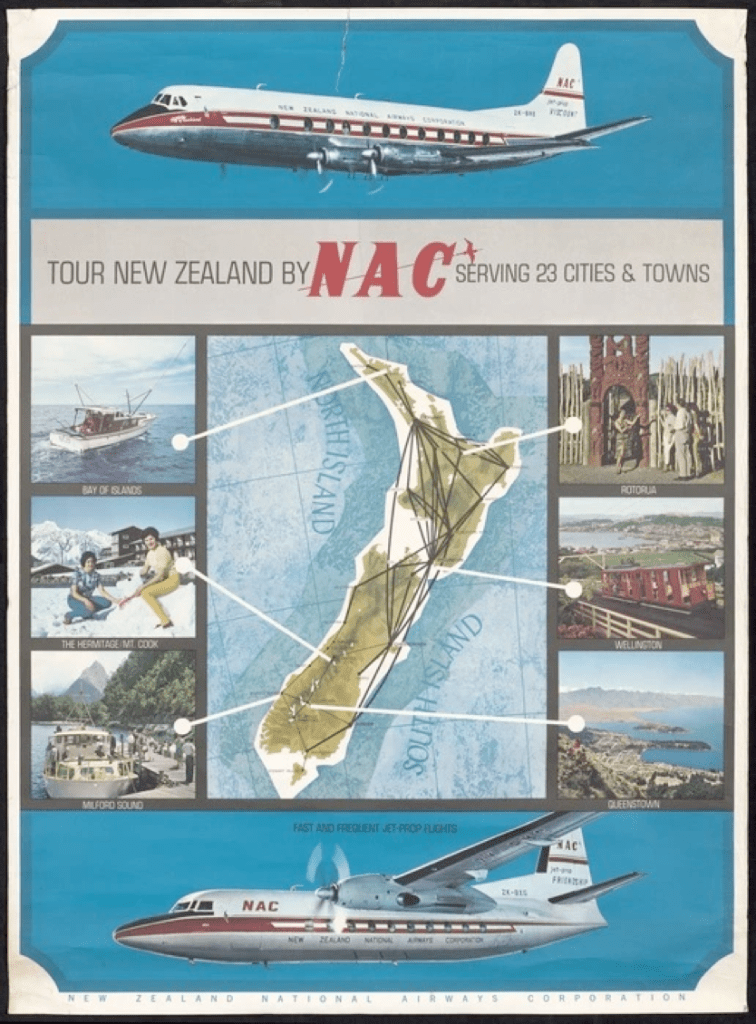
As part of the publicity, NAC produced some snazzy posters, including the one that was made into a jigsaw – perhaps not their best work, although it certainly worked on me.
The jigsaw was made for NAC by Holdson. Formerly Thos. Holdsworth & Sons Ltd, Holdson is an Auckland-based game and toy company founded in 1939, still owned and operated by the Holdsworth family today. They began by turning leftover calendars into jigsaws, cut by hand on plywood using a jury-rigged saw made from a Singer sewing machine.6
The side of the box reads “Over 400 pieces fully interlocking”, which suggests that interlocking pieces were not yet fully standardised. The piece shapes are more variable than in most modern puzzles, too. It’s not clear if the puzzle was sold commercially or used by NAC as a promotion. At least one other museum, MOTAT, holds a copy.7
The design
The centre of the puzzle shows NAC’s domestic route network. It includes Whakatāne, which was added in November 1962, but not Taupō or Ōamaru, added in March 1966.8 That dates the puzzle firmly to the mid 1960s. The 23 airports served surpasses Air New Zealand’s current roster of 20.
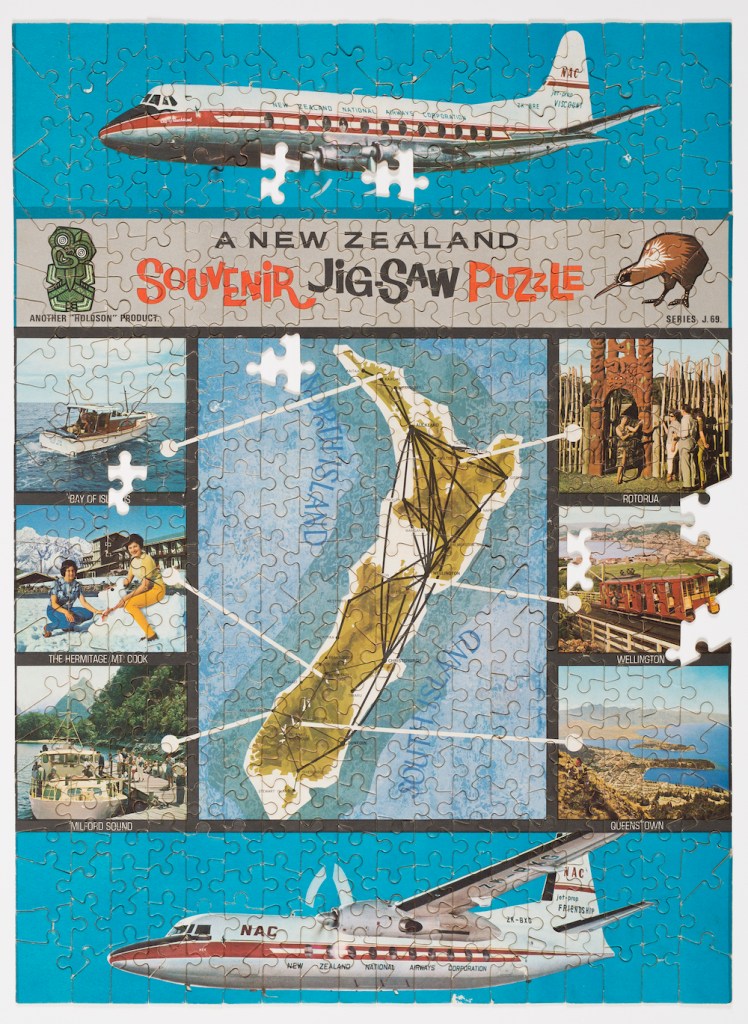
Around the map are six tourist destinations. From the beginning, aviation and tourism have been joined at the hip. The same six destinations could all be selected in a similar exercise today, although perhaps with different emphases. All six photos show tourists doing something, as opposed to the pure scenery which might be emphasised more today.
Rotorua
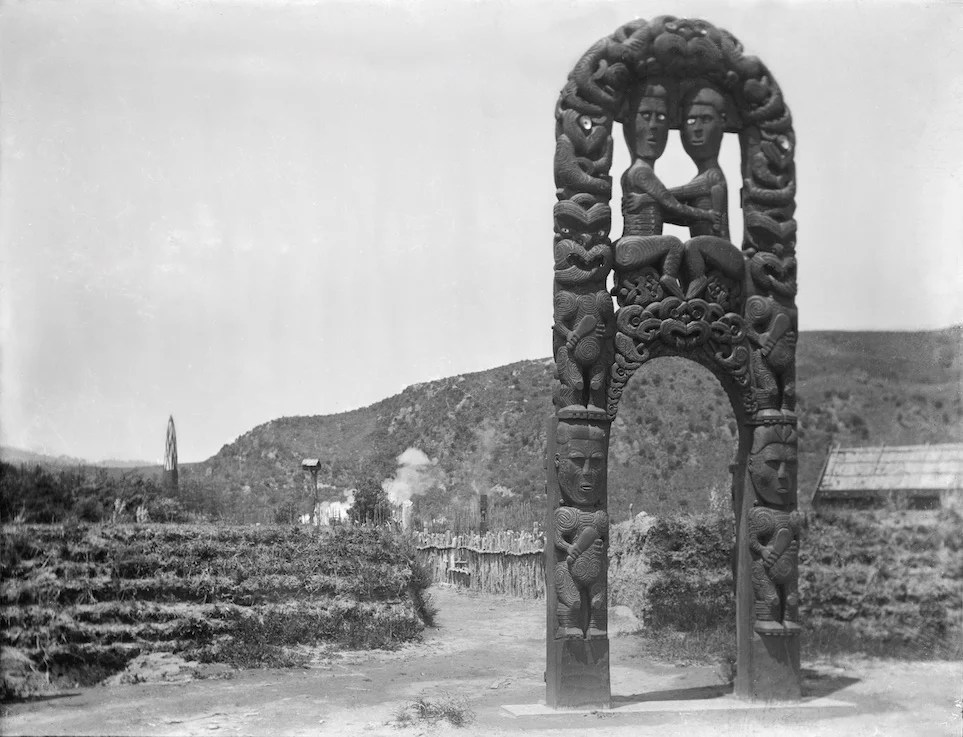
The photo shows a professional Māori guide welcoming tourists to Whakarewarewa, Aotearoa New Zealand’s most famous site of both Māori and geothermal tourism. Its iconic western waharoa (gateway) was carved by Tene Waitere (Ngāti Tarāwhai) in 1909, on commission from the Government Tourist Department.9 Former Auckland Museum curator Roger Neich called it a ‘non-traditional composition featuring a pair of embracing male and female figures, now usually identified as Hinemoa and Tutanekai.’10
By the early twenty-first century the waharoa had succumbed to the elements (including the geothermal vapours) and its remains were returned to Tene Waitere’s descendants. A replica was commissioned from tohunga whakairo Albert Te Pou (Tuhoe). At its unveiling in 2013, Te Puia chief executive Tim Cossar stressed how the waharoa symbolises the perpetuation of Māori art and craft skills and the tourism that maintains and preserves Whakarewarewa.11
Its reputation is well-deserved. Geyser fields are rare (there are only five worldwide) and New Zealand once had 135 active geysers. Due to development, only 5 are left, of which Pōhutu geyser at Whakarewarewa is the only large and reliable one. It too began to falter in the 1980s, prompting the emergency closure of hundreds of local geothermal bores.12
Wellington
The only city chosen; the view shows the famous cable car, used by both locals and tourists as much today as when it opened in 1902. This is the old-style car with outdoor seats, which was replaced with a safer enclosed design in 1979.
Queenstown
The view appears to be from Bob’s Peak. The private road up the peak was built in 1961, and the Skyline Gondola, which opened in 1967, was likely under construction. On the whole, not the best photo of one of New Zealand’s most famously scenic views – the Remarkables can scarcely be made out.
Milford Sound
This was another emerging tourist destination, thanks to the opening of the Homer Tunnel in 1953 and the opening of the new, luxurious Milford Hotel in 1954. Like the other state hotels, Milford had been losing money, and in 1955 all were transferred to the new Tourist Hotel Corporation. David Williamson, a hospitality and tourism lecturer at Auckland University of Technology, has argued that the THC played a heroic role in New Zealand tourism:
The THC was a key player in transforming post-war New Zealand hospitality, raising the bar for service, food and beverage and accommodation significantly. The THC invested heavily in improving buildings, vehicles, equipment and machinery, developing the skills and careers of its staff, and innovating menus … many of today’s most successful General Managers learnt their trade in THC properties.13
The THC operated about 10 hotels profitably throughout the 1970s and 1980s until its closure in 1991.
The Hermitage / Mt Cook
The current Hermitage (another THC property) was built in 1958; a classic of mid-century design, it won a prize for its architects. Although not an NAC destination, its rival Mt Cook Airlines served Mt Cook for a number of years, and aviation-glacier tourism had been pioneered here by Harry Wigley in 1955 when he attached home-made skis to his aircraft.
Bay of Islands
Instead of any actual islands, we see here a charter game fishing boat. Earlier in the century, the Government Tourist Department had seen big game fishing as a lure for just the kind of wealthy international tourists they wished to reel in. In 1926 they brought Zane Grey, world-famous writer of westerns, out to visit. He duly obliged, writing Tales of the Angler’s El Dorado New Zealand and returning periodically until 1933.14
New Zealand, especially the Bay of Islands, has the largest marlin in the world. Fish over 200 kg are still caught by rod today. Unlike in the 1960s, when fish were brought in to be weighed, photographed, and dumped, most fish are now tagged and released, the rest eaten. Commercial fishing of this species was banned in the 1990s.
The aftermath
NAC was folded into Air New Zealand in 1978. Apart from an unsuccessful period in private hands in the 1990s, it remains a majority state-owned enterprise. Of the two aircraft shown in the jigsaw, the Friendship (ZK-BXG, ‘Kea’) was damaged irreparably while landing at Gisborne in 1988 and is now on display in a partly dismantled form at the Ferrymead Heritage Park, Christchurch, and the Viscount (ZK-BRE, ‘City of Auckland’) went through a number of different owners after being sold in 1975 and was finally dismantled in the UK in 1982.15
Turboprop aircraft (now the French/Italian ATR-72) remain the mainstay of regional aviation. Domestic passenger numbers continued to grow. My estimates are: 1.5 million in 1970, 2.4 million in 1980, 4.5 million in 1990 and 13 million today.
I never flew on a Viscount or a Friendship. But in the 1970s my parents did take me on car trips to all six of the featured tourist destinations. And, starting in the 1990s, I developed an interest in climate change and began to work on the topic of aviation emissions. Was that thanks in part to the formative influences of NAC and Holdson?
Both the government and the aviation industry have stated goals of reaching net zero emissions by 2050. Yet their actions belie this goal, with the government promoting tourism (it became our biggest export earner in 2019) and subsidising regional airlines, while airlines and airports are likewise investing for substantial growth. The government no longer owns hotels, but it does operate tourist ventures like the Great Walks and Great Journeys.
Instead of hiring Zane Grey, we hire professional internet influencers and pitch to digital nomads. Despite innovations such as adventure tourism and mass cruise ship tourism, most of the attractions and activities have not changed since the 1960s. The trend has been towards more and more tourists visiting for shorter and shorter periods, while locals complain of the impacts. Of the six destinations in the jigsaw, all except Wellington are subject to massive numbers of tourists, and even that has tried to rebrand as Wellywood.
How do we fit all this together in a responsible way for the future? Now that really is a puzzle.

Footnotes
- Hancock, ‘Along Came Greedy Cat’, p. 90. ↩︎
- Waugh, NAC, p. 256. ↩︎
- Waugh, NAC, p. 251. ↩︎
- Press, 3 February 1958, p. 14. ↩︎
- Statistics New Zealand, New Zealand Official Year-Book, 1961–71. ↩︎
- Holdson, ‘About Us’, 2025. ↩︎
- Jigsaw puzzle [National Airways Corporation], 2016.96, MOTAT, URL: https://collection.motat.nz/objects/94883/jigsaw-puzzle-national-airways-corporation (accessed 25 September 2025). ↩︎
- Until the early 1950s there were even scheduled flights to Whataroa, Waiho (Franz Josef), Haast, and – even further south – Okuru and (briefly) Milford Sound. See Waugh, NAC, p. 8. ↩︎
- Neich, ‘Nineteenth to Mid-Twentieth Century Individual Maori Woodcarvers and Their Known Works’, p. 76. ↩︎
- Neich, Carved Histories, p. 312. ↩︎
- Rotorua Daily Post, 15 November 2013. ↩︎
- McLachlan, ‘Geyserland’; Johnston, ‘Geysers on Postage Stamps’. ↩︎
- Williamson, ‘The Tourist Hotel Corporation’. ↩︎
- Warne, ‘Angler’s El Dorado’. ↩︎
- Waugh, NAC, pp. 251, 256. Ferrymead Heritage Park also has the NAC Viscount ZK-BRF ‘City of Christchurch’ on display. ↩︎
Bibliography
Hancock, Kay, ‘Along Came Greedy Cat: Exploring the “Ready to Read” Instructional Reading Series 1963–1983’, PhD thesis, Victoria University of Wellington, 2018.
Holdson, ‘About Us’, URL: https://www.holdson.com/about-us (accessed 25 September 2025).
Johnston, Wm. Robert, ‘Geysers on Postage Stamps’, 11 May 2010: URL: https://www.johnstonsarchive.net/geysers/geyserstamp.html (accessed 25 September 2025).
McLachlan, Robert, ‘Geyserland, or, What happened at Taupō’, Planetary Ecology, 1 May 2021, URL: https://blog.planetaryecology.org/2021/01/05/geyserland-or-what-happened-at-taupo/.
Neich, Roger, Carved Histories: Rotorua Ngati Tarawhai Woodcarving, Auckland University Press, Auckland, 2001.
Neich, Roger, ‘Nineteenth to Mid-Twentieth Century Individual Maori Woodcarvers and Their Known Works’, Papahou: Records of the Auckland Museum, vol. 41, 2004, pp. 53–86, URL:
https://www.biodiversitylibrary.org/page/62830935#page/55/mode/1up (accessed 25 September 2025).
‘Replica carving of gateway unveiled’, Rotorua Daily Post, 15 Nov 2013, URL: https://www.nzherald.co.nz/rotorua-daily-post/news/replica-carving-of-gateway-unveiled/ZTLEZLS476BQXYCPNVPWJG3LZQ/ (accessed 25 September 2025).
Statistics New Zealand, New Zealand Official Yearbook, 1961, 11–D Civil Aviation and Air Transport, URL: https://www3.stats.govt.nz/New_Zealand_Official_Yearbooks/1961/NZOYB_%201961.html#idsect1_1_108666 (accessed 25 September 2025).
Statistics New Zealand, New Zealand Official Yearbook, 1971, 11D–Civil Aviation, URL: https://www3.stats.govt.nz/New_Zealand_Official_Yearbooks/1971/NZOYB_1971.html#idsect1_1_101631 (accessed 25 September 2025).
Warne, Kennedy, ‘Angler’s El Dorado’, New Zealand Geographic, no. 103, May-June 2010, URL: https://www.nzgeo.com/stories/anglers-el-dorado/ (accessed 25 September 2025).
Waugh, Richard, with Peter Layne and Graeme McConnell, NAC: The Illustrated History of New Zealand National Airways Corporation 1947–1978, Kynaston Charitable Trust in conjunction with Craig Printing Co, Invercargill, 2007.
Williamson, David, ‘The Tourist Hotel Corporation: It is time the story was told in full’, Hospitality Insights, vol. 1, no. 1, 2017, URL: https://ojs.aut.ac.nz/hospitality-insights/article/view/6 (accessed 25 September 2025).
 Te Manawa Museum Society

Leave a comment