Pamela Joe
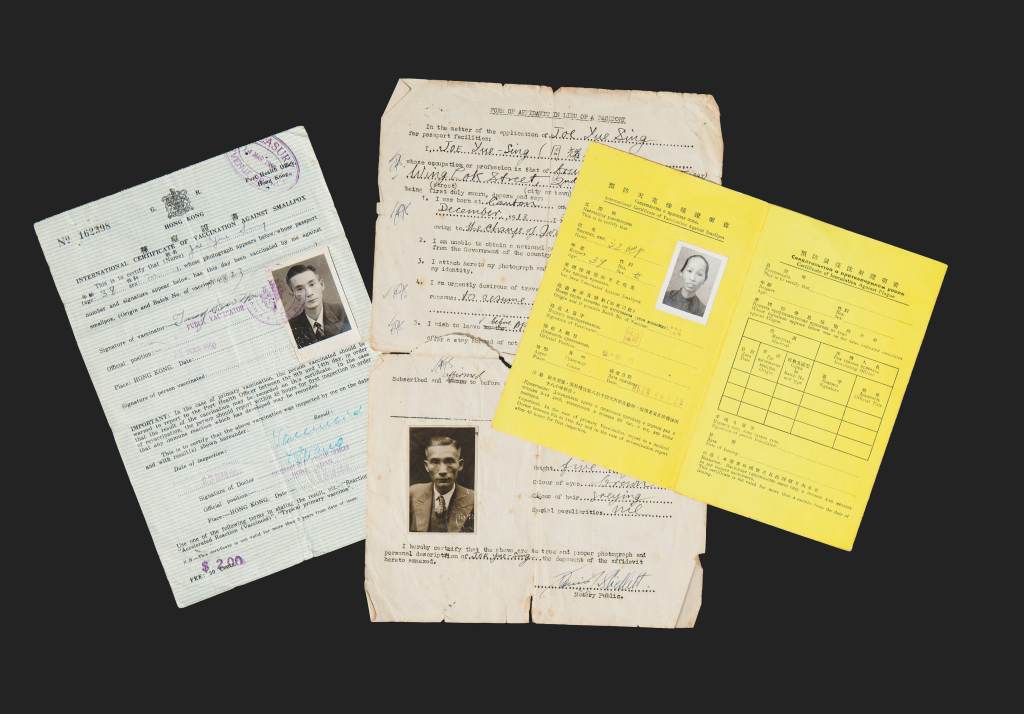
When our father passed away in Palmerston North in 1999, my sister Margaret Young and I found an intriguing set of inoculation certificates at the bottom of a Chinese carved rosewood chest lined with camphor wood. Issued in Hong Kong to our parents, Joe Yue Sing and Joe Kong She, they were proof of vaccination against cholera and smallpox, as required by immigrants to New Zealand in the early 1950s.1 They settled in Manawatū, where they were to become successful market gardeners. We had not known the certificates existed and donated them to The Science Centre & Manawatu Museum (now Te Manawa) to ensure their ongoing preservation.
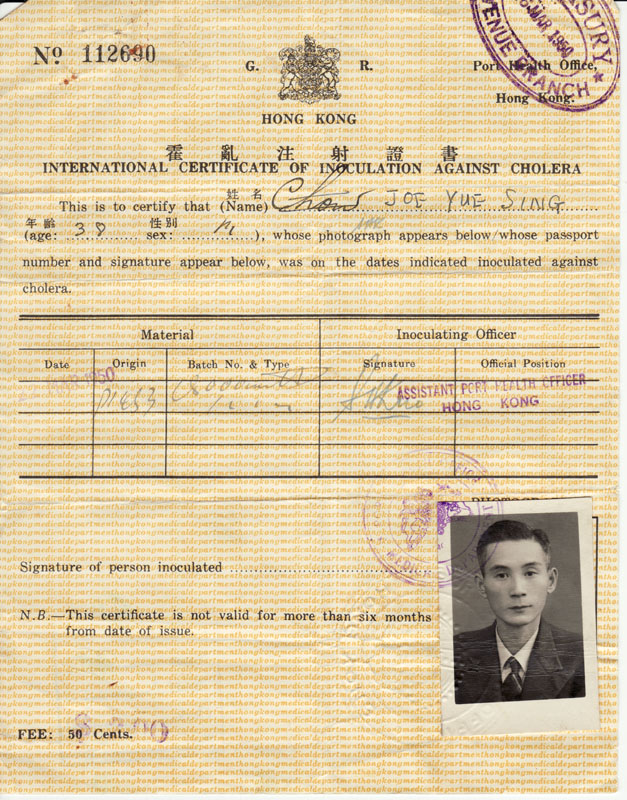
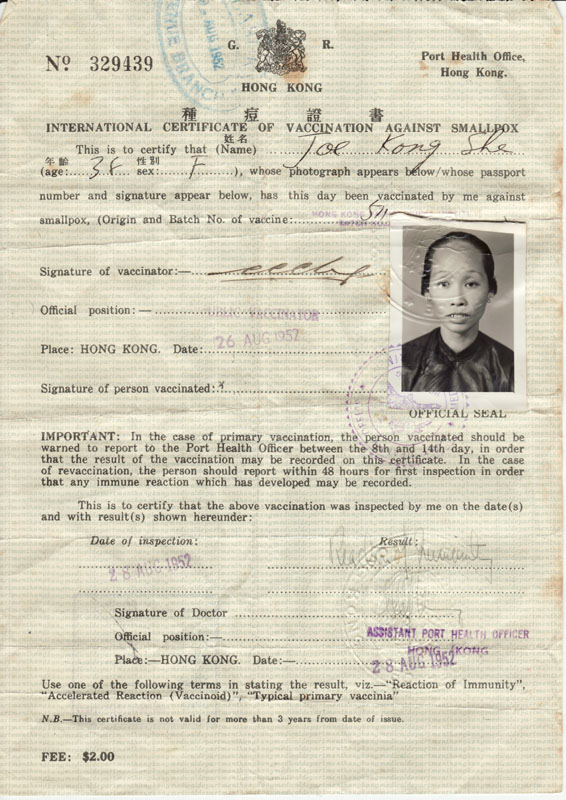
Joe Yue Sing was born in Canton (Guangdong) in 1913. His family had strong ties with New Zealand. His maternal grandfather had worked on the goldfields of Otago in the 1870s, taking the gold he panned back to China. His father, Joe Bing Jow, came to New Zealand to work as a fruiterer in 1906, going back and forth from Marton to his family in China before he died in New Zealand in 1922. Joe Yue Sing followed a similar path after arriving in Palmerston North in 1938 to work in the fruit shop of his cousin, Joe York.
Under New Zealand immigration law, Joe Yue Sing could have a work permit to take the place of another Chinese who left New Zealand for two years. While Joe York went back to China to visit his family, Joe Yue Sing came here. The outbreak of the Second World War forced him to remain in New Zealand. During the early years of the war he worked at a market garden on Te Matai Road, Palmerston North, where he was later to have his own market garden. Between 1944 and 1948 he had a fruit shop business at Petone, where he became involved with the New Zealand Chinese Association (NZCA). After the war he was granted permanent residence.
In 1947 the Labour government changed its immigration policy to allow families to be united in New Zealand.2 This development coincided with a period of civil war in China. With the money he had saved he went back to his village, Narm Chuen, near Guangzhou, in 1948, to visit Joe Kong She and their three children. The following year a fourth child was born. Joe Yue Sing returned to New Zealand with his eldest son, Chartland (Len) in 1950. The set of certificates also included an affidavit in lieu of a passport issued by the Hong Kong government in that year. His original documents could not be used because of the change of government in China.
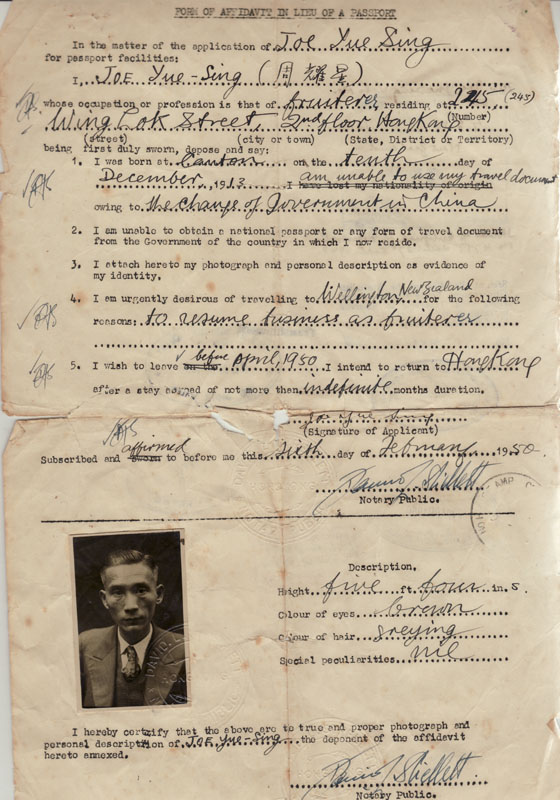
Joe Yue Sing worked at ‘Joe and Joe’, a fruit shop on The Square, Palmerston North. Along with other Chinese immigrant children, Len attended St Mary’s School, where, although they were not Catholic, or even Christian, the nuns patiently taught them English. Joe Yue Sing successfully applied for his wife and children to join him in New Zealand. They all became New Zealand citizens during the 1960s.
Joe Kong She was born in Canton (Guangdong) in 1914. She never attended school because her family was too poor, and remained illiterate in Cantonese and English. Her two-month journey to New Zealand in 1952 was not an easy undertaking: she travelled from Guangzhou to Hong Kong by train, to Sydney on a freighter, to Wellington on the SS Wanganella, and to Palmerston North in Joe Yue Sing’s small truck.
In the summer of 1952 Joe Yue Sing and his family co-leased with Ernie Thackery 16 acres of land at Whakarongo, between Palmerston North and Ashhurst. With family labour available, market gardening was a good choice for earning a living. Len had left school by this time. The family grew brussels sprouts, cabbages, cauliflowers, lettuces, radishes and tomatoes to sell at auction (Dominion Auctioneering Co., Arlidge Bros and J.L. Bennetts). Joe built a small bungalow on the property, and they lived there until they were able to purchase land at Whakarongo in 1959. Three more children were born during these years.
Before the 1960s, the cultivating, weeding and harvesting of vegetables was done by hand. Fertiliser was sprinkled by hand from a bucket, weeding was done with hoes, and cabbages were cut with a knife. Twelve cauliflowers or fourteen cabbages were packed into recycled wooden banana boxes. Three or four boxes, each weighing about 22 kg, would be loaded on to a hand trolley and taken to where the truck was parked – often at the other end of the field. It was heavy work and market gardeners often suffered from a bad back.
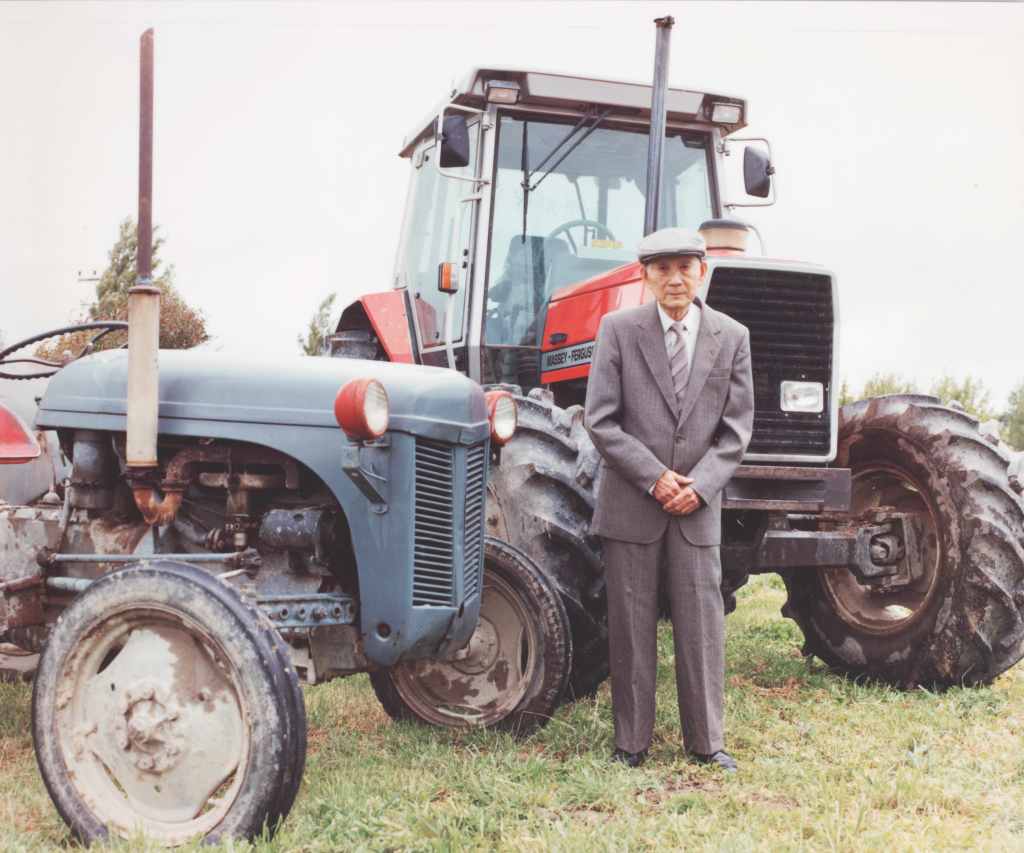
As was the custom of market gardens, the whole family worked, often long hours, in all weathers, and seven days a week. As more children left school the garden was able to increase production. More land was converted and modern machinery was introduced. Green vegetables like cabbage, cauliflower, celery and lettuce were mainly grown, as well as carrots, onions, parsnips, potatoes and pumpkins. The family bought two more farms to keep up production and ran their own trucks to Wellington and New Plymouth. At the height of the spring–summer season in the early 1970s, 200 to 300 cases of cauliflower would be trucked twice weekly to the wholesale markets or sent by rail to Turners and Growers’ Auckland market.
Carrots and parsnips were packed in recycled wooden apple and pear boxes that held about 15 kg. Smaller wooden stone fruit cases held 10 kg of tomatoes, cucumbers, brussels sprouts, beans or peas. Potatoes were packed in recycled wheat sacks that held 55 kg. By the 1980s sacks made of paper held 10 or 20 kg. Pumpkins were packed in crates. The use of recycled boxes was a practical and inexpensive way to standardise vegetables for presentation to the market. Retailers usually returned the boxes to the market for collection by the gardeners. Today cardboard cartons and plastic crates are used.
Most Chinese market gardeners learned to grow vegetables by trial and error. They were not necessarily gardeners at home, and did not know much about European vegetables. Here Joe Yue Sing’s ability to speak English was an advantage. He had begun learning English in Guangzhou. In Palmerston North, he took English lessons from the pastor of the local Chinese mission, Noel Bathurst, in exchange for lessons in Cantonese. For this reason, he was regularly elected to the national executives of the NZCA and the Dominion Federation of New Zealand Chinese Commercial Growers (DFNZCCG), as well as heading the Manawatū branch committees for many years.
Established in 1934, the NZCA’s main tasks were to maintain friendly contact among Chinese in New Zealand – to solve problems, settle disputes and offer mutual assistance. It also raised funds to assist China’s war against Japan and the subsequent reconstruction work.3 The DFNZCCG was first registered in Wellington in July 1942. It was established to ensure an adequate wartime vegetable supply through liaison between Chinese growers, wholesalers, retailers and the government.4 By the mid-1960s the Manawatū branch of the NZCA had a strong membership, mostly comprising market gardeners and fruit retailers. Up to 200 people would gather at the association’s hall for celebratory dinners and to watch Chinese films.
Between 1965 and 1985, the boom years of market gardening in Manawatū, there were up to 30 market gardens. Now there are only six of a reasonable size. There have been many changes in the types of vegetables grown over the past 50 years. Celery had yellow stalks in the early 1960s, before American green celery took over in popularity. Broccoli came onto the market In the mid-1970s, and courgettes in the 1980s. There have also been more significant. Many growers had stopped producing tomatoes, peas and beans by the late 1960s because housewives could purchase these items processed and no longer preserved their own. Most homes now had refrigerators and did not need fresh vegetables every day.
More recently bok choy has become popular as new Asian immigrants have arrived and trendy restaurants have begun using it in their dishes. Previously Chinese market gardeners grew it only for their own tables, along with choy-sum, garlic chives, gai-laan, gai-choy, sze-gwa, winter melon and bitter melon. All these products can now be bought in Chinese supermarkets and farmers’ markets.
As they aged and their physical strength declined, Joe Yue Sing and Joe Kong She grew lighter vegetables. They retired in the early 1980s and Joe Kong She died in 1983. At the end of Joe Yue Sing’s life, there was a lot of community interest in his papers and his book, Niu Xi Lan hua qiao she lue: A Brief History of the Overseas Chinese in New Zealand, published in 1996. This records oral histories of his generation that would otherwise have been lost.
Joe Yue Sing and Joe Kong She’s inoculation certificates are not isolated items at Te Manawa. They sit alongside other everyday items – flour bag aprons, kerosene heaters, quilts – from other Chinese market gardening families in Manawatū. Together they help tell the story of a generation of Chinese immigrants. These were men and women who came to New Zealand with little money to begin family businesses such as market gardens, fruit shops, laundries, and takeaway shops, which required little capital and little English, but gave you the opportunity to be your own boss. Most of the next generation went to university, which perhaps explains the gradual disappearance of Chinese market gardens.
First published in Fiona McKergow and Kerry Taylor, eds, Te Hao Nui – The Great Catch: Object Stories from Te Manawa, Random House, 2011; updated and republished with the author’s permission.
Footnotes
- In Chinese custom the surname comes first and the given name follows. ↩︎
- Manying Ip, Home Away from Home, p. 179. ↩︎
- For more on the history of the NZCA, see its website: http://www.nzchinese.org.nz/ (accessed 15 October 2026). ↩︎
- Joe Yue Sing, A Brief History of the Overseas Chinese in New Zealand, pp. 81–9. ↩︎
Bibliography
Ip, Manying, Home Away from Home: Stories of Chinese Women in New Zealand, New Women’s Press, 1994.
Joe Yue Sing, A Brief History of the Overseas Chinese in New Zealand, Niu Xi Lan Shuang Xing Chu Ban She, 1996.


Leave a Reply