Rodney Wong
Chinese pig roasting
There is a rich culture of whole pig roasting in Manawatū. Other places in New Zealand have had this tradition, but not to the same extent as Manawatū, and not for the general public. A few Chinese in the region, including myself, still know how to do it, but it is important that a knowledge of the process and the practical skills to carry it out are handed on to future generations.
In this region there was a very close relationship between market gardens and pig roasting ovens as they had to be situated on land that was not urban. Many ovens were built at local market gardens in the 1950s through to the 1970s. At the peak, there were about twelve pig roasting ovens, and these were actively used until the mid-1980s. As Chinese growers sold their land and later generations moved into professional occupations they fell out of use.
The paddle
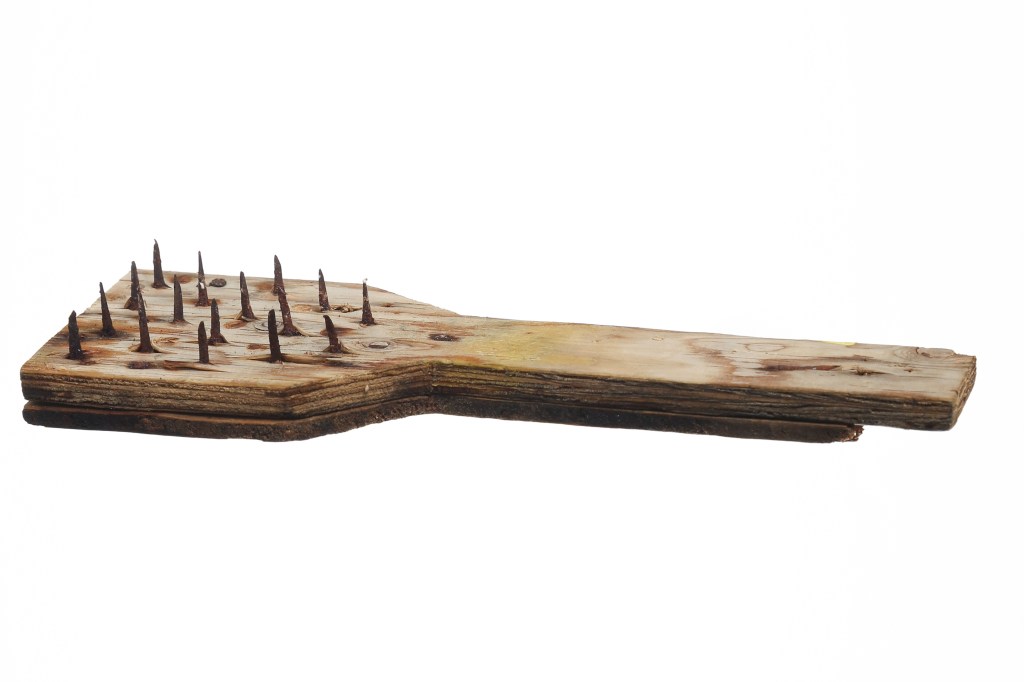
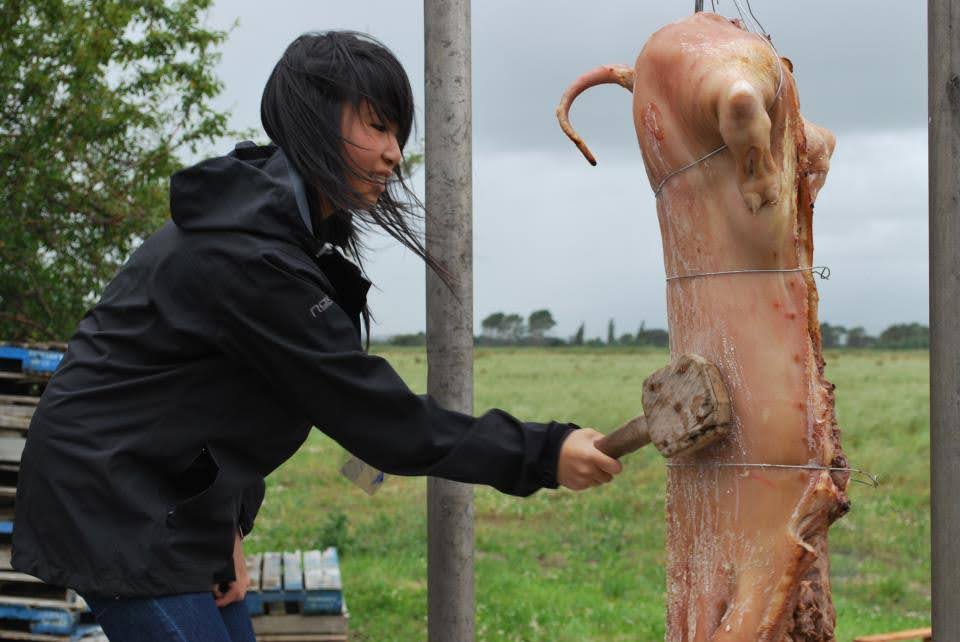
A pig roasting paddle is an essential part of the process of roasting a whole pig. This example is a very agricultural, poorly-made appliance of plywood and carpet tacks, and looks like something that would have been made by my father-in-law Yick Gee (Chue Yick Hon), who was a market gardener and taught me how to pig roast. Modern examples are a different shape.1 You can buy them at Chinese shops. They are used with a stabbing motion on the pig’s skin. With the older one, you use a paddling motion against the skin.
These tools break the skin so that the fat can come through and create crispiness. When the fat gets hot, it blows up the skin so that it bubbles and becomes like popcorn. You need bubbles to get crackling. If the carpet tacks, or the stainless steel prongs, accidentally go into the meat then moisture and steam comes out and makes the skin rubbery and hard, rather than crisp.
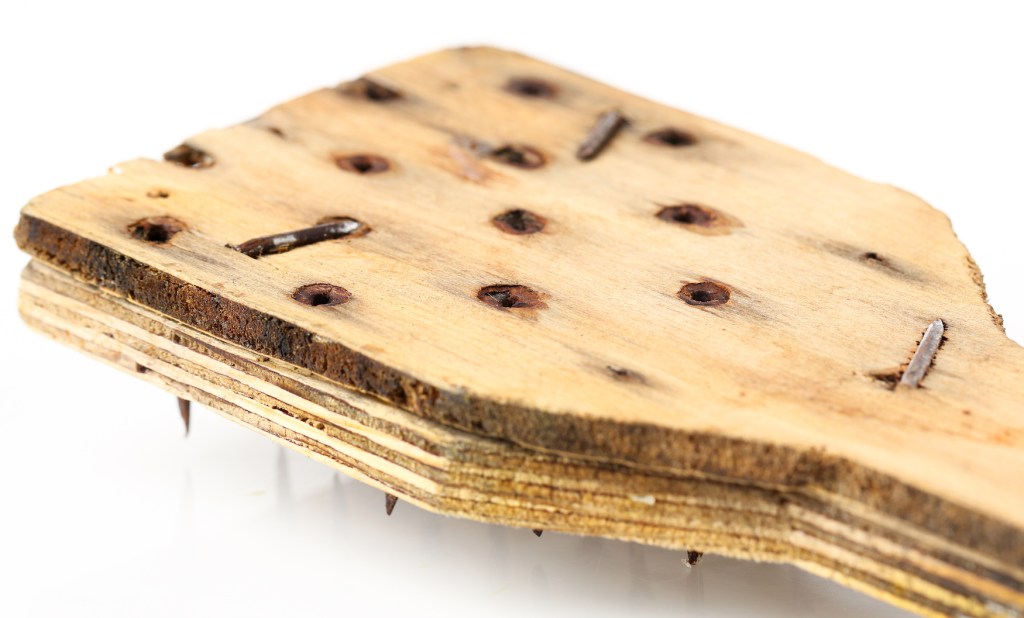
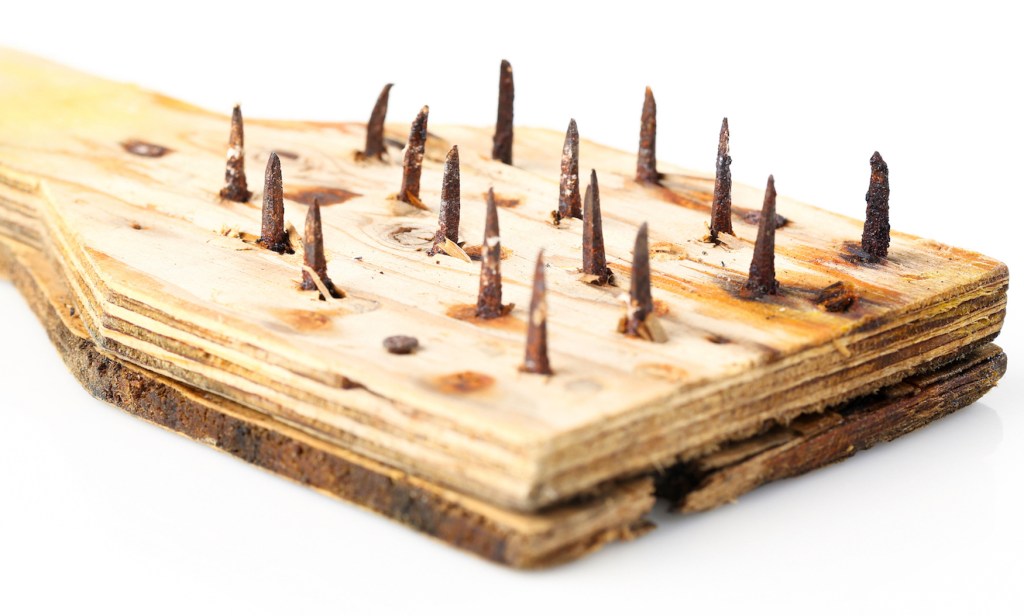
The fat layer varies between different pigs. A free range pig is likely to have a very thick fat layer compared to a commercially-grown pig that has been raised for lean pork. This is exactly the opposite of what is needed for good crackling. A good layer of fat is needed so enough of it can come through the holes to make the skin of a whole roast pig crackle.
There has been an evolution in taste and texture over time. Back in Canton they had their own variety of pigs. These were very short, flat-nosed and barrel-like, and being small would roast differently. The pigs used here are typically 65 kilos, which is huge by comparison, and blocks and pulleys are needed to lift them. There was a close association with local pig farmers and butchers, with many pigs sourced from the Rongotea butchery.
Preparing the pig
The process of preparing a pig has many steps. You get a free-range female pig with all the little side bits retained. The kidneys and the tongue are the most revered pieces because of their texture and flavour, which is dense, crisp and sweet, but guests will typically never see these as the cooks will have eaten them.
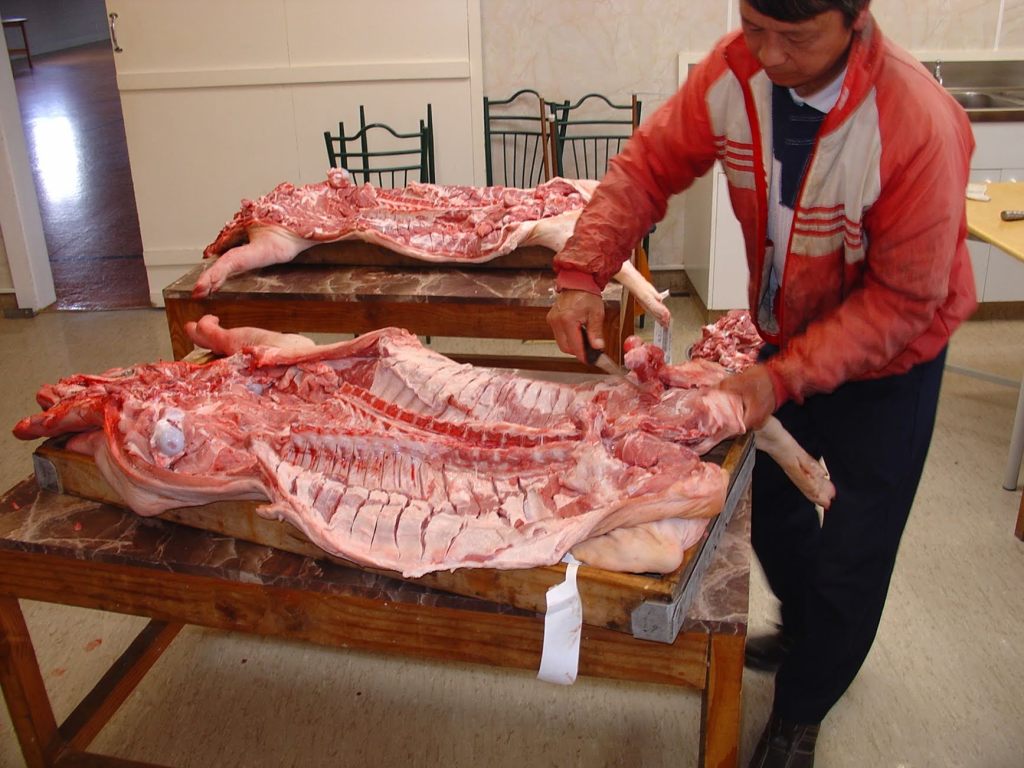
After the pig has been hung for a short time, we will split it down the middle using a cleaver or an axe to open it up, and then we thin out the meat by removing some of the bones and some of the meat to ensure the thickness is consistent across the whole pig.
The meat that has been removed is cut into the size of a pork fillet and becomes what is known as char siu (char meaning fork and siu meaning burn). After the marinade, it is roasted at a very high temperature, very quickly, for a lot of caramelisation, and to keep it very juicy. Again, the char siu is normally given to the cooks as payment for roasting the pig.
Marinade recipes
The marinade for a whole roast pig tends to be a combination of a number of herbs and spices. I have a marinade recipe from the mid-1940s that was used on the Leong’s market garden on Te Matai Road. It was five spice and lots of salt, and no sugar. By not having sugar, the meat did not burn and kept better. A grand pig master called J. J. Chu had a pig oven in Staces Road, Aokautere, that was built in the early-1960s, and he had a marinade of soy sauce, sugar, salt and five spice, and that was the standard recipe.
About 20 years ago I became a pig master for the Manawatū Chinese Association. Since then we have gradually modified the marinade, but could not do this straight away. When you are feeding 200–300 people at a Chinese dinner everyone has a memory of the taste of whole roast pig. It took about ten years to slowly modify the recipe. We added flavours like garlic, rice wine and nam yu, a fermented red bean curd, which is quite smelly, but with a beautiful depth of umami flavour. We only added a little bit to start with to ensure the change was subtle.
Pig roasting oven
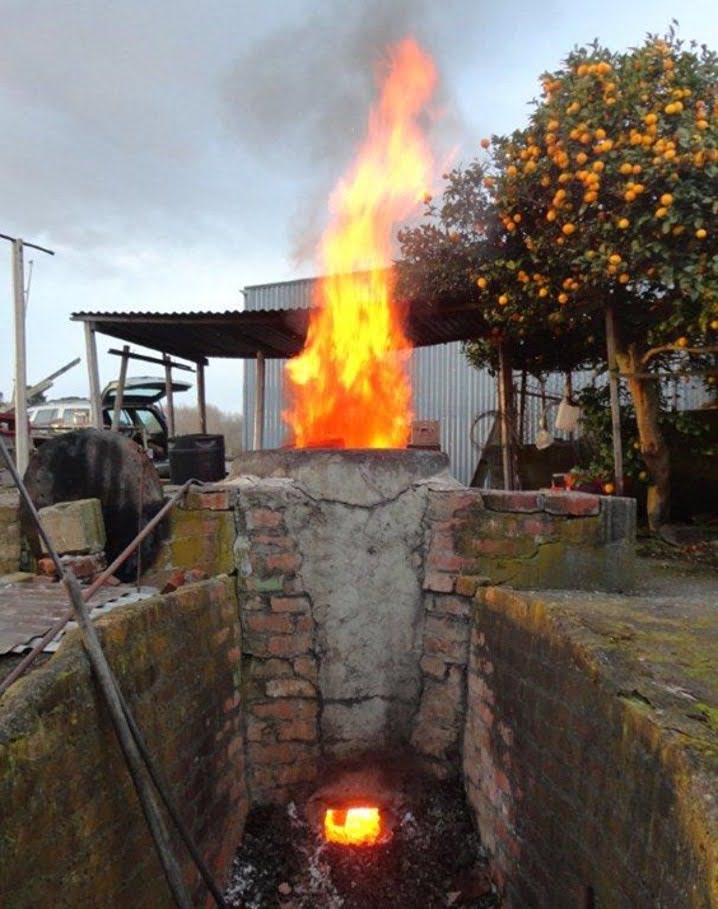
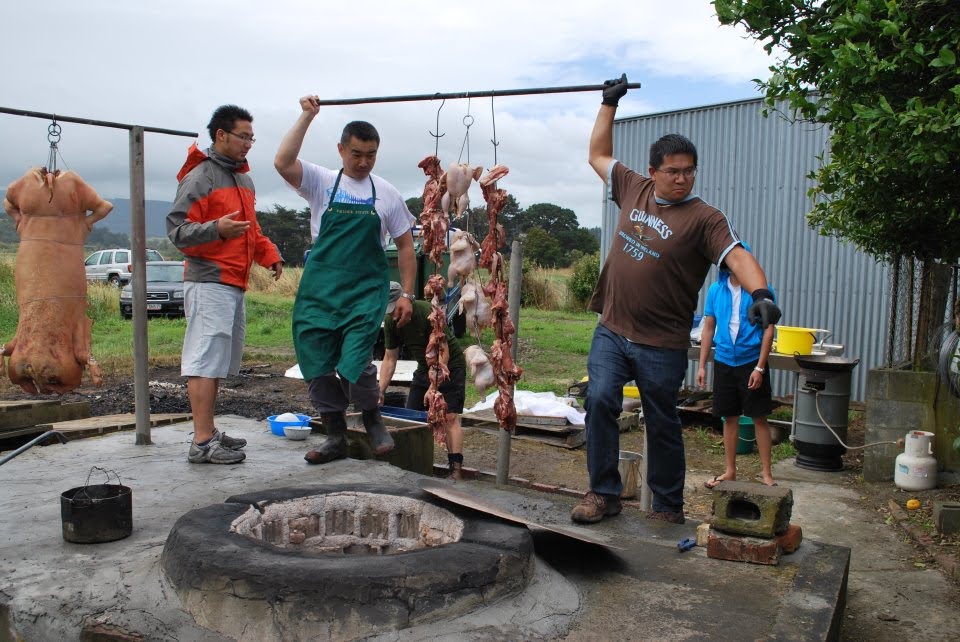
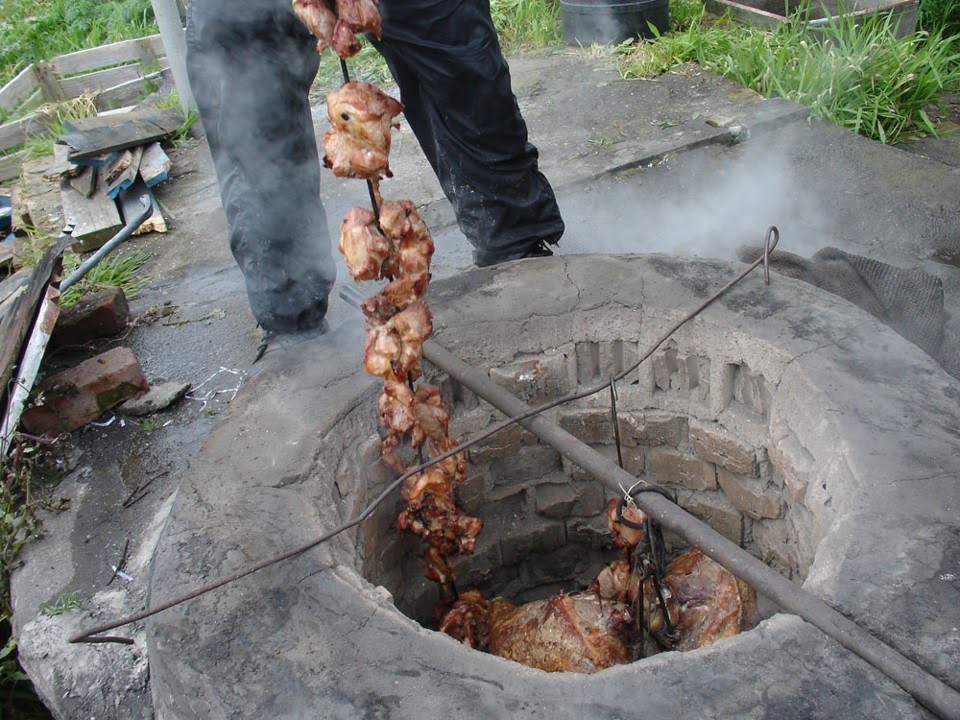
The oven is about two metres deep and like a barrel with a small firebox at the bottom. It is either double- or triple-bricked depending on how and where it is made. Ovens built above ground tend to have more bricks compared to those built in the ground. If you do not use them, moisture gets in and they deteriorate and collapse. My father-in-law’s newer high tech oven was above ground with an outer lining of pink batts, to provide insulation, and a chicken wire and cement finish.
Every oven has its own profile in terms of how it holds its temperature and where it is situated in relation to the wind. Ovens above ground cool down faster compared to those below ground, but they can be fired up straight away. Ovens below ground can become very wet in winter and may take two days to heat up and dry out. When you have set a fire to heat up a brick oven, you can see how hot and dry it is by throwing in a couple of chickens to see if they cook.
The sort of timber used in the fire affects the flavour of the meat. When Raymond Joe and I began roasting pigs, he had access to untreated timber shipping pallets that were a mixture of Indonesian hardwood and pine. We combined these with apple timber, which gave a sweetness of flavour and the advantage of long branches to help get the fire up through the chimney.
How to roast a whole pig
Wrapping wire around the pig to get the right curvature is important. You want the pig to be round, so that when you put it into the oven it is an equal thickness all around and open. The heat should go up through the middle of the pig and around it so there’s heat from all sides. The wire around its nose, along its backbone, all the way up to the hook is your safety line, so if the pig falls or breaks it is held together.
After that you give it a good rinse with hot water and baking soda all over. The baking soda helps soften up with the skin a little bit. The next step is making sure your oven is up to temperature, which is around 300 to 400 degrees Celsius. In the past, they would put their hand over the top of the oven and would know from looking at how the embers swirled around when it was hot enough. Now we use a laser digital thermometer to scan the surface temperature of the bricks.
The pig goes headfirst into the oven to briefly dry the skin and warm up the layer of fat below the skin. You pull it out and prick the skin with the pig roasting paddle. The skin has an almost papery texture because it is very dry, and it has a bit of a wobble, but it is not rubbery. You know that the temperature of the skin is about right when little droplets of fat come through the paddle holes. Then you rub it with salt, and maybe a little bit of baking soda mixed into the salt to break down the collagen and help the crackle. It is ready for the main crackling firing.
While you are paddling and salting the skin, the people running the fire are putting in very light material, such as fast-burning pieces of pine, to give a very high heat to the surface of the oven. We pull out the embers from the bottom of the firebox, close it up, and then drop the pig head first in the oven with a dish, a pan, of water at the bottom to catch any fat that drips off the pig so you do not set fire to the meat. You put the lid on and wet sacks on top of that and that basically holds the heat in. Then you listen, another part of the art of roasting, because it is like listening to popcorn. You want a controlled crackle, so it should go pop, pop, pop, pop, pop, not pop-pop-pop-pop-pop.
The char siu takes about 15 minutes to cook and chicken takes about an hour. You should not open and close your oven too many times as each time you do that you lose heat. And if it is a windy day, or a day with high moisture, you easily can lose 50 degrees. If you are doing three pigs, you have to do them one after the other, and they take an hour and twenty minutes to cook, but there are three or four hours to preparation. Garland Joe’s pig oven, which still exists in Napier Road, could do two pigs at once, as it is a fairly big oven.
When you roast a whole pig this way it has a minerally, slightly smoky taste, which cannot be replicated in a stainless steel electric or gas oven.
Reclaiming pig roasting
Efforts are being made to reclaim the tradition of pig roasting. The Joe’s property now has new owners and the pig oven was used on a one-off basis for the production of our daughter Jess Wong’s 2023 Sik Fan Lah! television series.2 There is still a pig oven on Staces Road, but the property is leased and largely inaccessible.
An effort has been made to ensure the techniques of whole pig roasting are recorded in cookery books. The recipe book associated with Sik Fan Lah! has a useful comic illustration by Kathy Do showing the process, and there is a section on whole pig roasting in chef Al Brown’s Stoked: Cooking with Fire, published in 2022. But the process is not easily learned from books as there is a lot of tacit knowledge involved.
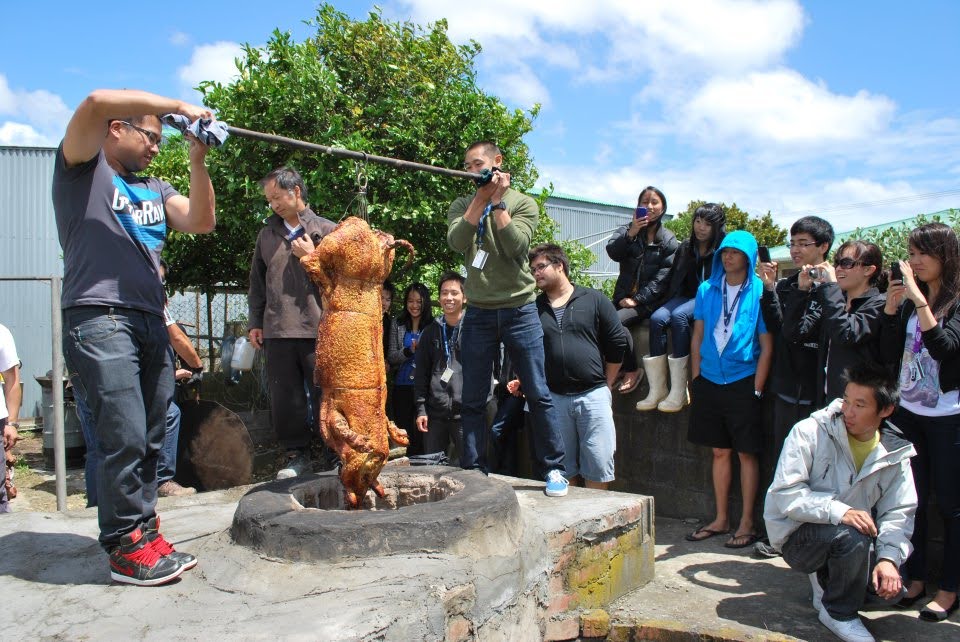
Ten years ago there was a group of about 25 young Chinese New Zealanders who came to Palmerston North to learn about leadership from a Chinese perspective with Chinese facilitators and Chinese speakers. We roasted a pig at Massey University to raise cultural awareness. Most were ‘city kids’ with little experience of animals or butchery, who had to handle raw meat and go out and fire up an oven alongside all the uncertainty of it going wrong. The idea was that they would develop leadership skills and gain cultural understanding and reconnection.3
Celebrating and fundraising
A whole pig was roasted for a range of reasons. In the past, local butchers would kill a dozen pigs at a time for local Chinese to roast around Christmas time. This was because everything shut down and families could get together, not necessarily because they were Christian.
They would also do a pig roast for weddings, usually on commission. Willie Wong had a pig oven in Kaiwharawhara, Wellington, and he effectively served as a commercial pig roaster for the lower part of the North Island in the period from 1980 to -2000.
There might be a pig roast to acknowledge the birth of a baby. Traditionally, babies were not named until they were a hundred days old due to high mortality rates. A number of special foods would be served up in celebration, especially if it was a boy, including a whole roast pig and red boiled eggs. A range of foods are symbolic and the whole roast pig is one. These days it might be a chunk of pork belly, or shoulder, or another cut.
Two festivals were celebrated with a whole roast pig. One was Chinese New Year and the other one was August Moon. At Chinese New Year three pigs, averaging about 45 kilos each, might be roasted. One and a half pigs would be enough to serve 300 people, while the other one and a half pigs would be chopped up and bagged to be raffled or auctioned as a fundraiser.
In the 1960s and 1970s, the building of the Manawatū Chinese Association hall in Napier Road was funded, at the instigation of a number of senior Chinese market gardeners and fruit shop owners, by having Chinese dinners of whole roast pig. Hundreds of people came to these dinners, and many non-Chinese residents looked forward to the roast pork as it was unlike anything they had eaten before. Enough money was raised to buy the land and put up the building.
As chef Al Brown has said, whole pig roasting not only leads to ‘a feast of magnificent proportions, a celebration of nationalities, and a scene of complete happiness’, but also flavour and texture that is ‘off the dial’.4
Footnotes
- Modern crisping tools can be found on eBay, see for instance, URL: https://www.ebay.com/itm/306245322177 (accessed 26 September 2026). ↩︎
- Wong, ‘Pig Out in Palmy’, Sik Fan Lah! (television series). ↩︎
- New Zealand Chinese Association, ‘Sixth NZ Chinese leadership conference’, 7 January 2012, URL: https://www.scoop.co.nz/stories/PO1201/S00014/sixth-nz-chinese-leadership-conference.htm (accessed 23 September 2026). ↩︎
- Brown, Stoked, p. 149. ↩︎
Bibliography
Brown, Al, Stoked: Cooking with Fire, Random House, 2022.
Collinson, Jennifer Yee, and Jess Wong, Sik Fan Lah! From Kitchens around Aotearoa featured in Sik Fan Lah!, self-published, 2023.
Oakes, Malcolm, ‘Pieces of Eight: Pig Ovens’, Our Chinese Past, URL: https://ourchinesepast.org.au/pieces-of-eight-pig-ovens (accessed 23 September 2026).
Wong, Jess (producer), ‘Pig Out in Palmy: Roasting a 65 kg Pig in a Chinese Earth Oven’ (episode five of a six-part television series), Sik Fan Lah!, YouTube, 2023, URL: https://www.youtube.com/watch?v=0RUC_0bp_UQ (accessed 23 September 2026).


Leave a comment