Yuni Ibrahim
Call Me, Maybe
When we see an old telephone in a museum, we may simply see an object from the past. However, a telephone can reveal a much broader history of how people communicated, worked, obtained information and maintained social relationships.
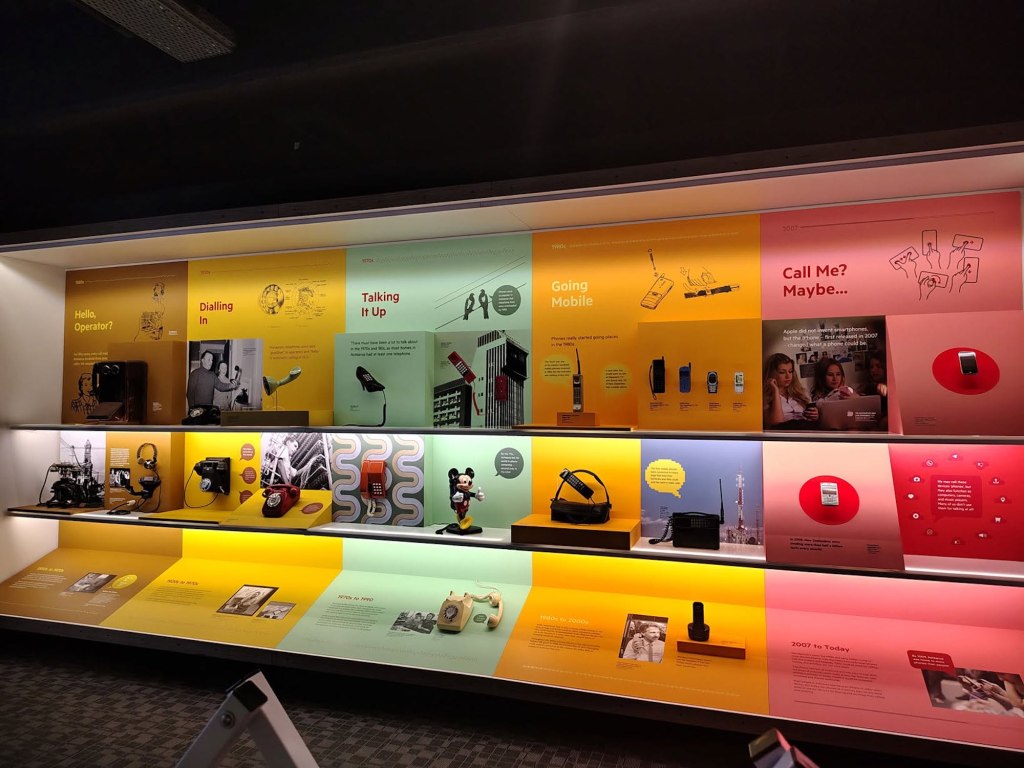
At Te Manawa Museum this history is presented in ‘Call Me, Maybe’, a display that traces the development of telephones – from early operator-assisted systems and party lines to rotary-dial, push-button and modern mobile phones – using examples from Manawatū.
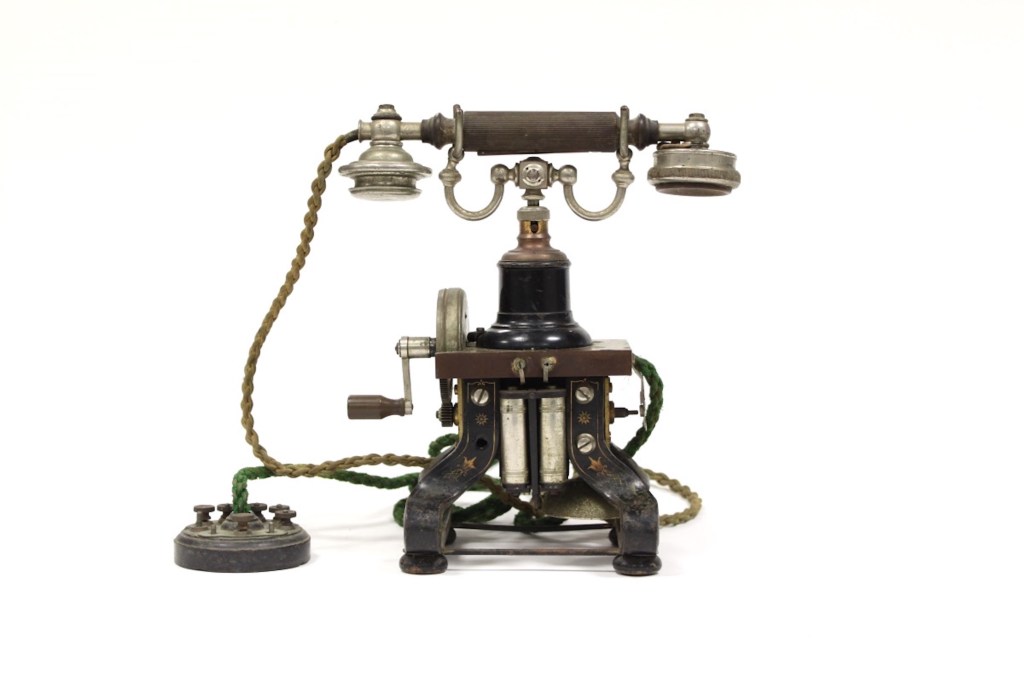
One particularly interesting object in the display is a skeleton telephone, which according to the museum’s records came from the home of Les Gandar (1919–1994), a former National Party politician who also served as a chancellor at Massey University. This telephone provides an entry point into the much larger story of the transformation of communication in Palmerston North over more than a century.
The Arrival of the Telephone in Palmerston North
Telephone technology reached Aotearoa New Zealand in the late nineteenth century. In 1878, the government established a telephone test line between Dunedin and Milton, while another demonstration connected Blenheim and Nelson.1
Christchurch and Auckland opened telephone exchanges in 1881, followed by other centres. Palmerston North became part of this growing network. Government records show that the town already had a telephone exchange with subscribers during the 1890s, and the number of connections increased as the town developed.2 This growth occurred alongside Palmerston North’s emergence as a centre for commerce, agriculture, government and transportation.
The telephone changed how information moved through the city. Businesses could communicate more quickly with customers and suppliers, farmers could obtain information about prices and goods, and households could contact relatives and local services without travelling. Communication was becoming faster and less dependent on physical distance.
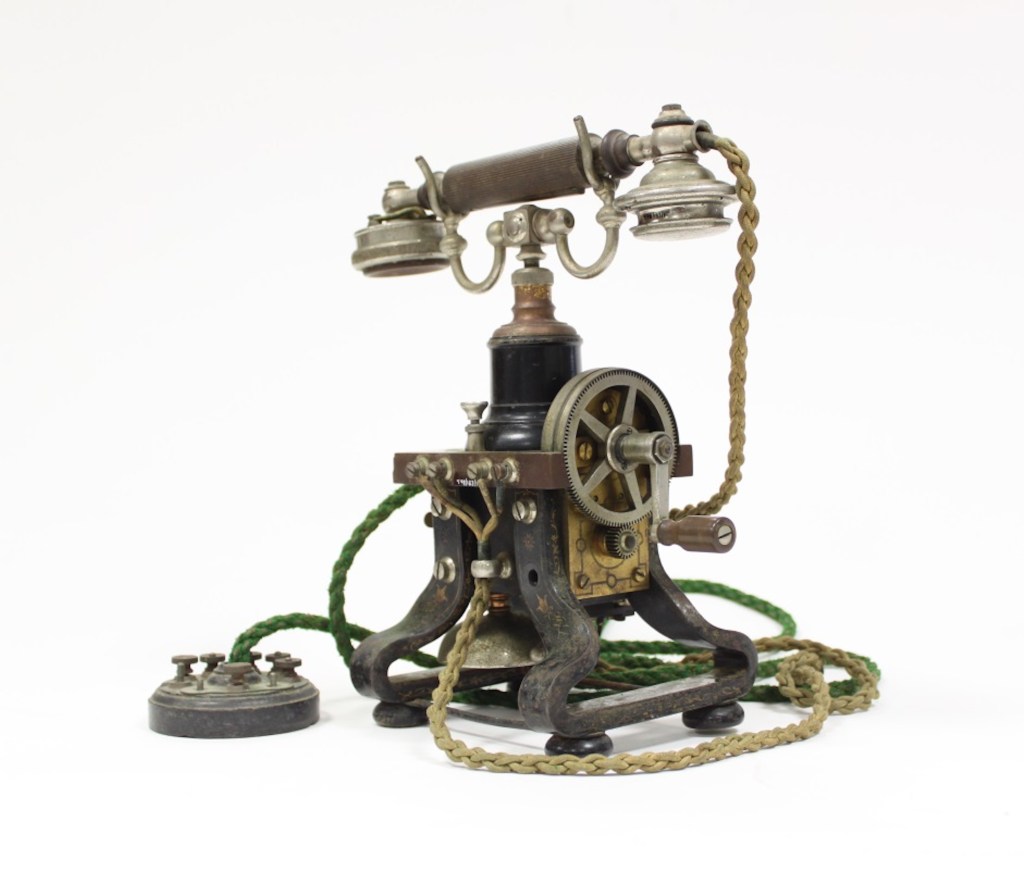
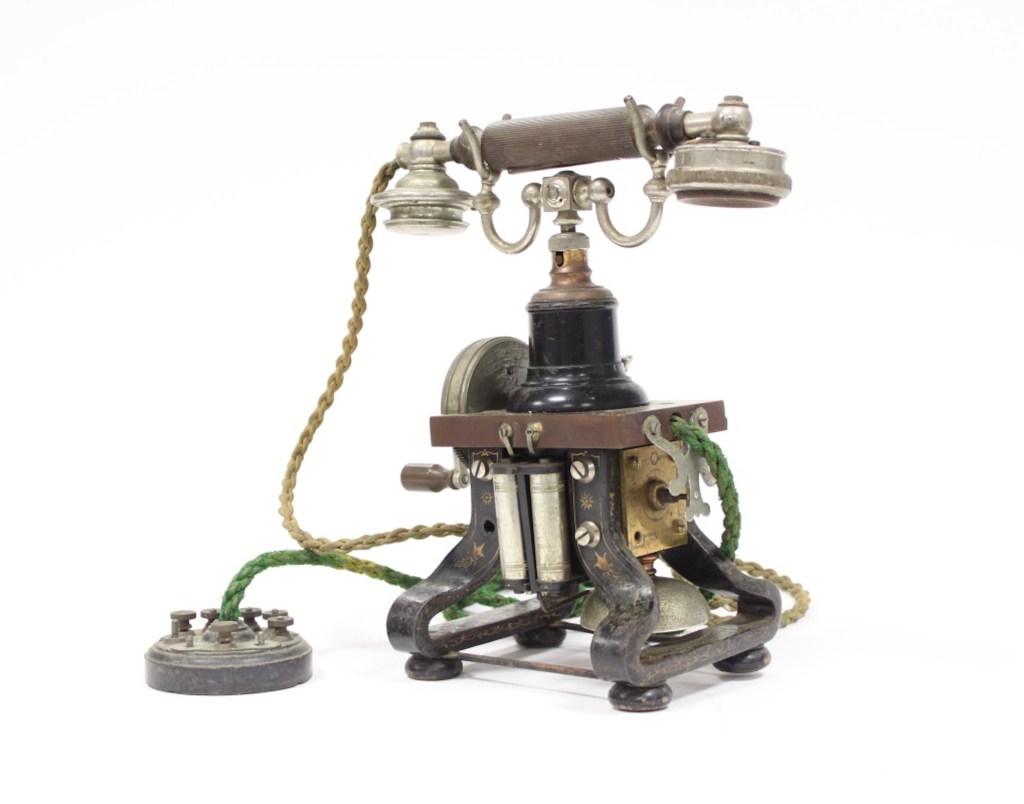
Swedish inventor and entrepreneur Lars Magnus Ericsson designed the skeleton-style telephone for desks and tables in the late nineteenth century. It is about 300 mm high, 280 mm wide and 140 mm deep and weighs about five kilos so that it sits firmly and does not slide when it is used. The horizontal handset on two hooks was a design innovation. Users picked the handset up with one hand and rotated the crank with the other; the handset is sitting in the cradle the wrong way around in the above images. The crank was used to turn the armature between the magnets, which produced a ring tone at the other end of the line. The stylised floral motifs on the black lacquered stand are partially worn away on this example. These were added to make telephones more ‘consumer-friendly’.3
Operators, Exchanges and Party Lines
Early telephone communication was very different from using a smartphone today. A telephone was connected by wires to a central exchange, and calls often depended on an operator manually establishing the connection. The skeleton telephone is useful reminder of this system because its open construction exposes some of the mechanical technology that supported early voice communication.
Party lines were another feature of early telephone networks, particularly in rural communities. Several subscribers shared the same line and used different ringing patterns to identify who was being called. Although party lines made telephone services more affordable and accessible, they also provided limited privacy because other subscribers could potentially listen to conversations.4
Telephone operators were essential to the functioning of the network. In New Zealand, women became an important part of the telephone-operating workforce. The first female telephonists were appointed in 1881, and women’s lower wages were one factor encouraging their employment in telephone exchanges. In smaller communities, operators could also become important sources of local information and links to medical, police and emergency services.
The early telephone system was consequently not simply a collection of machines. It was a network involving technology, infrastructure and human labour.
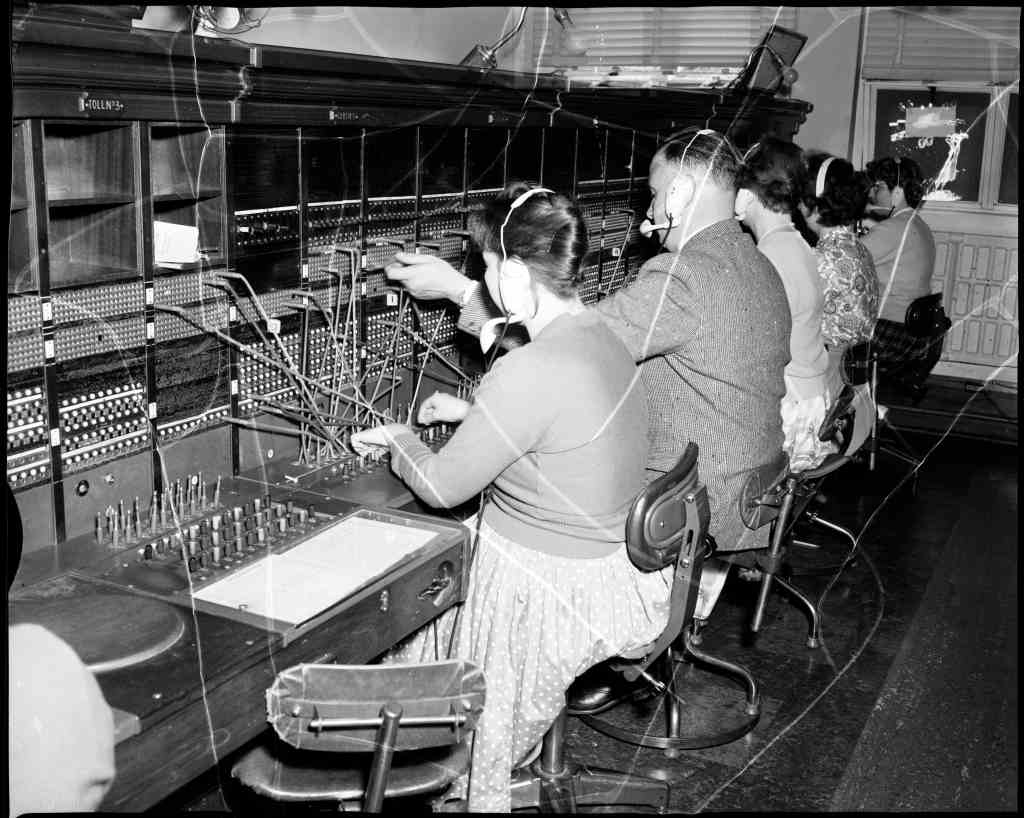
Palmerston North and Automatic Telephones
One of the most significant changes in telephone history was the move from manual to automatic switching. A local source that illustrates this transition is an interview with Arthur Dalton and Constance Dalton, recorded in 1984 as part of the New Zealand Post Office Oral History Project. Arthur Dalton had worked as a linesman at the Palmerston North Post Office and recalled the work of rewiring Palmerston North houses as part of a transition to automatic telephones, providing a first-hand perspective on how the technological change affected subscribers’ homes.5
Automatic systems gradually reduced the need for operators to connect local calls manually. Instead, subscribers could dial numbers themselves, making telephone communication faster and more convenient by becoming less dependent on a small number of specialised workers and more accessible to ordinary users.
Palmerston North as a Telecommunications Centre
During the mid-twentieth century, telephone technology continued to develop. While automatic switching increased efficiency, later switching systems increased network capacity and reliability. The development of Palmerston North’s telephone infrastructure reflects the wider developments in New Zealand’s telecommunication network.
As the telephone network expanded, Palmerston North became increasingly important as a regional telecommunications centre. A major telephone exchange building was constructed at 514 Main Street between 1966 and 1979. The seven-storey building, later commonly known as Telecom Tower, served as a telecommunications hub for the Manawatū region and accommodated technical staff involved in telephone and telegraph services.
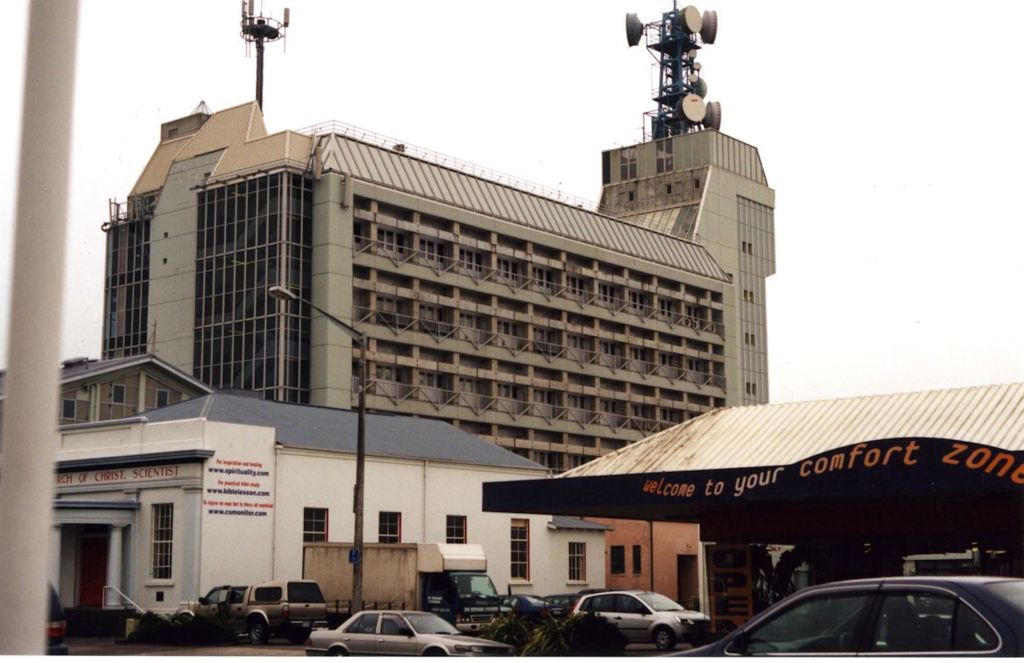
The development of this infrastructure shows how important telecommunications had become to the city’s economy and administration. Telephone exchanges were no longer simply places where operators connected calls. They had become major technical centres supporting business, government, household and regional communication.
From Direct Dialling to Digital Communication
Another major change came with Subscriber Trunk Dialling (STD) introduced in New Zealand between 1976 and 1978.6 STD allowed subscribers to make national and international calls without requiring an operator to connect every call. For ordinary users, this represented a major change in the experience of long-distance communication. Distance became easier to overcome and there was greater personal control of the calling process.
During the 1980s, telephone exchanges also began incorporating computer technology. Stored Programme Controlled (SPC) exchanges used computers to control switching and provided services such as conference calls, call holding and call diversion. At the same time, higher-capacity technologies such as optical fibre helped telecommunications networks carry increasing amounts of information.7
The telephone was therefore becoming part of a digital network rather than simply an instrument for transmitting voice. This development created the technological foundation for later mobile and internet-based communication.
From Fixed Telephones to Mobile Phones
The arrival of mobile telephones represented another fundamental change. For much of the twentieth century, a telephone was located in a particular position within a house, office, shop or public facility. Mobile technology separated the telephone from a fixed location.
Mobile services developed in New Zealand during the 1980s, and mobile phones became increasingly common during the 1990s. The introduction of Short Message Service (SMS) added another form of communication. People could now send written messages without making a voice call.8
This was more than a technological improvement. It changed people’s expectations about communication. Messages could be sent while travelling, working, shopping or socialising, making communication increasingly immediate and personal.
From Mobile Phones to Smartphones
The smartphone transformed the telephone even further. A modern smartphone is no longer primarily a device for making calls. It combines a telephone, camera, computer, navigation system, media player, messaging platform, and access point to the internet.
For people in Palmerston North, smartphones make it possible to communicate instantly with people locally, nationally and internationally. They can be used for video calls, social media, online banking, education, work, photography, navigation, and access to news and government services.
The transformation is particularly striking when compared with the skeleton telephone in Te Manawa’s collection. The early telephone depended on wires, exchanges, operators and fixed locations. The smartphone can connect to global digital networks while being carried in person’s pocket.
From Skeleton Telephones to Smartphones
The history of communication in Palmerston North can be understood as a progression from fixed, operator-dependent communication to personal, mobile and digital communication. The significance of the skeleton telephone at Te Manawa is therefore greater than its appearance might suggest. It provides a tangible connection to a period when communication required new types of infrastructure and human labour.
Placed within the wider history of Palmerston North, it helps demonstrate how technological change has not only transformed the design of telephones, but also the ways people work, maintain relationships, obtain information and experience distance. Yet, in the dramatic changes from the skeleton telephone to the smartphone the fundamental purpose remains similar: to connect people across distance.
Footnotes
- Wilson, ‘Telecommunications – Telephones, 1877–1914’, Te Ara – the Encyclopedia of New Zealand. ↩︎
- See for instance, New Zealand Post and Telegraph Department, ‘Post and Telegraph Department Report for the Year 1895’, AJHR, p. xix, which gives a tally of 81 subscribers or connections in Palmerston North. ↩︎
- Ericsson, ‘The skeleton type 1892’. ↩︎
- Wilson, ‘Telecommunications – Post and Telegraph, 1914–1945’, Te Ara – the Encyclopedia of New Zealand. ↩︎
- Arthur Dalton, interview, 4 December 1984. ↩︎
- Wilson, ‘Telecommunications – Phones, faxes and satellites’, Te Ara – the Encyclopedia of New Zealand. ↩︎
- Wilson, ‘Telecommunications – Phones, faxes and satellites’, Te Ara – the Encyclopedia of New Zealand. ↩︎
- Wilson, ‘Telecommunications – Mobile phones’, Te Ara – the Encyclopedia of New Zealand. ↩︎
Bibliography
Dalton, Arthur (1901–1987) and Constance Dalton (1902–1985), interview, 4 December 1984, Judith Fyfe, New Zealand Post Office Oral History Project, OHInt-0070/30, Alexander Turnbull Library, Wellington.
Ericsson, ‘The skeleton type 1892’, URL: https://www.ericsson.com/en/about-us/history/products/the-telephones/the-skeleton-type-1892 (accessed 24 August 2026).
New Zealand Post and Telegraph Department, ‘Post and Telegraph Department Report for the Year 1895’, Appendices to the Journals of the House of Representatives (AJHR), F-1, 1896, URL: https://paperspast.natlib.govt.nz/parliamentary/AJHR1896-I.2.3.2.1?page=4 (accessed 24 August 2026).
Swarbrick, Nancy, ‘Rural Services – Communications’, Te Ara – The Encyclopedia of New Zealand, URL: https://teara.govt.nz/en/rural-services/page-5 (accessed 24 August 2026).
Wilson, A. C., ‘Telecommunications’, Te Ara – the Encyclopedia of New Zealand, URL: https://teara.govt.nz/en/telecommunications (accessed 24 August 2026).


Leave a Reply